
Jacob Katz (1904–1998)
Author of Exclusiveness and tolerance; studies in Jewish-gentile relations in medieval and modern times
About the Author
Jacob Katz was former holder of the Bella and Israel Unterberg Memorial Chair of Jewish Social and Educational History at Hebrew University, Jerusalem. Bernard Dov Cooperman is Louis L. Kaplan Professor of Jewish History at the University of Maryland.
Works by Jacob Katz
Exclusiveness and tolerance; studies in Jewish-gentile relations in medieval and modern times (1961) 148 copies, 1 review
Out of the Ghetto: The Social Background of Jewish Emancipation, 1770-1870 (1973) 141 copies, 2 reviews
A House Divided: Orthodoxy and Schism in Nineteenth-Century Central European Jewry (The Tauber Institute Series for the Study of European Jewry) (1998) 12 copies
עת לחקור ועת להתבונן : מסה היסטורית על דרכו של בית ישראל מאז צאתו מארצו ועד שובו אליה (1998) 3 copies
פרקים בתולדות החברה היהודית : בימי הבינים ובעת החדשה ; מוקדשים לפרופסור יעקב כ"ץ במלאת לו שבעים… 3 copies
פרקים בתולדות החברה היהודית בימי הביניים ובעת החדשה : מוקדשים לפרופסור יעקב כ"ץ במלאת לו שבעים… (1980) 2 copies
Halakhah ve-Kabalah : mehkarim be-toldot dat Yiśrael al medoreha ve-zikatah ha-hevratit (1984) 2 copies
THE SABBATH GENTILE The Socio-Economic and Halakhic Background to the Employment of Gentiles on Jewish Sabbaths and Festivals (1983) 1 copy
Tagged
Common Knowledge
- Birthdate
- 1904-11-15
- Date of death
- 1998-05-20
- Gender
- male
- Education
- Pressburg Yeshiva (Bratislava)
- Organizations
- Hebrew University of Jerusalem
- Nationality
- Israel
- Places of residence
- Magyargencs, Hungary (birth)
Tel Aviv, Israel
Jerusalem, Israel - Associated Place (for map)
- Israel
Members
Reviews

I just finished reading From Prejudice to Destruction: Anti-Semitism 1700-1933 by Jacob Katz. It was quite a worthwhile slog.. The material is new to me. Also, there is a focus on philosophy and philosophers, one subject I didn't take in college. Still, I recommend reading this book.
The book focuses almost exclusively on Anti-Semitism in Western and Central Europe, specifically, France, (modern) Germany, and Austria-Hungary, sometime separately and sometimes jointly. Of particular parochial show more interest was the portion about Hungary. I had not realized that Hungary included Bratislava, in modern Slovakia. That is where my father's side of the family hailed from. The book explained, basically, why it was necessary for them to flee despite what we believe to be their good fortune, complete with a large house with servants, for an essentially penniless existence in New York City. As good as having "emancipation" in Europe was, i.e. full economic rights and political freedom, the levels of hatred of Jews because much worse. We know how it ended, unfortunately.
All the history aside, this book adds to the several I've previously read, including Why the Jews? by Dennis Prager and Joseph Telushkin, Why the Germans? Why the Jews?: Envy, Race Hatred, and the Prehistory of the Holocaust by Aly, Götz, and Anti-Judaism: The Western Tradition by David Nirenberg. These books all take a slightly different approach. None satisfactorily explain why Anti-Semitism is a persistent problem. I posit that it's not as much of a problem in "new world" countries, where the focus is what a person brings to the table, not who they are. All of these books, though, hint at the problem is "who" in the cradle of European "civilization." show less
The book focuses almost exclusively on Anti-Semitism in Western and Central Europe, specifically, France, (modern) Germany, and Austria-Hungary, sometime separately and sometimes jointly. Of particular parochial show more interest was the portion about Hungary. I had not realized that Hungary included Bratislava, in modern Slovakia. That is where my father's side of the family hailed from. The book explained, basically, why it was necessary for them to flee despite what we believe to be their good fortune, complete with a large house with servants, for an essentially penniless existence in New York City. As good as having "emancipation" in Europe was, i.e. full economic rights and political freedom, the levels of hatred of Jews because much worse. We know how it ended, unfortunately.
All the history aside, this book adds to the several I've previously read, including Why the Jews? by Dennis Prager and Joseph Telushkin, Why the Germans? Why the Jews?: Envy, Race Hatred, and the Prehistory of the Holocaust by Aly, Götz, and Anti-Judaism: The Western Tradition by David Nirenberg. These books all take a slightly different approach. None satisfactorily explain why Anti-Semitism is a persistent problem. I posit that it's not as much of a problem in "new world" countries, where the focus is what a person brings to the table, not who they are. All of these books, though, hint at the problem is "who" in the cradle of European "civilization." show less
Exclusiveness and Tolerance: Studies in Jewish-Gentile Relations in Medieval and Modern Times (Scripta Judaica, 3) by Jacob Katz
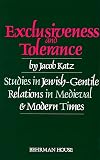
NO OF PAGES: 200 SUB CAT I: Jewish - Christian Relations SUB CAT II: SUB CAT III: DESCRIPTION: This book is broken into three parts: Part 1 - The Problem and its Terms of Reference, Part 2 - Some Types and Attitudes in Medieval Times, and Part 3 - From Exclusiveness to Tolerance.NOTES: SUBTITLE: Studies in Jewish-Gentile Relations in Medieval & Modern Times
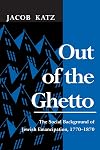
Account of the developing interrelationship between Jews and Gentile environment, unique in breadth and objectivity
Awards

You May Also Like


Associated Authors
Statistics
- Works
- 32
- Members
- 684
- Popularity
- #36,990
- Rating
- 4.0
- Reviews
- 4
- ISBNs
- 50
- Languages
- 4