
Ferruccio Busoni (1866–1924)
Author of Three Classics in the Aesthetic of Music
About the Author
Image credit: Postcard, circa 1890-1900 (George Grantham Bain Collection, LoC Prints and Photographs, LC-USZ62-126592)
Works by Ferruccio Busoni
Toccata and Fugue in D Minor and the Other Bach Transcriptions for Solo Piano (Dover Music for Piano) (1996) 22 copies
Bach : Two- and Three-Part Inventions for the piano {score : piano} {Schirmer : Busoni} (1986) — Editor — 12 copies, 1 review
Arlecchino 6 copies
Doktor Faust [programme book] 3 copies
Goldberg Variations and Other Bach Transcriptions for Solo Piano (Dover Music for Keyboard and Piano Four Hands) (2013) 3 copies
Sonatina [Nr. 1] 2 copies
Elegien : 7 Klavierstücke 2 copies
Sonatina seconda per pianoforte 2 copies
Berceuse 2 copies
Fantasia Contrappuntistica. CD 2 copies
Doktor Faust 2 copies
Turandot and Perséphone 1 copy
Regarder Busoni Regardant 1 copy
Turandot 1 copy
Ballet Scene 1 copy
Piano Concerto (etc.) 1 copy
Rondo arlecchinesco für Orchester ... Op. 46. [Score. With a portrait.] (Philharmonia Partituren) (1924) 1 copy
Sonatina for Solo Piano 1 copy
Sarabande and Cortege 1 copy
Busoni: Piano Concerto 1 copy
Busoni: Turnadot 1 copy
Fünf Goethe-Lieder 1 copy
Berceuse : für Pianoforte 1 copy
Elegie ; Diario indiano [CD] 1 copy
Songs. CD 1 copy
J. S. Bach Klavierwerke Busoni-Ausgabe II (Edition Breitkopf, Wohltemperiertes Klavier II. Teil Heft 2) (1913) 1 copy
Turandot 1 copy
The essence of Busoni (CD) 1 copy
Konzert für Violine und Orchester D-dur Op. 35a (Concerto for Violin and Orchestra in D major) 1 copy
Arlecchino / Turandot 1 copy
Toccata 1 copy
Zweite Sonate 1 copy
Sonatina 1 copy
Sonatina Seconda 1 copy
Busoni: Fantasia Contrappuntistica, Liszt: Fantasy & Fugue on the Chorale Ad Nos arr Busoni, etc (2008) 1 copy
The Six Sonatas for Piano 1 copy
Klavierwerke 1 copy
Associated Works
Two and Three-Part Inventions (Pierpont Morgan Library Music Manuscript Reprint Series) (1968) — Editor, some editions — 160 copies
Adams : El Dorado + Berceuse Élégiaque + The Black Gondola [sound recording] — Composer — 7 copies
Bach : Toccata, Adagio & Fugue in C, BWV.564 + Glinka : The Lark + Mussorgsky : Pictures at an exhibition [sound recording] (2002) — Arranger — 5 copies
Doktor Faust {opera companion} — Composer — 1 copy
Tagged
Common Knowledge
- Canonical name
- Busoni, Ferruccio
- Legal name
- Busoni, Ferruccio Dante Michelangiolo Benvenuto
- Birthdate
- 1866-04-01
- Date of death
- 1924-07-27
- Gender
- male
- Occupations
- composer
conductor
pianist - Relationships
- Busoni, Rafaello (son)
- Nationality
- Italy
- Birthplace
- Empoli, Italy
- Place of death
- Berlin, Germany
- Burial location
- Städtischer Friedhof III, Berlin, Germany
- Associated Place (for map)
- Berlin, Germany
Members
Reviews
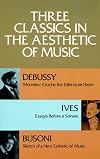
One of the joys of reading about aesthetics, particular as the field applies to music, is that there is such a variance of thought about what is beautiful. For all three of the authors included in this collection, beauty is not solely defined by consonance and dissonance. These composer-authors grapple with the role of inspiration, philosophical contexts, and music itself.
Claude Debussy, "Monsieur Croche the Dilettante Hater" (1927)
Debussy does not mince words and offers invective toward show more everything from opera to arts administration. It is more music criticism than a specific treatise on aesthetics. It is impossible, however, to read this group of essays without tasting the clear flavor of Debussy's own aesthetic agenda. For example, the Paris Opera, for Debussy, "...continue[s] to produce curious noises which the people who pay call music, but there is no need to believe them implicitly." (24)
Ferruccio Busoni, "Sketch of a New Esthetic of Music "(1911)
Busoni gives the reader a more straightforward offering complete with footnotes and musical examples. However, even Busoni likes to wax poetic: "Tradition is a plaster mask taken from life..." (n.1, p. 7). In another footnote, Busoni makes the case for microtonality, attacking the idea of musical "purity":
"But what is "pure," and what "impure?" We hear a piano "gone out of tune," and whose intervals may thus have become "pure, but unserviceable," and it sounds impure to us. The diplomatic "Twelve-semitone system" is an invention mothered by necessity yet none the less do we sedulously guard its imperfections." (89)
Charles Ives, "Essays before a Sonata" (1920)
It is Ives' contribution that is the most beautiful read. He offers an essay that is one part program note (for the Concord Sonata (1915, rev. 1947)) to two parts philosophical and aesthetic treatise. Writing with all the passion and transcendental fervor he can muster, Ives presents various New England literary figureheads as aesthetes, blurring the line between the artistry of literature and that of music. show less
Claude Debussy, "Monsieur Croche the Dilettante Hater" (1927)
Debussy does not mince words and offers invective toward show more everything from opera to arts administration. It is more music criticism than a specific treatise on aesthetics. It is impossible, however, to read this group of essays without tasting the clear flavor of Debussy's own aesthetic agenda. For example, the Paris Opera, for Debussy, "...continue[s] to produce curious noises which the people who pay call music, but there is no need to believe them implicitly." (24)
Ferruccio Busoni, "Sketch of a New Esthetic of Music "(1911)
Busoni gives the reader a more straightforward offering complete with footnotes and musical examples. However, even Busoni likes to wax poetic: "Tradition is a plaster mask taken from life..." (n.1, p. 7). In another footnote, Busoni makes the case for microtonality, attacking the idea of musical "purity":
"But what is "pure," and what "impure?" We hear a piano "gone out of tune," and whose intervals may thus have become "pure, but unserviceable," and it sounds impure to us. The diplomatic "Twelve-semitone system" is an invention mothered by necessity yet none the less do we sedulously guard its imperfections." (89)
Charles Ives, "Essays before a Sonata" (1920)
It is Ives' contribution that is the most beautiful read. He offers an essay that is one part program note (for the Concord Sonata (1915, rev. 1947)) to two parts philosophical and aesthetic treatise. Writing with all the passion and transcendental fervor he can muster, Ives presents various New England literary figureheads as aesthetes, blurring the line between the artistry of literature and that of music. show less
Busoni is one of my favorite composers. He possessed a complex style that combined the height of the Romantic era with a Modernism based on new ideas. In compositions like his operas (Doktor Faust, Turandot, and Arlecchino) he was on the leading edge of the twentieth century. Yet, he looked backward to Bach with a stylistic approach steeped in the soul of Liszt. Born in Italy but German in his approach to music he was also a theorist of Music and this volume is his exploration of absolute show more music and the nature of modern tonal music. show less

I've read through some of these, but they are pretty difficult for me. I'm a bit more romantically inclined when it comes to my piano playing (not my listening, though). The intricacies of fingering necessary for these pieces is tricky for me (probably because of a distinct lack of practice).
Bach-Busoni Toccata and Fugue In D Minor For the Piano (Schirmer's Library of Musical Classics, Vol. 1629) by Ferruccio B. Busoni

One of my very favorite pieces of music. Unfortunately, it's a bit beyond the scope of my ability at this time, but maybe one of these days I'll do more than stumble through a sight-reading.
Lists
You May Also Like


Associated Authors
Statistics
- Works
- 145
- Also by
- 6
- Members
- 423
- Popularity
- #57,687
- Rating
- 4.1
- Reviews
- 4
- ISBNs
- 35
- Languages
- 7
- Favorited
- 1
