
Michael A. Hoffman II
Author of Secret Societies and Psychological Warfare
About the Author
Works by Michael A. Hoffman II
Tagged
Common Knowledge
- Birthdate
- 1957
- Gender
- male
- Nationality
- USA
- Birthplace
- Geneva, New York, USA
- Associated Place (for map)
- New York, USA
Members
Reviews
They Were White and They Were Slaves: The Untold History of the Enslavement of Whites in Early America. by Michael Hoffman
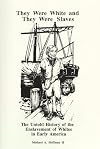
Here is history that should be taught but which has been systematically suppressed. Many if not most of the people brought from England to the American colonies were simply paupers who were cajoled or impressed (kidnapped) and shipped out under guise of "indentured servitude." But in all actuality they were slaves. There was serious money to be made in supplying farm and early industrial labor. What indentures (contracts) there were were easily broken and amended. Workers were not allowed to show more marry without permission of the employer (slave owner). Any children born to the women were considered bastards whom the owner could freely sell or use at will. The imported workers as a class had no visibility or rights, no courts to hear grievances. In practice, owners were free to flog these workers, even to death, for any minor infraction.
The story this short book tells is horrific in the extreme. Is it exaggerated? If perhaps occasionally in its rhetoric, it's clearly more than well enough researched to be taken very seriously. The book reminds us that slavery isn't something that just happened for a time in the American South. Rather, sad to say, it's been more the norm than the exception over all of human history. That scarcely imaginable cruelty on a very large scale has been a major feature of our collective inheritance is something we must face. Perhaps, only if we do face it, head on, it will we become collectively able to do something about it. show less
The story this short book tells is horrific in the extreme. Is it exaggerated? If perhaps occasionally in its rhetoric, it's clearly more than well enough researched to be taken very seriously. The book reminds us that slavery isn't something that just happened for a time in the American South. Rather, sad to say, it's been more the norm than the exception over all of human history. That scarcely imaginable cruelty on a very large scale has been a major feature of our collective inheritance is something we must face. Perhaps, only if we do face it, head on, it will we become collectively able to do something about it. show less
They Were White & They Were Slaves: The Untold History of the Enslavement of Whites in Early America by Michael Hoffman
I mistakenly thought this could be an eye-opening book on the treatment of non-whites who underwent poor treatment by the wealthy classes. I thought it might be a call for poor whites to ally with poor blacks on the basis of the two groups having had a common history of oppression and abuse at the hands of the upper classes.
Sadly, the author prefers to use this history to "one-up" African American suffering with claims that white people were worse off than blacks. His overall agenda seems to show more be that African American suffering is not so unique, and that we don't owe the black descendants of slavery any form of reparations.
The author also seems to have a poor grasp on racism. First of all, many of the people he labels "White" were not considered white at the time they were enslaved, Irish and Slavic peoples being two examples. His labeling them white is retroactive. The extent to which these groups are considered white today is in large part because they are no longer oppressed groups. They are groups that for the most part no longer live under oppressive conditions, and no longer need reparations. Whereas racism against African Americans is still a very real problem for these people. For another thing, most of the oppression of white people he's talking about wasn't targeted against "white people", it was targeted at the working class. The working class in England were hardly targeted because they were white, they were targeted because they were poor. Framing the issue as one of racism seems bizarre.
Beyond that, the book, although well-researched, is simply badly written. The book is largely a collection of quotes from historical sources, lumped together without any good system of organization, with some text by the author to try to produce a cohesive story. show less
Sadly, the author prefers to use this history to "one-up" African American suffering with claims that white people were worse off than blacks. His overall agenda seems to show more be that African American suffering is not so unique, and that we don't owe the black descendants of slavery any form of reparations.
The author also seems to have a poor grasp on racism. First of all, many of the people he labels "White" were not considered white at the time they were enslaved, Irish and Slavic peoples being two examples. His labeling them white is retroactive. The extent to which these groups are considered white today is in large part because they are no longer oppressed groups. They are groups that for the most part no longer live under oppressive conditions, and no longer need reparations. Whereas racism against African Americans is still a very real problem for these people. For another thing, most of the oppression of white people he's talking about wasn't targeted against "white people", it was targeted at the working class. The working class in England were hardly targeted because they were white, they were targeted because they were poor. Framing the issue as one of racism seems bizarre.
Beyond that, the book, although well-researched, is simply badly written. The book is largely a collection of quotes from historical sources, lumped together without any good system of organization, with some text by the author to try to produce a cohesive story. show less
Lists
You May Also Like


Statistics
- Works
- 16
- Members
- 358
- Popularity
- #66,977
- Rating
- 3.7
- Reviews
- 2
- ISBNs
- 15