
David Carl
Author of Heraclitus in Sacramento
Works by David Carl
Tagged
Common Knowledge
There is no Common Knowledge data for this author yet. You can help.
Members
Reviews
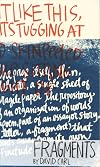
It’s hard to write a review for a book of fragments that begins with, “In the end, the most constitutive characteristic of the fragment may lie somewhere between the intention of the author and the approach of the reader; the former always undiscoverable, the latter always in the act of discovering,” and contains sentences like “Can there be a reading of the text which is not a form of co-authorship?” or “She has come to realize that interpretations are interpretations of show more interpretations.” Or, maybe these are warrants to say anything one wants. But, probably not.
The “fragments” that compose the book are literally that: snippets of varying length. Some are aphorisms, most aren’t. The easiest way for a reader to connect them is to take the collection as a relationship story without a narrative. This would be interesting enough in itself but too limiting. It’s also possible to read it as an exploration of the nature of language, but it seems too rich for that. It’s not clear, in the end, that the book can be nailed down. It may be its own category.
I can only recommend that you read it for yourself. Regardless of what you make of the book as a whole, you’ll be rewarded by individual fragments—by the language, if nothing else. I particularly liked “All of life is a lie in response to the truth that whatever beauty does not end was never there to begin with,” though I have no idea what to do with this. Other personal favorites were:
“Shocked at the thought of barns.”
“She drank to the immobility of stationary things.”
“He wanted some confirmation of his worth from the outside world, but when the phone rang he was not prepared to answer it.”
“Slowly he’s learning to behave; he doesn’t scream anymore when he sees a pretty girl—at least not out loud.”
“‘What if Kant had been at the Alamo?’” she asks.”
“He spent weeks in the waiting room at the wrong hospital.”
“She has lostthatperfectcontrol of the spacebar that characterized her earlier writing.”
“She told him he was losing his marbles, to which he replied, ‘at least marbles can be found.’”
Different fragments are very different in kind, however. Some are out-and-out philosophical epigrams. There is something here for all tastes. Intellectual stimulation aside, the book is highly worth reading for the sheer fun of it. show less
The “fragments” that compose the book are literally that: snippets of varying length. Some are aphorisms, most aren’t. The easiest way for a reader to connect them is to take the collection as a relationship story without a narrative. This would be interesting enough in itself but too limiting. It’s also possible to read it as an exploration of the nature of language, but it seems too rich for that. It’s not clear, in the end, that the book can be nailed down. It may be its own category.
I can only recommend that you read it for yourself. Regardless of what you make of the book as a whole, you’ll be rewarded by individual fragments—by the language, if nothing else. I particularly liked “All of life is a lie in response to the truth that whatever beauty does not end was never there to begin with,” though I have no idea what to do with this. Other personal favorites were:
“Shocked at the thought of barns.”
“She drank to the immobility of stationary things.”
“He wanted some confirmation of his worth from the outside world, but when the phone rang he was not prepared to answer it.”
“Slowly he’s learning to behave; he doesn’t scream anymore when he sees a pretty girl—at least not out loud.”
“‘What if Kant had been at the Alamo?’” she asks.”
“He spent weeks in the waiting room at the wrong hospital.”
“She has lostthatperfectcontrol of the spacebar that characterized her earlier writing.”
“She told him he was losing his marbles, to which he replied, ‘at least marbles can be found.’”
Different fragments are very different in kind, however. Some are out-and-out philosophical epigrams. There is something here for all tastes. Intellectual stimulation aside, the book is highly worth reading for the sheer fun of it. show less
Statistics
- Works
- 3
- Members
- 13
- Popularity
- #774,334
- Rating
- 4.5
- Reviews
- 1
- ISBNs
- 3