
Penko Gelev
Author of Journey to the Center of the Earth [Graphic Classics]
Works by Penko Gelev
Associated Works
Twenty Thousand Leagues Under the Sea (1869) — Illustrator, some editions — 21,225 copies, 283 reviews
Adventures of Huckleberry Finn (adapted, comic book ∙ Graphic Classics) (2008) — Illustrator, some editions — 46 copies, 1 review
Tagged
Common Knowledge
There is no Common Knowledge data for this author yet. You can help.
Members
Reviews
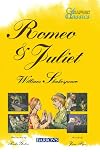
This is one of the worst Shakespearean adaptations on the market today. It simultaneously manages to make Shakespeare--Shakespeare!--seem clumsy and badly written, while also casting aspersions on the entire genre of graphic novels. While one can only applaud Barron's for trying to update classic literature, they seem to have gone about it without having any idea how to present their story according to the conventions and strengths of their chosen format.
Each of the 24 double-page spreads show more is covered in at least 12 small frames of roughly the same size, floating in a grid pattern on a white background. Each frame is still and rigid-- a tableau, not a frozen moment. What's worse, the static, washed-out pencil drawings make this, one of the most overwrought and melodramatic of Shakespeare's plays, seem tinny and hollow, as though it is being acted out by marionettes. A quick perusal of almost any graphic novel, manga, or comic book in print today will show a much more dramatic and dynamic use of space. Playing with the size, shape and borders of individual frames not only make for a much more engaging and entertaining reading experience, but can help convey the tone and subject of the story. Furthermore, any kindergartner can tell you that pictures are meant to show, not tell, but in this adaptation, the words almost swallow up the characters.
The lines of dialogue are printed in word bubbles and small captions beneath most pictures describe what is going on in terse, declarative substances. At the bottom of every page is four to six lines of tiny footnotes explaining the meaning of words like "consent" and "chide", while ignoring such tongue twisters as, "I'll look to like, if looking liking move." Jim Pipe's trite commentary on the scenes manages to make it all, if possible, even more boring. The only saving grace of this book is its appendix-- a rather weighty and bland-looking discussion of the history of the play and the circumstances of its creation which nevertheless contains some interesting historical context. However, the lack of pictures in this section only reinforces my impression that the well-meaning people at Barron's have no idea how to effectively employ the graphic novel format to educate or entertain. show less
Each of the 24 double-page spreads show more is covered in at least 12 small frames of roughly the same size, floating in a grid pattern on a white background. Each frame is still and rigid-- a tableau, not a frozen moment. What's worse, the static, washed-out pencil drawings make this, one of the most overwrought and melodramatic of Shakespeare's plays, seem tinny and hollow, as though it is being acted out by marionettes. A quick perusal of almost any graphic novel, manga, or comic book in print today will show a much more dramatic and dynamic use of space. Playing with the size, shape and borders of individual frames not only make for a much more engaging and entertaining reading experience, but can help convey the tone and subject of the story. Furthermore, any kindergartner can tell you that pictures are meant to show, not tell, but in this adaptation, the words almost swallow up the characters.
The lines of dialogue are printed in word bubbles and small captions beneath most pictures describe what is going on in terse, declarative substances. At the bottom of every page is four to six lines of tiny footnotes explaining the meaning of words like "consent" and "chide", while ignoring such tongue twisters as, "I'll look to like, if looking liking move." Jim Pipe's trite commentary on the scenes manages to make it all, if possible, even more boring. The only saving grace of this book is its appendix-- a rather weighty and bland-looking discussion of the history of the play and the circumstances of its creation which nevertheless contains some interesting historical context. However, the lack of pictures in this section only reinforces my impression that the well-meaning people at Barron's have no idea how to effectively employ the graphic novel format to educate or entertain. show less
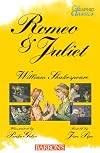
This graphic novel interpretation of Shakespeare's Romeo and Juliet isn't formatted in the way people typically imagine a graphic novel, but it is easy to follow and provides several helpful tools for those who struggle to read Shakespeare. For starters, each page is made up of a series of illustrations, each in a small box and each containing pictures of the characters along with speech bubbles/dialogue. Under each picture, narrative text outlines the plot. Shakespeare's play is retold by show more Jim Pipe, who utilizes authentic Shakespearean language; to help his reader, though, he includes footnotes on each page, translating tricky wording for the modern day reader. Sometimes the footnotes are excessive, creating a cluttered and confused first glance. The book also begins with a character page, depicting each character with his or her name under their drawing. The illustrations, done by Penko Gelev, are well-matched, colorful and classic without being distracting or flashy. All of these elements help navigate the reader through one of Shakespeare's most popular tales! Although most teenagers still won't be salivating at the chance to pick this up, it's an adequate option for Bard exposure. show less
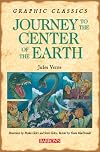
in a sentence: a professor and his nephew chance upon the directions leading to the center of the earth...so of course they have to check it out!
i was not sure what to expect at all with this book. and for the record, the cover image i have used for this post is not the version that i read (i wish), but i thought it looked pretty cool and spelled centre the way it did on my puffin paperback copy.
the writing style, though obviously dated to the time it was written (1860s), was easy to read show more and follow. having never read another jules verne book, i was a bit apprehensive of reading something that was a classic such as this one. would i appreciate it enough? would i even enjoy it? if i didn't enjoy it, would i have the guts to admit it? bizarre, i know, but true. in any case, i did enjoy it, which was an especially pleasant surprise after my previously stated anxieties.
especially with the new movie coming out so recently, i expected a heart racing adventure from start to finish...not the case. however, it was the fact that it was a paced and intentional journey that i really liked. the title is not misleading - it is not "the outrageously explosive and ridiculous journey", but rather "the journey". from the konigstrasse back in Hamburg to the inner depths of the earth, Verne does an amazing job of keeping the novel paced and interesting. he also has a desire to make sure that what the professor, Axel (the nephew) and Hans (the guide) encounter are scientifically possible...i'm not entirely convinced it was necessary for the story but it was interesting none the less.
the simplistic yet vivid descriptions from Axel, the narrator, added to the paced and intentional telling of this story. i appreciated Verne's balance of detail and plot - never too heavy on either side.
without throwing in any spoilers, let me say that the book is well worth the read - just don't expect something like you've seen from the recent previews (and be glad for it). the title is totally self explanatory, so much more summary from my part would be spoiler heaven. i should also note that i have not seen any movie version of this book, and would be super apprehensive to do so in a comparative sense. it would seem to me that there is too much temptation to turn the journey into something Verne did not intend it to be.
fave quotes: (not related to the actual journey at all...)"Oh how hard it is to understand the hearts of girls and women. When they are not the most timid of creatures, they are the bravest. Reason has no part in their lives" (44)
(resonated most with me as a reader) "Since the beginning of our journey I had had so many surprises that I might be forgiven for thinking myself immune to astonishment and incapable of amazement" (255)
fix er up: Hans seemed to me at times like a deus ex machina, which i am not the hugest fan of. show less
i was not sure what to expect at all with this book. and for the record, the cover image i have used for this post is not the version that i read (i wish), but i thought it looked pretty cool and spelled centre the way it did on my puffin paperback copy.
the writing style, though obviously dated to the time it was written (1860s), was easy to read show more and follow. having never read another jules verne book, i was a bit apprehensive of reading something that was a classic such as this one. would i appreciate it enough? would i even enjoy it? if i didn't enjoy it, would i have the guts to admit it? bizarre, i know, but true. in any case, i did enjoy it, which was an especially pleasant surprise after my previously stated anxieties.
especially with the new movie coming out so recently, i expected a heart racing adventure from start to finish...not the case. however, it was the fact that it was a paced and intentional journey that i really liked. the title is not misleading - it is not "the outrageously explosive and ridiculous journey", but rather "the journey". from the konigstrasse back in Hamburg to the inner depths of the earth, Verne does an amazing job of keeping the novel paced and interesting. he also has a desire to make sure that what the professor, Axel (the nephew) and Hans (the guide) encounter are scientifically possible...i'm not entirely convinced it was necessary for the story but it was interesting none the less.
the simplistic yet vivid descriptions from Axel, the narrator, added to the paced and intentional telling of this story. i appreciated Verne's balance of detail and plot - never too heavy on either side.
without throwing in any spoilers, let me say that the book is well worth the read - just don't expect something like you've seen from the recent previews (and be glad for it). the title is totally self explanatory, so much more summary from my part would be spoiler heaven. i should also note that i have not seen any movie version of this book, and would be super apprehensive to do so in a comparative sense. it would seem to me that there is too much temptation to turn the journey into something Verne did not intend it to be.
fave quotes: (not related to the actual journey at all...)"Oh how hard it is to understand the hearts of girls and women. When they are not the most timid of creatures, they are the bravest. Reason has no part in their lives" (44)
(resonated most with me as a reader) "Since the beginning of our journey I had had so many surprises that I might be forgiven for thinking myself immune to astonishment and incapable of amazement" (255)
fix er up: Hans seemed to me at times like a deus ex machina, which i am not the hugest fan of. show less
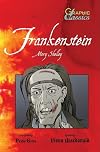
In this version of Frankenstein, Fiona Macdonald tells the story of how a scientist creates a monster from parts he has taken from graves and tombs. This graphic novel is a well presented introduction to Mary Shlelley’s Frankenstein. Several footnotes are present throughout the book in order to help readers understand the more formal writing style. The illustrations and text do an excellent job of keeping the mood of the book somber by using muted colors. I found the story line to be show more broken up without any flow. Although the text does not develop the characters, the illustrations do a phenomenal job of showing us the characters emotions and how they change throughout the plot. Overall, this adaptation was a strong first read for a graphic novel and has sparked my interest for reading the classic Mary Shelley novel. show less
You May Also Like
Associated Authors
Statistics
- Works
- 8
- Also by
- 8
- Members
- 334
- Popularity
- #71,210
- Rating
- 3.8
- Reviews
- 10
- ISBNs
- 40
- Languages
- 2