
Goran Sudžuka
Author of Y: The Last Man Vol. 06: Girl on Girl
About the Author
Image credit: By Luigi Novi, CC BY 3.0, https://commons.wikimedia.org/w/index.php?curid=22443614
Series
Works by Goran Sudžuka
Y: The Last Man #47 — Illustrator — 6 copies
Y: The Last Man #53 — Illustrator — 5 copies
Wonder Woman, Vol. 4 #19 — Illustrator — 5 copies
Y: The Last Man #42 — Illustrator — 5 copies
Y: The Last Man #40 — Illustrator — 5 copies
Y: The Last Man #39 — Illustrator — 5 copies
Wonder Woman, Vol. 4 #24 — Illustrator — 4 copies
Wonder Woman, Vol. 4 #25 — Illustrator — 4 copies
Wonder Woman, Vol. 4 #26 — Illustrator — 4 copies
Y: The Last Man #54 — Illustrator — 4 copies
Y: The Last Man #35 — Illustrator — 3 copies
Y: The Last Man #33 — Illustrator — 3 copies
Wonder Woman, Vol. 4 #32 — Illustrator — 3 copies
Y: The Last Man #32 — Illustrator — 3 copies
Wonder Woman, Vol. 4 #18 — Illustrator — 3 copies
Wonder Woman, Vol. 4 #31 — Illustrator — 3 copies
Wonder Woman, Vol. 4 #30 — Illustrator — 3 copies
Secret Origins [2014] #6 — Illustrator — 2 copies
Nação Fora da Lei vol. 1 1 copy
Martine Moon #1 — Illustrator — 1 copy
Martine Moon #2 — Illustrator — 1 copy
Martine Moon #3 — Illustrator — 1 copy
Associated Works
9-11: The World's Finest Comic Book Writers & Artists Tell Stories to Remember (2002) — Illustrator — 256 copies, 1 review
Tagged
Common Knowledge
- Birthdate
- 1969
Members
Reviews
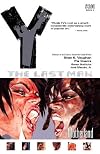
Any story needs to be held up to the yardstick of its wrap-up, and this is no slouch.
I'm not used to seeing comics throw all their focus and love on a single idea after so much time has been spent on what appears to be, you know, THE LAST MAN.
But here's a little secret. It's not really about him at all. It never was. And even after so much panel time, he's really nothing more than a red herring.
Do I need to spell it out?
Well, yeah! It's about women. Hello!! And this volume is doing a very show more fine job of it. All complicated and messed up as it is, how cheeky and sad and gritty and girly, it's just as crazy as the whole subject we've been sloshing through for this entire comic.
And it just feels right. One more to go! Let's see if the *ahem* hero gets his girl. :) show less
I'm not used to seeing comics throw all their focus and love on a single idea after so much time has been spent on what appears to be, you know, THE LAST MAN.
But here's a little secret. It's not really about him at all. It never was. And even after so much panel time, he's really nothing more than a red herring.
Do I need to spell it out?
Well, yeah! It's about women. Hello!! And this volume is doing a very show more fine job of it. All complicated and messed up as it is, how cheeky and sad and gritty and girly, it's just as crazy as the whole subject we've been sloshing through for this entire comic.
And it just feels right. One more to go! Let's see if the *ahem* hero gets his girl. :) show less

For sheer shock value, the main story of the penultimate book of Y: The Last Man is one of the best of the series. I ain't giving nothing away here, except to say that I think I literally gasped on pages 48 and 51, and the following pages kept up the revelations. There's a lot of answers and explanations, and sometimes it gets convoluted, but it's mostly satisfying. There is an answer of sorts for the plague, but as many reviewers before have pointed out, it's mostly nonsense. It doesn't show more both me, though, as I never really cared why the plague happened-- as in Mary Shelley's original The Last Man, the answer is unimportant. The plague is just there to reveal things about the characters and the world they/we live in, and it does that spectacularly.
Case in point are the two side stories in this volume, which really worked for me (though one wonders if Vaughan was spinning his wheels a little bit to stretch the whole thing out to sixty issues by putting these just before the climax). "The Obituarist" and "Tragicomic" both show the women, after four years on their own, beginning to build their own post-male world, and they're both good examples of what this series does so well, in trying to suss out what makes women women, and thus men men, and where it all comes from anyway and what we ought to do about it.
Y: The Last Man: « Previous in sequence | Next in sequence » show less
Case in point are the two side stories in this volume, which really worked for me (though one wonders if Vaughan was spinning his wheels a little bit to stretch the whole thing out to sixty issues by putting these just before the climax). "The Obituarist" and "Tragicomic" both show the women, after four years on their own, beginning to build their own post-male world, and they're both good examples of what this series does so well, in trying to suss out what makes women women, and thus men men, and where it all comes from anyway and what we ought to do about it.
Y: The Last Man: « Previous in sequence | Next in sequence » show less

This review is for the entire run of Y: The Last Man, not any single installment.
In an instant all the men, in fact every mammal with a Y chromosome, all around the world are wiped out. Except for one man and his monkey (and yes, the inevitable Beatles joke does eventually get made). That man, Yorick Brown, and his helper capuchin in training, Ampersand, are taken under the protection of a spy/assassin member of a secret organization answerable only to the President of the USA and sent to show more meet an expert in (human) cloning to try and discover why Yorick survived and how to continue the human species. And incidentally for Yorick to re-unite with his fiancée, last known to be in Australia.
Of course most of the story is about the troubles of being the only remaining man alive in a world that just lost half its population while trying to travel from New York to Boston to California and eventually most of the rest of the world. How would women react? What sorts of communities would they re-build? The short answer is well and badly, communities of hate and communities of inclusion, all with very recognizable human motivations. There are neo-amazons who set out to destroy any vestige of maleness in the world. There are the ex-cons that were let out of prison (what if the female guards hadn't freed them?) who form a community based around shared pasts and a belief in reform, responsibility and independence. Fanatic nationalists, drug smugglers, post-male feminist activist acting troupes.
Throughout the entire run a variety of possible causes ranging from disease, to curses, to divine retribution, to gaia/evolution re-setting a balance are proposed. The thing they all have in common, aside from never being definitively set as "the" cause, is that every single one of them revolves around the incredible hubris that the actions of a single person caused this to happen. Right along side the obvious parallel of the hubris that a single man could "save" the entire human species.
The story is well told, beautifully illustrated, and plays with a whole range of human emotions and motivations in a fairly believable fashion. If it skims past a lot of the practical details and problems, it at least acknowledges them in passing. My biggest problem is that while any given installment contains some time references like "New York, 10 minutes ago" and "Washington D.C., now" the actual timeline of the entire series of chapters (issues? installments?) is not clearly laid out. And it doesn't help that two chapters might take place in immediate succession, or weeks or months apart. That probably worked fine for anyone reading each installment as it came out each month but if you're reading them in collected and straight through it becomes slightly annoying and distracting. show less
In an instant all the men, in fact every mammal with a Y chromosome, all around the world are wiped out. Except for one man and his monkey (and yes, the inevitable Beatles joke does eventually get made). That man, Yorick Brown, and his helper capuchin in training, Ampersand, are taken under the protection of a spy/assassin member of a secret organization answerable only to the President of the USA and sent to show more meet an expert in (human) cloning to try and discover why Yorick survived and how to continue the human species. And incidentally for Yorick to re-unite with his fiancée, last known to be in Australia.
Of course most of the story is about the troubles of being the only remaining man alive in a world that just lost half its population while trying to travel from New York to Boston to California and eventually most of the rest of the world. How would women react? What sorts of communities would they re-build? The short answer is well and badly, communities of hate and communities of inclusion, all with very recognizable human motivations. There are neo-amazons who set out to destroy any vestige of maleness in the world. There are the ex-cons that were let out of prison (what if the female guards hadn't freed them?) who form a community based around shared pasts and a belief in reform, responsibility and independence. Fanatic nationalists, drug smugglers, post-male feminist activist acting troupes.
Throughout the entire run a variety of possible causes ranging from disease, to curses, to divine retribution, to gaia/evolution re-setting a balance are proposed. The thing they all have in common, aside from never being definitively set as "the" cause, is that every single one of them revolves around the incredible hubris that the actions of a single person caused this to happen. Right along side the obvious parallel of the hubris that a single man could "save" the entire human species.
The story is well told, beautifully illustrated, and plays with a whole range of human emotions and motivations in a fairly believable fashion. If it skims past a lot of the practical details and problems, it at least acknowledges them in passing. My biggest problem is that while any given installment contains some time references like "New York, 10 minutes ago" and "Washington D.C., now" the actual timeline of the entire series of chapters (issues? installments?) is not clearly laid out. And it doesn't help that two chapters might take place in immediate succession, or weeks or months apart. That probably worked fine for anyone reading each installment as it came out each month but if you're reading them in collected and straight through it becomes slightly annoying and distracting. show less
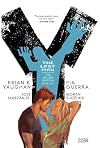
Having read all five deluxe volumes within ten days, I'm reviewing this as a complete graphic novel. The plot is simple: an unknown cause killed all the males of Earth at the same moment, except for Yorrick and the capuchin monkey he's training as a service animal, named Ampersand. While the story is told mostly from Yorrick's pov, we also get the perspective of others, female characters with a reason to be interested in Yorrick, many of whom are in a position of power, including his mother, show more a cabinet member of the US government. All Yorrick wants is to reunite with his girlfriend who has been studying archeology in Australia. An immature young man at the story's start, Yorrick matures over the course of the story while retaining his irritating charm.
Reading this soon after reading Lauren Beukes' Afterland, which deals with the slow deaths of most males due to an unknown virus, I can't help comparing the two. Afterland is focused on a mother trying to protect her adolescent son by disguising him as a girl, is a small story in the midst of a devastating pandemic, that of a mother protecting her child from outside forces and a coming-of-age story for that child. It was good, but left me wanting more. In Y: The Last Man, Vaughan gives us more. The story is simple at its heart, yet complex in the telling, with a global scope that includes Australian pirate ships, Japanese scientists, Israeli spies, and a whole lot more. And unlike Afterland, we get answers regarding what killed the males and why.
And then there's the lovely art by Pia Guerra.
Y: The Last Man is a thoroughly enjoyable and thought-provoking read. show less
Reading this soon after reading Lauren Beukes' Afterland, which deals with the slow deaths of most males due to an unknown virus, I can't help comparing the two. Afterland is focused on a mother trying to protect her adolescent son by disguising him as a girl, is a small story in the midst of a devastating pandemic, that of a mother protecting her child from outside forces and a coming-of-age story for that child. It was good, but left me wanting more. In Y: The Last Man, Vaughan gives us more. The story is simple at its heart, yet complex in the telling, with a global scope that includes Australian pirate ships, Japanese scientists, Israeli spies, and a whole lot more. And unlike Afterland, we get answers regarding what killed the males and why.
And then there's the lovely art by Pia Guerra.
Y: The Last Man is a thoroughly enjoyable and thought-provoking read. show less
Lists
Awards


You May Also Like
Associated Authors
Statistics
- Works
- 43
- Also by
- 10
- Members
- 9,032
- Popularity
- #2,662
- Rating
- 4.1
- Reviews
- 137
- ISBNs
- 98
- Languages
- 7
- Favorited
- 1