
Kevin Chambers
Author of Lonely Planet : Phrasebook : Japanese : 1989 : 1st edition : language survival kit
Works by Kevin Chambers
Succeed in Business: Vietnam (Culture Shock! Success Secrets to Maximize Business) (1997) 2 copies, 1 review
CultureShock! Succeed In Business Taiwan: The Essential Guide for Business and Investment (1999) 1 copy
Associated Works
Tagged
Common Knowledge
- Birthdate
- 1954
- Gender
- male
- Education
- American Graduate School of International Management, Oklahoma State University
- Occupations
- International Business, US diplomat
- Nationality
- USA
- Places of residence
- Oklahoma, USA
Shanghai, China
Tokyo, Japan
Members
Reviews
Succeed in Business: Vietnam (Culture Shock! Success Secrets to Maximize Business) by Kevin Chambers
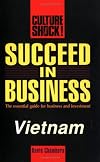
I'm not a business person, so it's always fascinating to read a text that thinks unbridled development and commerce is good for a country. Yes, Vietnam certainly has cumbersome, Byzantine, and corrupt business and governmental practices. However, Chambers seems to be of the opinion that any regulation is a problem. Indeed, Chambers seems to have a low opinion of Vietnam in general (at least from a business standpoint), so those intending to do business in Vietnam probably should consult show more other sources for a less negative cultural perspective.
As Chambers notes, government offices, policies, and laws change frequently in Vietnam. Thus, with a 1997 publication date on the newest edition, much of this book is superseded. The reader's difficulty in mapping the contents onto contemporary Vietnam will be magnified by both the passage of time and Chambers' disorganized presentation (for example, basic information such as the currency is presented on page 822, though it's been referred to several times before that). The map on page 12, featuring the "Gulf of Tongking" (sic) does not inspire confidence, nor the reference to "Toule Sap" (sic) elsewhere.
The vest features of the book are the cultural observations, especially as they affect business transactions. Thus, while it's helpful to know that food taken from a communal bowl should be placed on one's own plate before being eaten, this information is available elsewhere. In contrast, Chambers' observation that "there is also the common view among Vietnamese that the terms of a contract lose validity when the original signers and deal-makers change" (p. 96) is both informative and unavailable elsewhere.
So much has changed in Vietnam in the last decade--politically, economically, and structurally--that any information in the book should be fact-checked before being acted on. As a few examples: There was no restriction on my taking a cellphone to Vietnam; there were coins; the airport tax was included in my ticket. Much (though not all) of the cultural information was still accurate. I recommend that the reader concentrate on these sections and use those likely to have changed as the basis for formulating questions about commerce and government that can be answered with more up-to-date data. show less
As Chambers notes, government offices, policies, and laws change frequently in Vietnam. Thus, with a 1997 publication date on the newest edition, much of this book is superseded. The reader's difficulty in mapping the contents onto contemporary Vietnam will be magnified by both the passage of time and Chambers' disorganized presentation (for example, basic information such as the currency is presented on page 822, though it's been referred to several times before that). The map on page 12, featuring the "Gulf of Tongking" (sic) does not inspire confidence, nor the reference to "Toule Sap" (sic) elsewhere.
The vest features of the book are the cultural observations, especially as they affect business transactions. Thus, while it's helpful to know that food taken from a communal bowl should be placed on one's own plate before being eaten, this information is available elsewhere. In contrast, Chambers' observation that "there is also the common view among Vietnamese that the terms of a contract lose validity when the original signers and deal-makers change" (p. 96) is both informative and unavailable elsewhere.
So much has changed in Vietnam in the last decade--politically, economically, and structurally--that any information in the book should be fact-checked before being acted on. As a few examples: There was no restriction on my taking a cellphone to Vietnam; there were coins; the airport tax was included in my ticket. Much (though not all) of the cultural information was still accurate. I recommend that the reader concentrate on these sections and use those likely to have changed as the basis for formulating questions about commerce and government that can be answered with more up-to-date data. show less

You May Also Like
Associated Authors
Statistics
- Works
- 10
- Also by
- 1
- Members
- 38
- Popularity
- #383,441
- Rating
- 3.5
- Reviews
- 2
- ISBNs
- 10