
Deborah Meier
Author of The Power of Their Ideas: Lessons for America from a Small School in Harlem
About the Author
Linda Darling-Hammond is Charles E. Ducommun Professor of Education at Stanford University School of Education Stan Karp has been a public school teacher in Paterson, New Jersey, for over twenty-five years Alfie Kohn is the author of nine books on education and human behavior. A former teacher, he show more now works with educators across North America and speaks regularly at national conferences Deborah Meier, forty years in public education, is currently co-principal of Mission Hill, a public school in Boston; she is the founder of several New York City public schools Monty Neill, Ed.D., is the executive director of the National Center for Fair & Open Testing (FairTest) Theodore R. Sizer is University Professor emeritus at Brown University George H. Wood is the principal of Federal Hocking High School in Stewart, Ohio show less
Image credit: deborahmeier.com
Works by Deborah Meier
The Power of Their Ideas: Lessons for America from a Small School in Harlem (1995) 209 copies, 1 review
Many Children Left Behind: How the No Child Left Behind Act Is Damaging Our Children and Our Schools (2004) 101 copies
In Schools We Trust: Creating Communities of Learning in an Era of Testing and Standardization (2002) 90 copies, 1 review
These Schools Belong to You and Me: Why We Can't Afford to Abandon Our Public Schools (2017) 30 copies, 8 reviews
Teaching in Themes: An Approach to Schoolwide Learning, Creating Community, and Differentiating Instruction (Practitioner Inquiry Series) (2015) 10 copies
Beyond Testing: Seven Assessments of Students and Schools More Effective Than Standardized Tests (2017) 10 copies
Associated Works
Tagged
Common Knowledge
- Birthdate
- 1931-04-06
- Gender
- female
- Occupations
- teacher
- Relationships
- Willen, Paul (sibling)
- Nationality
- USA
- Places of residence
- New York, New York, USA
Philadelphia, Pennsylvania, USA
Chicago, Illinois, USA - Associated Place (for map)
- USA
Members
Reviews
These Schools Belong to You and Me: Why We Can't Afford to Abandon Our Public Schools by Deborah Meier

As a community college professor, I see the products of today's public education system. It doesn't take a lot of poking around to realize that the system is broken, but not for the reasons that conservative, neoliberal, anti-government folks would have you believe. It's broken because of the emphasis on taking tests instead of learning, it's broken because it's being starved of money and resources, and it's broken because it's being purposefully dismantled by the free market.
These Schools show more Belong to You and Me helps to define the purpose of public schooling, explain how radical public schools were built in the mid-late 20th century, and explains how the conservative agenda has co-opted that agenda to take down public schools. It's a quick read, and an important one. show less
These Schools show more Belong to You and Me helps to define the purpose of public schooling, explain how radical public schools were built in the mid-late 20th century, and explains how the conservative agenda has co-opted that agenda to take down public schools. It's a quick read, and an important one. show less
 This review was written for LibraryThing Early Reviewers.
These schools belong to you and me : why we can't afford to abandon our public schools by Deborah Meier
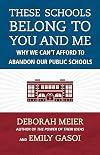
I was looking forward to this book, because I had enjoyed Deborah Meier's earlier book. Unfortunately, the experience of both authors of the book These schools belong to you and me is so different from my experience in public schools that I keep thinking that they are writing about charter schools and private schools, not public schools. This confusion between reality in most public schools, espectially rural and inner city schools and the author's hopeful and unrealistic plans was upsetting show more to me. show less
This review was written for LibraryThing Early Reviewers.These Schools Belong to You and Me: Why We Can't Afford to Abandon Our Public Schools by Deborah Meier
These Schools Belong to You and Me by Deborah Meier (and Emily Gasoi) did something that even few fictional works do to me: it brought me to tears. Deborah Meier, founder of the outstanding Central Park East school in 1974 (that I was privileged to visit when attending the Bank Street College of Education in New York City), presents a profoundly stirring case for the preservation of public education as a place both to practice and to sustain democracy.
Meier maintains an optimism that I show more struggle to emulate that education will not be co-opted by corporate greed. She holds to the hope that despite the current administration (including a Department of Education led by an outspoken opponent of public schools), people can still make a difference. She belives that the opportunity to turn things around, from a relentless pursuit of wealth acquired by a privileged few to a country addressing its demons of classism and racism and moving towards creating a true democratic education for all, is still possible.
The schools Meier describes in depth include her New York City experiment within the racially segregated and financially impoverished East Harlem and her Boston school, the Mission Hill School, are run with deep engagement by teachers, administrators, students, and families. Assessments were meaningful portfolios in which students created projects and explained them to a group of educators who provided feedback, including areas that needed to be redone. My own daughter went to a school that practiced this form of assessment. She worked harder than I ever did to pass a Regent's exam, and learned a variety of skills in addition to mastering content. She learned to present herself and her work to professionals, to deeply work through and convey the thinking that guided her work, to learn everything from how to use visual aids and technology to how to put into her own words the knowledge she had gained from projects that had been done independently but with the guidance and feedback along the way of professional educators who were respected by administrators.
Instead of dismantling public schools, Meier argues for an expansion of their function, making them centers of wrap around services supporting neighborhoods. Indeed, she argues for the value of neighborhoods as embodying templates of democracy.
Meier laments how many of the ideas she and the others who led progressive school movements have been taken over and distorted by the current reformers. Small schools are not necessarily good if they don't serve the community, if the educational process does not engage both students and teachers as learners and listeners.
Voices like Meier's keep me from plummeting into total despair. These are dark times, especially for education but that may be because there is no where that the battle for democracy is more clearly fought. Schools that often are created for private greed, no-excuses schools that put test results (which Meier analyzes brilliantly) above the growth of students as thinkers and members of a larger community and subject the poor, primarily children of color, to a prison-like environment stripped to the bare essentials of school offerings while negating the worth of their own traditions, the takeover of a public good by individual interests, all this is discouraging, to say the least.
The very survival of democracy as an ideal, even if imperfectly realized, seems to be on trial at this time and its future survival is far from assured. Meier's passion and intelligence keeps hope alive that there are people who care passionately about our country and the dream it embodies of governance by all. This book describes education at its best, articulately explains how it can best be achieved, and offers the hope that all children can participate in excellent schools.
Let's hope there are enough people who hold on to these dreams and are willing to speak out for them to preserve our schools and our democracy.
I want to thank LibraryThing, Beacon Hill Press, and above all Deborah Meier and her collaborator Emily Gasoi for the opportunity to read this important work. show less
Meier maintains an optimism that I show more struggle to emulate that education will not be co-opted by corporate greed. She holds to the hope that despite the current administration (including a Department of Education led by an outspoken opponent of public schools), people can still make a difference. She belives that the opportunity to turn things around, from a relentless pursuit of wealth acquired by a privileged few to a country addressing its demons of classism and racism and moving towards creating a true democratic education for all, is still possible.
The schools Meier describes in depth include her New York City experiment within the racially segregated and financially impoverished East Harlem and her Boston school, the Mission Hill School, are run with deep engagement by teachers, administrators, students, and families. Assessments were meaningful portfolios in which students created projects and explained them to a group of educators who provided feedback, including areas that needed to be redone. My own daughter went to a school that practiced this form of assessment. She worked harder than I ever did to pass a Regent's exam, and learned a variety of skills in addition to mastering content. She learned to present herself and her work to professionals, to deeply work through and convey the thinking that guided her work, to learn everything from how to use visual aids and technology to how to put into her own words the knowledge she had gained from projects that had been done independently but with the guidance and feedback along the way of professional educators who were respected by administrators.
Instead of dismantling public schools, Meier argues for an expansion of their function, making them centers of wrap around services supporting neighborhoods. Indeed, she argues for the value of neighborhoods as embodying templates of democracy.
Meier laments how many of the ideas she and the others who led progressive school movements have been taken over and distorted by the current reformers. Small schools are not necessarily good if they don't serve the community, if the educational process does not engage both students and teachers as learners and listeners.
Voices like Meier's keep me from plummeting into total despair. These are dark times, especially for education but that may be because there is no where that the battle for democracy is more clearly fought. Schools that often are created for private greed, no-excuses schools that put test results (which Meier analyzes brilliantly) above the growth of students as thinkers and members of a larger community and subject the poor, primarily children of color, to a prison-like environment stripped to the bare essentials of school offerings while negating the worth of their own traditions, the takeover of a public good by individual interests, all this is discouraging, to say the least.
The very survival of democracy as an ideal, even if imperfectly realized, seems to be on trial at this time and its future survival is far from assured. Meier's passion and intelligence keeps hope alive that there are people who care passionately about our country and the dream it embodies of governance by all. This book describes education at its best, articulately explains how it can best be achieved, and offers the hope that all children can participate in excellent schools.
Let's hope there are enough people who hold on to these dreams and are willing to speak out for them to preserve our schools and our democracy.
I want to thank LibraryThing, Beacon Hill Press, and above all Deborah Meier and her collaborator Emily Gasoi for the opportunity to read this important work. show less
This review was written for LibraryThing Early Reviewers.These schools belong to you and me : why we can't afford to abandon our public schools by Deborah Meier
These Schools Belong to You and Me, by Deborah Meier and Emily Gasoi, presents thoughtful, penetrating observations on the need to strengthen public education instead of abandoning it to charter schools and private academies. Their book, presented almost as a conversation between the two authors, emphasizes several key factors in education: the crucial role of democratic education in a democratic society; the need for an education that produces thinkers and decision makers; the need for show more education through collaboration and trust among students; the need to teach students thoughtful resistance to common assumptions, among others. Standardized tests have no role in their educational proposals. Hands-on inquiry takes priority over memorization of somebody else's list of facts. And so on.
Their discussion is based on thorough research into educational practices, along with (especially in Meier's case) decades of experience with alternative, community-based schools in New York and elsewhere. Speaking as a retired teacher in both college and alternative secondary school settings, I can say that their experiences and advice are very strong indeed. Learning happens through inquiry, not rote memory. Good teachers find out what students want to know and help them ask the questions that will satisfy that want. Collaborative learning beats solitary learning almost every time. Meier and Gasoi explore how to produce such learning. Everyone in a democracy needs participants who can learn and listen and collaborate and act. Read this book. show less
Their discussion is based on thorough research into educational practices, along with (especially in Meier's case) decades of experience with alternative, community-based schools in New York and elsewhere. Speaking as a retired teacher in both college and alternative secondary school settings, I can say that their experiences and advice are very strong indeed. Learning happens through inquiry, not rote memory. Good teachers find out what students want to know and help them ask the questions that will satisfy that want. Collaborative learning beats solitary learning almost every time. Meier and Gasoi explore how to produce such learning. Everyone in a democracy needs participants who can learn and listen and collaborate and act. Read this book. show less
This review was written for LibraryThing Early Reviewers.Lists
Beacon Press (1)
You May Also Like


Associated Authors
Statistics
- Works
- 10
- Also by
- 1
- Members
- 520
- Popularity
- #47,759
- Rating
- 4.0
- Reviews
- 10
- ISBNs
- 22
- Favorited
- 1
