
Deborah M. Newton Chocolate
Author of My First Kwanzaa Book
About the Author
Image credit: via Macmillan Publishers
Works by Deborah M. Newton Chocolate
My First Kwanzaa book 1 copy
Elizabeth's Wish 1 copy
Tagged
Common Knowledge
- Canonical name
- Chocolate, Deborah M. Newton
- Birthdate
- 1954-01-25
- Education
- Spelman College (BA)
Brown University (MA) - Occupations
- author
high school English teacher - Nationality
- USA
Members
Reviews

I really like this book because it gives a great overview of what Kwanzaa is while still attracting readers by using a story-telling format. The first three pages are an introduction to the holiday of Kwanzaa, and the entire rest of the book is presenting information about Kwanzaa in a story as told by a “main character”. I think this would be very effective for elementary school considering the point of view is unique for an informational text. Instead of presenting it textbook style, show more the author takes on the persona of a young male who celebrates Kwanzaa with his family. The author uses phrases such as “Mama wears … an African dress”, “We decorate our home in the black, red, and green colors of Kwanzaa”, and “Together we prepare a table for the Kwanzaa karamu, or feast,”. Younger readers easily understand this information because they can picture it being done in a family or home setting. Additionally, the illustrations depict the main character as his family performing the traditions stated in the text, which helps the reader visualize the information in a relatable way. Even if the reader does not celebrate the same religion, they can identify with the holiday by thinking about a time they celebrated their own traditions with their family. Another reason I liked this book was because the text included words from the African culture. This gives students a real taste of African culture and new information that will enhance their understanding. On each page, all of the words introduced have a phonetic pronunciation guide, which would help readers pronounce them. The main idea of this story is all about Kwanzaa and how it is celebrated in the present time. show less

When Imani must travel to the distant market to sell her produce, she warns her children to stay safe near the family hut. But, like children everywhere, they become distracted during the course of their play, and when a herd of wild animals thunders through the village, they are far from shelter. Returning home and discovering that they have been swallowed by the terrible Simba, King of Beasts, Imani sets out to rescue them, ending up in the belly of her enemy. Will she find a way to save show more herself, her children, and the other villagers trapped in Simba's belly...?
Originally collected in G.M. Theal's 1886 Kaffir Folk Tales, this tale from the Xhosa people of South Africa emphasizes - both through its heroine's name and actions - the importance of faith, when confronted with frightening events. I cannot say that the cut-paper illustrations by Alex Boies were really very appealing - David Wisniewski does this sort of thing so much better - but the story was interesting, and should appeal to young folklore lovers, particularly those looking for South African tales.
One note: the publisher of this book clearly needs to hire better editors and blurb-writers, as the front dust-jacket flap reads: "The rich tapestry of western Africa comes alive in Deborah M. Newton Chocolate's masterful retelling of a Swahili tale." Hard to imagine, since Swahili is spoken in eastern and southern Africa... show less
Originally collected in G.M. Theal's 1886 Kaffir Folk Tales, this tale from the Xhosa people of South Africa emphasizes - both through its heroine's name and actions - the importance of faith, when confronted with frightening events. I cannot say that the cut-paper illustrations by Alex Boies were really very appealing - David Wisniewski does this sort of thing so much better - but the story was interesting, and should appeal to young folklore lovers, particularly those looking for South African tales.
One note: the publisher of this book clearly needs to hire better editors and blurb-writers, as the front dust-jacket flap reads: "The rich tapestry of western Africa comes alive in Deborah M. Newton Chocolate's masterful retelling of a Swahili tale." Hard to imagine, since Swahili is spoken in eastern and southern Africa... show less
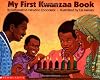
I thought this was a great book for children for a couple of reasons. Before I read this book, I didn't know what Kwanzaa was, and it describes it briefly, but is very informative on the aspects of Kwanzaa. It's about a little boy's first Kwanzaa, and on each page starting from December 26th-Jan1st it shows what he does for Kwanzaa that day. This includes dressing up in African clothing, making African beads, looking at the map and flag, learning about African history, and finally, spending show more time with family. The overall message is that Kwanzaa is a time for family to share memories and become more informed on the African heritage, while spending time with loved ones. As he learns about all the different aspects of his culture, he gets to spend time with his relatives and really be proud of his culture.
I thought the way the book was set up really helped understand the days and events of Kwanzaa. For example, the first page "December 26th" has one candle lit, the next page "December 27th" has two candles lit, and so on, until the last page "January 1st" where all the candles are lit because it is the last day of Kwanzaa. On the different pages, it describes another tradition of Kwanzaa. On the third page, December 28th, he is learning about the map and flag. On December 30th, he makes African beads with his grandma, and on January 1st, his family shares hugs and presents. The way they set it up made it really easy to learn the different Kwanzaa traditions.
I also thought the pictures helped a lot when picturing the celebration. In the beginning of the book, he and his family put on African clothing, which are depicted in the pictures throughout the book as colorful, bold, exotic clothing. On the page where he is learning about the flag and map, his dad is holding the red, black, and green flag, and his mama is hanging up a map of Africa.The reading was simple, it had one or two sentences on a page, but the pictures further explained the text. The author did a good job showing the different African clothing, jewelry, and beads that they make.
As someone who doesn't know anything about Kwanzaa, I learned a lot from reading this easy-to-read picture book. I think it would be a great book for young children to read and become more familiar with different culture's holidays. In the end, Kwanzaa is about spending time with family and friends who love each other, which is what most holidays entail. This can help children realize that although there are many differences among holidays and celebrations, there are also similarities such as family coming together. show less
I thought the way the book was set up really helped understand the days and events of Kwanzaa. For example, the first page "December 26th" has one candle lit, the next page "December 27th" has two candles lit, and so on, until the last page "January 1st" where all the candles are lit because it is the last day of Kwanzaa. On the different pages, it describes another tradition of Kwanzaa. On the third page, December 28th, he is learning about the map and flag. On December 30th, he makes African beads with his grandma, and on January 1st, his family shares hugs and presents. The way they set it up made it really easy to learn the different Kwanzaa traditions.
I also thought the pictures helped a lot when picturing the celebration. In the beginning of the book, he and his family put on African clothing, which are depicted in the pictures throughout the book as colorful, bold, exotic clothing. On the page where he is learning about the flag and map, his dad is holding the red, black, and green flag, and his mama is hanging up a map of Africa.The reading was simple, it had one or two sentences on a page, but the pictures further explained the text. The author did a good job showing the different African clothing, jewelry, and beads that they make.
As someone who doesn't know anything about Kwanzaa, I learned a lot from reading this easy-to-read picture book. I think it would be a great book for young children to read and become more familiar with different culture's holidays. In the end, Kwanzaa is about spending time with family and friends who love each other, which is what most holidays entail. This can help children realize that although there are many differences among holidays and celebrations, there are also similarities such as family coming together. show less
In this book, an unnamed boy talks about various things that his family does to celebrate Kwanzaa. With the constant refrain of "It's Kwanzaa time," he notes something new like lighting candles or unfurling a map of Africa. In this way, the book introduces young readers to various Kwanzaa traditions in a way that is slightly more exciting than a dry nonfiction book.
The downside of this book is I feel like it doesn't do enough to explain the seven principles of Kwanzaa. Each day of Kwanzaa show more is given a spread with a picture of a kinara in the lower right indicating what principle is relevant that day. But the text itself does not necessarily show the family doing something that embodies that principle. For instance, December 30th is for "nia" ("purpose"), but the text and illustrations show the boy beading necklaces with his mother and grandmother -- an activity that seems better fitted to the following day's principle ("kuumba" = "creativity") in which the story goes on to have other family members come visit.
In an afterword section, the author does explain more about Kwanzaa, the seven principles, and a variety of Swahili words related to the holiday. While this is certainly helpful for further learning, I wish that the story itself had done a better job of illuminating the Kwanzaa traditions - although it did well enough in terms of discussing the holiday with my very young class of toddlers. show less
The downside of this book is I feel like it doesn't do enough to explain the seven principles of Kwanzaa. Each day of Kwanzaa show more is given a spread with a picture of a kinara in the lower right indicating what principle is relevant that day. But the text itself does not necessarily show the family doing something that embodies that principle. For instance, December 30th is for "nia" ("purpose"), but the text and illustrations show the boy beading necklaces with his mother and grandmother -- an activity that seems better fitted to the following day's principle ("kuumba" = "creativity") in which the story goes on to have other family members come visit.
In an afterword section, the author does explain more about Kwanzaa, the seven principles, and a variety of Swahili words related to the holiday. While this is certainly helpful for further learning, I wish that the story itself had done a better job of illuminating the Kwanzaa traditions - although it did well enough in terms of discussing the holiday with my very young class of toddlers. show less
Lists
Awards


You May Also Like


Associated Authors
Statistics
- Works
- 24
- Members
- 2,535
- Popularity
- #10,127
- Rating
- 3.8
- Reviews
- 55
- ISBNs
- 53
- Favorited
- 1