
Christopher Paolini
Author of Eragon
About the Author
Christopher Paolini was born in Southern California on November 17, 1983, but grew up primarily in Paradise Valley, Montana. He was home schooled and at the age of 15, graduated from high school through an accredited correspondence course at American School in Chicago, Illinois. He decided to write show more a book and after three years of writing and editing, Eragon was self-published in 2001. The Paolini family spent the following year promoting the book themselves by giving presentations to the local library and high school and then eventually branching out to libraries, bookstores, and schools across the United States. After his step-son read a copy of the book, author Carl Hiaasen brought Eragon to the attention of publisher Alfred A. Knopf, who acquired the rights to publish Eragon and the rest of the Inheritance Cycle in 2003. The other books in the cycle include Eldest, Brisingr, and Inheritance. Eragon was made into a movie in December 2006. (Bowker Author Biography) show less
Image credit: Christopher Paolini en 2019
Series
Works by Christopher Paolini
Associated Works
The Acts of King Arthur and His Noble Knights (1976) — Foreword, some editions — 3,258 copies, 56 reviews
Tagged
Common Knowledge
- Legal name
- Paolini, Christopher James
- Birthdate
- 1983-11-17
- Gender
- male
- Education
- homeschooled (American School of Correspondence)
- Occupations
- novelist
- Relationships
- Paolini, Kenneth (father)
Hodgkinson, Talita (mother)
Paolini, Angela (sister) - Short biography
- Paolini was raised in the Paradise Valley, Montana area. His family members include his parents, Kenneth Paolini and Talita Hodgkinson, and his sister, Angela Paolini. Home schooled for the duration of his education, Paolini graduated from high school at the age of 15 through a set of accredited correspondence courses from American School in Chicago, Illinois. Following graduation, he started his work on what would become the novel Eragon and its sequel Eldest, both set in the kingdom of Alagaësia. http://en.wikipedia.org/wiki/Christop...Christopher James Paolini (born November 17, 1983) is an American author. He is best known for The Inheritance Cycle, which consists of the books Eragon, Eldest, Brisingr, Inheritance, and the follow up short story collection The Fork, the Witch and the Worm. His first science fiction novel, To Sleep in a Sea of Stars, will be published on September 15, 2020. He lives in Paradise Valley, Montana, where he wrote his first book.
Following his high school graduation, he started his work on what would become the novel Eragon, the first of a four-book series set in the mythical land of Alagaësia.
In 2002, Eragon was published for the first time by Paolini International LLC, Paolini's parents' publishing company. To promote the book, Paolini toured over 135 schools and libraries, discussing reading and writing, all the while dressed in "a medieval costume of red shirt, billowy black pants, lace-up boots, and a jaunty black cap." He drew the cover art for the first edition of Eragon, which featured Saphira's eye, along with the maps on the inside covers of his books. - Nationality
- USA
- Birthplace
- Los Angeles, California, USA
- Places of residence
- California, USA
Anchorage, Alaska, USA
Paradise Valley, Montana, USA - Associated Place (for map)
- USA
Members
Discussions
Warrior Boy and Dragon Girl do pointless things (Brisingr) thread. ***SPOILER WARNING!*** in Hogwarts Express (February 2009)
Reviews

I was all set to mark To Sleep in a Sea of Stars by Christopher Paolini as a DNF after the first chapter. There is so much in the first quarter of the novel which reads like an extension of The Expanse series by James S. A. Corey. This includes terminology, anti-Earth sentiment, newly-found alien artifacts, the blending of alien and human biology, and consequences of that blending that impact the entire known universe.
A funny thing happened as I progressed to that twenty-five percent marker show more whereupon I would make my final decision. I started to care about the main character. A lot. I wanted to know more about what she was going to do with her Soft Blade issue. Moreover, I couldn’t tear myself away from the idea of an honest-to-goodness alien invasion and universe-wide war. And so a DNF turned into an 880-page devour.
Characters are not the heart of To Sleep in a Sea of Stars. In fact, other than Kira, the rest of the cast consists of nothing but space opera archetypes with no character development. And there is nothing wrong with this. The near-constant action counteracts the lack of strong characters.
One of the best things about space operas, outside of the story, is how each author approaches aliens. More importantly, how each author approaches humanity’s reaction to concrete proof of aliens. In To Sleep in a Sea of Stars, that reaction is intriguing. The “shoot first, ask questions later” human traits takes a backseat to the need for adequate study and determination of threat level. In fact, it is the aliens who are the aggressors. Personally, I think this is a rather optimistic view of humanity, but it makes for interesting reading.
I thoroughly enjoyed To Sleep in a Sea of Stars. It has everything I love about such stories, including so much space travel that it allows you to finally grasp the vastness of space. I liked it so much that I would love to see more of Kira’s story. Thankfully, Mr. Paolini left the ending open for more should he so choose. show less
A funny thing happened as I progressed to that twenty-five percent marker show more whereupon I would make my final decision. I started to care about the main character. A lot. I wanted to know more about what she was going to do with her Soft Blade issue. Moreover, I couldn’t tear myself away from the idea of an honest-to-goodness alien invasion and universe-wide war. And so a DNF turned into an 880-page devour.
Characters are not the heart of To Sleep in a Sea of Stars. In fact, other than Kira, the rest of the cast consists of nothing but space opera archetypes with no character development. And there is nothing wrong with this. The near-constant action counteracts the lack of strong characters.
One of the best things about space operas, outside of the story, is how each author approaches aliens. More importantly, how each author approaches humanity’s reaction to concrete proof of aliens. In To Sleep in a Sea of Stars, that reaction is intriguing. The “shoot first, ask questions later” human traits takes a backseat to the need for adequate study and determination of threat level. In fact, it is the aliens who are the aggressors. Personally, I think this is a rather optimistic view of humanity, but it makes for interesting reading.
I thoroughly enjoyed To Sleep in a Sea of Stars. It has everything I love about such stories, including so much space travel that it allows you to finally grasp the vastness of space. I liked it so much that I would love to see more of Kira’s story. Thankfully, Mr. Paolini left the ending open for more should he so choose. show less
#When I was just a little boy,
I asked my mother, what shall I read?
Something by [a:Priti|2757005|Priti Singh|http://www.goodreads.com/assets/nophoto/nophoto-U-50x66-4df4c878d4149c45fac159e88cb784ad.jpg]?
Something by [a:Rich|29947|Adrienne Rich|http://photo.goodreads.com/authors/1198772292p2/29947.jpg]?
Here's what she said to me.
Que será, será,
Whatever you'll read, you'll read.
Your habits aren't down to me,
Que será, será.#
I was ten and obsessed with dragons. The highlight of most months show more was going to the library in the next village with my mum and sister. There I would take out far more books than I ever got through before the next visit. Oddly, I almost never renewed my library books, so if I was only halfway through a book when the next month came along then tough luck, little Lee. One month during the height of my dragon obsession I took out a real tome, my first seriously big book. I don't remember what it was called, or anything much about it at all, except it involved a young man discovering a dragon and going on a journey both geographic and personal. I adored it enough to renew it the next month and for a long time it was my Favourite Book of All Time.
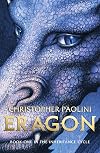
Eragon is not that book. I mean obviously it's not, When I was ten Christopher Paolini was… oh, wait, he was probably half way through a first draft of Eragon. It'd be easy to blame Paolini's youth and the Rebecca Black-esque manner of Eragon's publication for the myriad faults in the novel. So what the hell, I'll do just that. Damn you, Christopher Paolini's youth! The myriad faults in the novel are all your fault!
Phew. That was quite cathartic. I would add that Eragon isn't the worst mash-up of Star Wars: A New Hope and pretty much every fantasy novel ever, but let's be honest, how many of those have you read? You know an author is sticking a tad too closely to his inspirations when you can accurately predict most of a book's major plot points by thinking back to the adventure of R2-D2 et al. The writing falls into many of the typical problems we all have writing novels at fifteen: purple prose, Gary Stu falling for Mary Sue, too much telling, not enough showing, and more besides.
It's not utterly without the bounds of reason that I'll finish the series some day, although I'd probably have to see all three other books in my local charity shop's three-for-a-pound bargain bucket to be tempted to pick them up. It doesn't help that the cringeworthy attempts at foreshadowing mean I feel like I already know half the plot of what's left. Still, there are probably worse ways to spend a rainy few days and/or the Zombiepocalypse. Now, if you give me a few days, I can probably think of them. show less
I asked my mother, what shall I read?
Something by [a:Priti|2757005|Priti Singh|http://www.goodreads.com/assets/nophoto/nophoto-U-50x66-4df4c878d4149c45fac159e88cb784ad.jpg]?
Something by [a:Rich|29947|Adrienne Rich|http://photo.goodreads.com/authors/1198772292p2/29947.jpg]?
Here's what she said to me.
Que será, será,
Whatever you'll read, you'll read.
Your habits aren't down to me,
Que será, será.#
I was ten and obsessed with dragons. The highlight of most months show more was going to the library in the next village with my mum and sister. There I would take out far more books than I ever got through before the next visit. Oddly, I almost never renewed my library books, so if I was only halfway through a book when the next month came along then tough luck, little Lee. One month during the height of my dragon obsession I took out a real tome, my first seriously big book. I don't remember what it was called, or anything much about it at all, except it involved a young man discovering a dragon and going on a journey both geographic and personal. I adored it enough to renew it the next month and for a long time it was my Favourite Book of All Time.
Eragon is not that book. I mean obviously it's not, When I was ten Christopher Paolini was… oh, wait, he was probably half way through a first draft of Eragon. It'd be easy to blame Paolini's youth and the Rebecca Black-esque manner of Eragon's publication for the myriad faults in the novel. So what the hell, I'll do just that. Damn you, Christopher Paolini's youth! The myriad faults in the novel are all your fault!
Phew. That was quite cathartic. I would add that Eragon isn't the worst mash-up of Star Wars: A New Hope and pretty much every fantasy novel ever, but let's be honest, how many of those have you read? You know an author is sticking a tad too closely to his inspirations when you can accurately predict most of a book's major plot points by thinking back to the adventure of R2-D2 et al. The writing falls into many of the typical problems we all have writing novels at fifteen: purple prose, Gary Stu falling for Mary Sue, too much telling, not enough showing, and more besides.
It's not utterly without the bounds of reason that I'll finish the series some day, although I'd probably have to see all three other books in my local charity shop's three-for-a-pound bargain bucket to be tempted to pick them up. It doesn't help that the cringeworthy attempts at foreshadowing mean I feel like I already know half the plot of what's left. Still, there are probably worse ways to spend a rainy few days and/or the Zombiepocalypse. Now, if you give me a few days, I can probably think of them. show less
- "A man with a dragon was never truly alone."
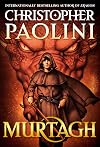
I was so excited for this to arrive and boy, this book is a thicc and meaty girl! I don't want to spoil too much, but Murtagh was basically my favorite character in the world of Eragon (we love me some older brother anti-heroes) and it is such a treat to get a WHOLE book about him! His bond with Thorn felt like a fresh take on what we saw between Eragon and Saphira that I really enjoyed. Here's to hoping we get many, many more books about them!
I was so excited for this to arrive and boy, this book is a thicc and meaty girl! I don't want to spoil too much, but Murtagh was basically my favorite character in the world of Eragon (we love me some older brother anti-heroes) and it is such a treat to get a WHOLE book about him! His bond with Thorn felt like a fresh take on what we saw between Eragon and Saphira that I really enjoyed. Here's to hoping we get many, many more books about them!
 This review was written for LibraryThing Early Reviewers.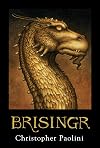
"Brisingr" means 'fire' in the ancient language of the world Paolini has created; unfortunately, 'fire' is exactly what this story lacks. In fact, it plods. Conversations are followed by internal moralising (of a very limited nature) which is followed by some political debate (ie. more conversation) and every once in a while there is an extended action sequence (more on these later). I find it very revealing that this should have been the final title in the 'Inheritance' trilogy, but it show more became so lengthy that Paolini decided to publish (at least) one more book to create a (VERY profitable) series. Realistically, this was not necessary: so much of what is in this book is mundane and unnecessary and - somewhat bizarrely, given the length - undeveloped. By which I mean that that after pondering, pontificating and pouting, the characters act and that section of the story just closes, without really changing anything or anyone, or anyone's opinion of anyone.
I have not read the first two in the series, so I cannot comment on how far the style here is similar, but I would imagine that to create such a successful fantasy series, you would have to include more elements of fantasy. Instead, Paolini mainly switches between two styles: extreme violence and gore; political/ moral conversation. Rather than seeing the main characters learning spells or exploring elvish or dwarvish customs (other than an extremely dull section regarding electing a new chief), we see copious amounts of slaughter.
The novel opens when Eragon (our hero) and his cousin, Roran, are hiding from a cult and about to witness a rather unpleasant custom. As part of their sacrifice to their Gods, these people hack off their own limbs and smile beatifically as they spray blood over the altar. Although Eragon reflects that it seems wrong to deliberately mutilate yourself, it is revealing that there is a "spark of excitement" in his heart as he watches them. His cousin is horrified, exclaiming that they are cannibals. Our hero calmly points out that this is not strictly true because "they do not partake of the meat." His reasoned approach is perhaps sensible, but it seems that war has dulled his own senses. Later on this lack of empathic response is emphasised when he and Roran fight in seemingly endless battles, repeatedly slaying soldier, after soldier, after soldier. Obviously, war does inure soldiers to death to some extent, but some genuine discomfort in the hero would make him more realistic and likeable. Instead of giving him this sensitivity, Paolini emphasises his violent credentials by describing how he and Roran kill each individual soldier and are hailed as magnificent heroes. Yes, there is a lot of violence in war, but I found it disturbing the way the author and his characters seemed to revel in carnage.
At the beginning of the book, Eragon has three main aims: rescue Katerina, Roran's beloved, continue his training with Oromis and defeat Galbatorix. One of these aims is tackled early on, another is touched upon towards the end of the book, but where is Galbatorix? After 750 pages, the dread warlord himself has not been seen and Eragon is almost exactly where he was at the beginning of the story: preparing to do battle against the evil King. This is slightly disappointing. After a few initial skirmishes, much of the book follows Eragon as he tries to meet the demands of the many oaths he has sworn, some of which are almost conflicting and result in important people trying to assert their control over him.
There is a continuous sense of plot, and although the reading never becomes exactly dull - how could it when you are describing interactions between dragons and elves? - it never becomes gripping, either. I read this book slowly, because I was never compelled to find out what happened next. Perhaps, for me personally, it is almost too clearly a saga. There is never any real sense of stories opening or closing, only a gradual build-up of information. Some characters seem to appear briefly just to say: "look! I'll be important later on! Remember what I said/did/looked like." Because of this, I read along fairly contentedly, with no real impetus to complete the experience.
It is possible to read this book without having read the previous two, since the author has usefully provided a synopsis of each before the 'main feature', but I question why anyone would want to. I suspect that those who have read and enjoyed "Eragon" and "Eldest" might be more willing to tolerate the lack of drama in this instalment because they share some bonds with the characters. Those who haven't read either should probably start there, because I suspect this is the weakest link in the series so far.
So is it worth reading? Personally, I think not. It was not a bad read really; it's just that there must be much better books out there, and 750 pages is a long time to spend on something that doesn't really grip you. I will qualify my review by stating that I do not typically read fantasy stories and much prefer science fiction or crime fiction or - well, most other types of writing, really. I read this as part of shadowing the 'Berkshire Book Award' with a group of pupils and will be very interested to hear their views on it, as they are the target audience. show less
I have not read the first two in the series, so I cannot comment on how far the style here is similar, but I would imagine that to create such a successful fantasy series, you would have to include more elements of fantasy. Instead, Paolini mainly switches between two styles: extreme violence and gore; political/ moral conversation. Rather than seeing the main characters learning spells or exploring elvish or dwarvish customs (other than an extremely dull section regarding electing a new chief), we see copious amounts of slaughter.
The novel opens when Eragon (our hero) and his cousin, Roran, are hiding from a cult and about to witness a rather unpleasant custom. As part of their sacrifice to their Gods, these people hack off their own limbs and smile beatifically as they spray blood over the altar. Although Eragon reflects that it seems wrong to deliberately mutilate yourself, it is revealing that there is a "spark of excitement" in his heart as he watches them. His cousin is horrified, exclaiming that they are cannibals. Our hero calmly points out that this is not strictly true because "they do not partake of the meat." His reasoned approach is perhaps sensible, but it seems that war has dulled his own senses. Later on this lack of empathic response is emphasised when he and Roran fight in seemingly endless battles, repeatedly slaying soldier, after soldier, after soldier. Obviously, war does inure soldiers to death to some extent, but some genuine discomfort in the hero would make him more realistic and likeable. Instead of giving him this sensitivity, Paolini emphasises his violent credentials by describing how he and Roran kill each individual soldier and are hailed as magnificent heroes. Yes, there is a lot of violence in war, but I found it disturbing the way the author and his characters seemed to revel in carnage.
At the beginning of the book, Eragon has three main aims: rescue Katerina, Roran's beloved, continue his training with Oromis and defeat Galbatorix. One of these aims is tackled early on, another is touched upon towards the end of the book, but where is Galbatorix? After 750 pages, the dread warlord himself has not been seen and Eragon is almost exactly where he was at the beginning of the story: preparing to do battle against the evil King. This is slightly disappointing. After a few initial skirmishes, much of the book follows Eragon as he tries to meet the demands of the many oaths he has sworn, some of which are almost conflicting and result in important people trying to assert their control over him.
There is a continuous sense of plot, and although the reading never becomes exactly dull - how could it when you are describing interactions between dragons and elves? - it never becomes gripping, either. I read this book slowly, because I was never compelled to find out what happened next. Perhaps, for me personally, it is almost too clearly a saga. There is never any real sense of stories opening or closing, only a gradual build-up of information. Some characters seem to appear briefly just to say: "look! I'll be important later on! Remember what I said/did/looked like." Because of this, I read along fairly contentedly, with no real impetus to complete the experience.
It is possible to read this book without having read the previous two, since the author has usefully provided a synopsis of each before the 'main feature', but I question why anyone would want to. I suspect that those who have read and enjoyed "Eragon" and "Eldest" might be more willing to tolerate the lack of drama in this instalment because they share some bonds with the characters. Those who haven't read either should probably start there, because I suspect this is the weakest link in the series so far.
So is it worth reading? Personally, I think not. It was not a bad read really; it's just that there must be much better books out there, and 750 pages is a long time to spend on something that doesn't really grip you. I will qualify my review by stating that I do not typically read fantasy stories and much prefer science fiction or crime fiction or - well, most other types of writing, really. I read this as part of shadowing the 'Berkshire Book Award' with a group of pupils and will be very interested to hear their views on it, as they are the target audience. show less
Lists
my sandbox (1)
al.vick-series (1)
Awful Books (1)
XXX (1)
Books About Boys (1)
Awards


You May Also Like


Associated Authors
Statistics
- Works
- 36
- Also by
- 5
- Members
- 107,093
- Popularity
- #82
- Rating
- 3.8
- Reviews
- 1,606
- ISBNs
- 875
- Languages
- 34
- Favorited
- 208


