
Stanley M. Horton
Author of Five Views on Sanctification
About the Author
Stanley M. Horton es un distinguido profesor emerito de Biblia y teologia del Assemblies of God Theological Seminary
Series
Works by Stanley M. Horton
The Old Testament Study Bible: Genesis (Complete Biblical Library Series, Volume 1) (1994) 19 copies
Genesis: The promise of blessing = [Be-reshit] (The complete biblical library commentary) (1996) 9 copies
Pneumatology: Study Guide 2 copies
Isaiah: A Logion Press Commentary 2 copies
O Livro de Atos 2 copies
The Book of Acts 1 copy
El Maestro Vol. 14 1 copy
Books of the Pentateuch: Genesis thru Deuteronomy (The Complete Biblical Library, v1-4) (1994) 1 copy
Sempre prontos 1 copy
Pneumatology 1 copy
Associated Works
Tagged
Common Knowledge
- Legal name
- Horton, Stanley Monroe
- Other names
- 霍斯理
- Birthdate
- 1916-05-06
- Gender
- male
- Education
- University of California (BS|1937)
Gordon-Conwell Theological Seminary (MDiv|1944)
Harvard University (STM|1945)
Central Baptist Theological Seminary (ThD|1959) - Organizations
- Society for Pentecostal Studies (president | 1980)
Evangelical Theological Society
Near East Archaeological Society
Assemblies of God Theological Seminary - Nationality
- USA
- Birthplace
- Huntington Park, California, USA
- Places of residence
- Springfield, Missouri, USA
- Associated Place (for map)
- USA
Members
Reviews

This book serves as an overview of the "16 Fundamental Truths" (i.e., a confession) of the Assemblies of God fellowship (i.e. denomination). It goes through the basic doctrines of AG, including the Trinity and the Deity of Christ, as well as distinctives such as second filling of the Holy Spirit, speaking in tongues (glossolalia), and the Rapture. This isn't the most technical of books, and reads decently. However, from the theological and exegetical perspective, it is quite weak. Certain show more things are presupposed in its theology, such as God allowing man to choose His own destiny, without much exegetical and Scriptural backing:
"Now, some may wonder how God can know who will be lost and allow them to be lost. God’s foreknowledge does not predetermine individual choices, for He has chosen not to violate the individual free will. In Ephesians 1:3–14 we have the outlines of the panorama of predetermined world history, but this glimpse into the predestination of the course of the universe does not rule out the “islands of freedom” God has reserved for the personal choices of free people. God does not send people to hell; He permits them to choose their own eternal destiny."
This passage would be fine with proper Scriptural citation, but the argument here is not fleshed out fully, and is assumed to be true by the author in this chapter about the "Attributes of God".
Either way, if you are committed to the theology of the Assemblies of God or are curious about what they believe, this is a good book. However, if you are trying to be convinced of the truth of their beliefs in a Scriptural manner, you may want to look elsewhere. show less
"Now, some may wonder how God can know who will be lost and allow them to be lost. God’s foreknowledge does not predetermine individual choices, for He has chosen not to violate the individual free will. In Ephesians 1:3–14 we have the outlines of the panorama of predetermined world history, but this glimpse into the predestination of the course of the universe does not rule out the “islands of freedom” God has reserved for the personal choices of free people. God does not send people to hell; He permits them to choose their own eternal destiny."
This passage would be fine with proper Scriptural citation, but the argument here is not fleshed out fully, and is assumed to be true by the author in this chapter about the "Attributes of God".
Either way, if you are committed to the theology of the Assemblies of God or are curious about what they believe, this is a good book. However, if you are trying to be convinced of the truth of their beliefs in a Scriptural manner, you may want to look elsewhere. show less
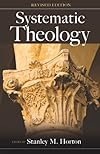
A systematic theology from the Pentecostal perspective as taught by the Assemblies of God, it surveys the doctrines found in the Bible. Horton's "Theology" includes 149 pages (a bit under 1/4 of the book) discussing the work of the Holy Spirit and His work in sanctification, baptism, spiritual gifts, and divine healing, which seems wholly missing in the more popular evangelical and scholarly systematic theologies (except for J. Rodman Williams, "Renewal Theology," which I also show more recommend).
This systematic work starts with a short history of Pentecostal history and the basis for Pentecostal theology before discussing the doctrines of inspiration, the existence and nature of God, angels and demons, Creation, Man, sin, the person and work of Christ – doctrines in every way the orthodox – and the Holy Spirit (as mentioned above; also orthodox, however, perhaps controversial to those who, not only disagree with Pentecostal theology but, mistakenly view it as heretical).
Although not as in-depth in handling certain controversial issues, nevertheless, it explores various views discusses their strengths and weaknesses from a Biblically Pentecostal perspective. Interesting enough, Horton's "Systematic Theology" briefly, yet, it seems adequately, discusses the controversial "Jesus Only" or "Oneness Pentecostalism," a little of it's history and doctrine, and soundly rejects it (comparing it to Modalism and Sabellianism) in favor of the doctrine of God's triune nature.
I recommend it for those who want to learn what are the main beliefs of Pentecostals, especially to those who adhere to whatever John MacArthur has to say, unjustifiably, against Pentecostals and Charismatics.
There is one slight drawback, which i must reluctantly not, and that is the editing of this book is less than desired; there quite a few places were a word is misspelled or missing and maybe a couple of places where the sentence is convoluted. I do hope that with any further additions, they would redo the editing. It's distracting, at least, to me. show less
This systematic work starts with a short history of Pentecostal history and the basis for Pentecostal theology before discussing the doctrines of inspiration, the existence and nature of God, angels and demons, Creation, Man, sin, the person and work of Christ – doctrines in every way the orthodox – and the Holy Spirit (as mentioned above; also orthodox, however, perhaps controversial to those who, not only disagree with Pentecostal theology but, mistakenly view it as heretical).
Although not as in-depth in handling certain controversial issues, nevertheless, it explores various views discusses their strengths and weaknesses from a Biblically Pentecostal perspective. Interesting enough, Horton's "Systematic Theology" briefly, yet, it seems adequately, discusses the controversial "Jesus Only" or "Oneness Pentecostalism," a little of it's history and doctrine, and soundly rejects it (comparing it to Modalism and Sabellianism) in favor of the doctrine of God's triune nature.
I recommend it for those who want to learn what are the main beliefs of Pentecostals, especially to those who adhere to whatever John MacArthur has to say, unjustifiably, against Pentecostals and Charismatics.
There is one slight drawback, which i must reluctantly not, and that is the editing of this book is less than desired; there quite a few places were a word is misspelled or missing and maybe a couple of places where the sentence is convoluted. I do hope that with any further additions, they would redo the editing. It's distracting, at least, to me. show less
This was a life-changing book for me because it showed me the flaws within Christianity. Oh, I'm sure that it didn't mean to. But if you have 10 different denominations swearing that their 10 different versions of baptism or the holy spirit, etc. are correct, then they all must be either wrong or insignificant to the grand scheme of things.

This volume is literally a commentary on the Holy Spirit... You will find exegetical excellence, doctrinal soundness, and practical application. More than that, however, you will find an inspirational touch which makes it a delight to refer to this book either in research or devotional reading. Written from a positive evangelical and Pentecostal perspective, this comprehensive book guides the reader through the Bible book by book and gives a fresh look at what the Scriptures teach about the show more Holy Spirit. It is the result of a lifetime of dedicated study by one of the most respected Pentecostal scholars of our day, and will become a standard text in its field. show less
Lists
You May Also Like


Associated Authors
Statistics
- Works
- 46
- Also by
- 1
- Members
- 1,983
- Popularity
- #12,965
- Rating
- 3.0
- Reviews
- 11
- ISBNs
- 61
- Languages
- 6
- Favorited
- 1