
Jerry M. Ruhl
Author of Balancing Heaven and Earth: A Memoir of Visions, Dreams, and Realizations
Works by Jerry M. Ruhl
Balancing Heaven and Earth: A Memoir of Visions, Dreams, and Realizations (1998) — Author — 151 copies
Living Your Unlived Life: Coping with Unrealized Dreams and Fulfilling Your Purpose in the...Second Half of Life (2007) — Author — 136 copies
Tagged
Common Knowledge
- Gender
- male
- Occupations
- psychologist
lecturer
writer - Short biography
- Jerry M. Ruhl is a clinical psychologist and a popular lecturer, who have studied spiritual traditions in Japan, Bali, Thailand, Nepal, and India. His books include Balancing Heaven and Earth and Contentment, both co-authored with Robert A. Johnson. He lives in Yellow Spring, Ohio. [from Living Your Unlived Life (2007)]
- Nationality
- USA
- Associated Place (for map)
- USA
Members
Reviews
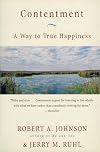
I've had this book on the shelf for a while and turned to it hoping for an antidote to the February doldrums. It's quite a short volume, easy to finish in the space of an hour or two, but provides good food for thought.
Johnson is a Jungian analyst and so uses story as a jumping-off point for his discussion of contentment - in this case, the story of King Lear, a tale of 'distorted expectations and painful illusions.' Examining just some of the interactions between the characters in the play, show more Johnson and Ruhl describe how psychological projection, artificial inflation of the ego, and obsessive attempts to control life lead to discontentment. The final section of the book reviews the 'gifts of contentment.' There are some simple exercises here to help the reader listen to the inner voice of the heart, but the description of the gifts is mostly comprised of folk tales and anecdotes that convey the wisdom of contentment.
Readers of strongly anti-religious bias may object to Johnson and Ruhl's reference to the inner 'divine voice' and discussion of the importance of connecting to a larger whole:
Can atheists make use of applied Jungian psychology? Perhaps only strict materialists would find the above passage difficult to relate to - or perhaps not, as the fabric of society and culture provide many 'wholes' for the self to identify with.
Although a short book, this is one that rewards careful reading and can provide food for thought for many months, if not a lifetime. show less
Johnson is a Jungian analyst and so uses story as a jumping-off point for his discussion of contentment - in this case, the story of King Lear, a tale of 'distorted expectations and painful illusions.' Examining just some of the interactions between the characters in the play, show more Johnson and Ruhl describe how psychological projection, artificial inflation of the ego, and obsessive attempts to control life lead to discontentment. The final section of the book reviews the 'gifts of contentment.' There are some simple exercises here to help the reader listen to the inner voice of the heart, but the description of the gifts is mostly comprised of folk tales and anecdotes that convey the wisdom of contentment.
Readers of strongly anti-religious bias may object to Johnson and Ruhl's reference to the inner 'divine voice' and discussion of the importance of connecting to a larger whole:
The original meaning of the word 'religion' is to rerelate or reconnect - to put back together again, heal the wounds of separation, and to make whole. Contentment grows, not out of pursuing self-interest, but from our capacity to connect to a larger whole - family, social groups, nature, and, ultimately, God. Some people have trouble with the word 'God,' but all that is really required here is a willingness to acknowledge a power greater than yourself.
Can atheists make use of applied Jungian psychology? Perhaps only strict materialists would find the above passage difficult to relate to - or perhaps not, as the fabric of society and culture provide many 'wholes' for the self to identify with.
Although a short book, this is one that rewards careful reading and can provide food for thought for many months, if not a lifetime. show less
This was a quick read but lacked depth and included a lot of generalizations about the culture that felt shallow and overstated.
Awards

You May Also Like
Associated Authors
Statistics
- Works
- 4
- Members
- 380
- Popularity
- #63,550
- Rating
- 4.0
- Reviews
- 2
- ISBNs
- 11
- Languages
- 1