
Jacob Milgrom (1923–2010)
Author of The JPS Torah Commentary: Numbers
About the Author
Jacob Milgrom (1923-2010), an esfeemed rabbi in Conservative Judaism, was Professor Emeritus of Near Eastern Studies at University of California, Berkeley. He was the author of many books, most notably The JPS Torah Commentary: Numbers (1966) and the-three-volume Anchor Bible Commentary of show more Leviticus (1991-2001). show less
Works by Jacob Milgrom
Leviticus 1-16: A New Translation with Introduction and Commentary (1991) — Translator — 272 copies, 1 review
Leviticus 17-22 : A New Translation with Introduction and Commentary (2000) — Translator — 160 copies, 1 review
Cult and ConscienceThe Asham and the Priestly Doctrine of Repentance (Studies in Judaism in late antiquity) (1976) 5 copies
Studies in the Temple Scroll 1 copy
Ezekiel's Hope 1 copy
Magic, Monotheism and the Sin of Moses — Author — 1 copy
The Bible Versus Babel 1 copy
Biblical Diet Laws 1 copy
The tassel and the tallith 1 copy
עולם התנ"ך: מגילות 1 copy
Associated Works
By Study and Also by Faith: Essays in Honor of Hugh W. Nibley, Vol. 1 (1990) — Contributor — 49 copies
Pomegranates and Golden Bells: Studies in Biblical, Jewish, and Near Eastern Ritual, Law and Literature in Honor of Jacob Milgrom (1995) — Honoree — 42 copies
The Temple in Antiquity: Ancient Records and Modern Perspectives (The Religious Studies Monograph Series) (1984) — Contributor — 38 copies
The Book of Leviticus: Composition and Reception (Supplements to Vetus Testamentum) (2002) — Contributor — 29 copies
The Idea of Biblical Interpretation: Essays in Honor of James L. Kugel (Supplements to the Journal for the Study of Judaism) (2004) — Contributor — 17 copies
The Quest for Context and Meaning: Studies in Biblical Intertextuality in Honor of James A. Sanders (1997) — Contributor — 3 copies
Tagged
Common Knowledge
- Canonical name
- Milgrom, Jacob
- Birthdate
- 1923-02-01
- Date of death
- 2010-06-05
- Gender
- male
- Education
- Brooklyn College
Jewish Theological Seminary - Occupations
- rabbi
scholar of Torah and the Dead Sea Scrolls - Organizations
- Guggenheim Foundation (fellow)
Institute for Advanced Studies in Jerusalem (fellow)
Algright Institute of Archaelogical Research (senior fellow) - Relationships
- Milgrom, Jo (wife)
Gane, Roy (student) - Nationality
- USA
- Birthplace
- Brooklyn, New York, USA
- Place of death
- Israel
- Associated Place (for map)
- New York, USA
Members
Reviews
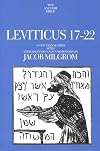
Jacob Milgrom, a rabbi and Bible scholar, has devoted the bulk of his career to examining the laws of the Torah. His incisive commentary on Leviticus, which began with Leviticus 1–16, continues in this second of three volumes. It provides an authoritative and comprehensive explanation of ethical values concealed in Israel’s rituals. Although at first glance Leviticus seems far removed from the modern-day world, Milgrom’s thoughtful and provocative comments and notes reveal its enduring show more relevance for contemporary society.
Leviticus 17–22 brings us to the heart of the book. These chapters focus mainly on the practice of holiness required of laity and priest alike. The commandments that lead to holiness are detailed in chapter 19, the core of the book, if not the whole Torah. The acme of this chapter, the author maintains, is not “love your neighbor (fellow Israelites) as yourself,” but “love him (the alien) as yourself,” endowing him with equal civil rights.
With its English translations that convey the nuance and power of the original Hebrew, this trilogy will take its place alongside the best of the Anchor Yale Bible. show less
Leviticus 17–22 brings us to the heart of the book. These chapters focus mainly on the practice of holiness required of laity and priest alike. The commandments that lead to holiness are detailed in chapter 19, the core of the book, if not the whole Torah. The acme of this chapter, the author maintains, is not “love your neighbor (fellow Israelites) as yourself,” but “love him (the alien) as yourself,” endowing him with equal civil rights.
With its English translations that convey the nuance and power of the original Hebrew, this trilogy will take its place alongside the best of the Anchor Yale Bible. show less
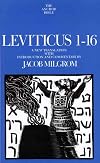
At the beginning of his academic career, author Jacob Milgrom determined to make his lifework a probing study of the Laws of the Torah. Here, with Leviticus 1–16, the first of three volumes on Leviticus, he has reached the pinnacle of his long pursuit. No other contemporary commentary matches Milgrom’s comprehensive work on this much misunderstood and often underappreciated biblical book.
In this richly detailed volume, the author traverses the shoals of legal thought and liturgical show more practice in ancient Israel. He clearly explains the role of the Tabernacle of the Wilderness as the all-important center of Israelite worship, the locus of the priestly orders, sacrificial rituals, and practices of purity to which the congregation repaired for penitence and reconciliation, restoration, and renewal. At the heart of the dwelling place of God was the real presence of the God of Israel, present through his splendor in the midst of the camp and the congregation—a permanent sign of the unique privilege and responsibility of Israel, perceived as a worshipping and serving people. show less
In this richly detailed volume, the author traverses the shoals of legal thought and liturgical show more practice in ancient Israel. He clearly explains the role of the Tabernacle of the Wilderness as the all-important center of Israelite worship, the locus of the priestly orders, sacrificial rituals, and practices of purity to which the congregation repaired for penitence and reconciliation, restoration, and renewal. At the heart of the dwelling place of God was the real presence of the God of Israel, present through his splendor in the midst of the camp and the congregation—a permanent sign of the unique privilege and responsibility of Israel, perceived as a worshipping and serving people. show less
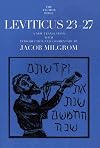
Jacob Milgrom’s incisive commentary on Leviticus, which began with Leviticus 1–16 and Leviticus 17–22, continues in this last volume of three. It provides an authoritative and comprehensive explanation of ethical values concealed in Israel’s rituals. Leviticus 23–27 brings us to the climactic end of the book and its revolutionary innovations, among which are the evolution of the festival calendar with its emphasis on folk traditions, and the jubilee, the priestly answer to the show more socio-economic problems of their time. show less

Ancient Israel's priests would be aghast at the moral pollution of the earth: the brazen slaughter of thousands, millions dying of hunger, while the free world silently changes the channel.
You May Also Like


Associated Authors
Statistics
- Works
- 25
- Also by
- 12
- Members
- 1,182
- Popularity
- #21,745
- Rating
- 4.3
- Reviews
- 11
- ISBNs
- 19