
Emily Norris
Author of My First Piano Sheet Music: Easy, Fun-to-Play Popular Songs for Kids
Works by Emily Norris
Tagged
Common Knowledge
There is no Common Knowledge data for this author yet. You can help.
Members
Reviews
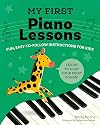
In a Nutshell: A beginner’s guide to playing the piano. Works nicely as a first piano book because of the range of information and the variety of songs. Might get a bit overwhelming at times.
———————————————
G-sharp the giraffe is our narrator on this musical journey where kids can understand the basics of piano playing. The book begins with the essentials such as correct posture and positioning, and then moves on to one new concept per chapter, thus covering show more quite a lot by the time they complete chapter ten.
Every chapter begins with information about a few terms and then illustrates the same with a couple of simple popular songs such as ‘Hot Cross Buns’ or ‘London Bridge is Falling Down.’ The lyrics have been modified in certain cases to avoid complicated notes. Every song in the book is played only with the white keys, thereby skipping out all mention of sharps and flats. The songs begin with three-note tunes and slowly increase in complication until the child can play notes from two staves simultaneously. This approach will work well for beginners, all the more as the initial songs do not use flagged notes.
The book offers many easy tips to remember some essentials such as the length of the notes. (The author’s explanation of time signatures is one of the simplest I have ever seen – excellent handling of this tricky concept!) There are also plenty of fun facts related to pianos (and a few connected to giraffes!) scattered throughout the book. At the end, there is a glossary of all the musical terms used in the book, and some additional resources that parents can use to continue their children’s journey on the pianoforte.
The information provided creates a slight paradox. On one hand, it is comprehensive, covering the two clefs (treble and bass), the middle C, reading the notes on the staves, finger positions and so on. It even goes into not-so-basic territory such as musical dynamics. On the other hand, it skips certain essentials. Basic facts such as there being seven notes (and hence the A-G nomenclature on the white keys) are skipped. The names of the two clefs are written but why they are also called G-Clef and F-Clef and the relevance of their positioning on the staves isn’t explained. Ledger lines are mentioned but the note gap between the two clefs isn’t clarified. Note beaming is mentioned but flags aren’t.
I feel that the range of information will be a bit overwhelming for beginners. The content worked for me as I already know how to read music. But if I were a child, such a plethora of information would have scared me away.
The book will work better if read leisurely, and under adult guidance. Maybe taking a chapter at a time, repeating it until perfected, and only then moving on to the next chapter would be more helpful than completing the ten chapters in ten days.
Recommended as an introductory guidebook to piano playing – this book will set kiddos on the right path of learning to play this delightful instrument, and will hopefully make them want to pursue it further.
Do note that the book follows the American musical notation system such as whole note, half note, and so on. (The British notation finds a little mention in one pop-out box.)
4 stars.
My thanks to Zeitgeist, Z Kids, and NetGalley for the DRC of “My First Piano Lessons”. This review is voluntary and contains my honest opinion about the book.
———————————————
Connect with me through:
My Blog | The StoryGraph | Instagram | Facebook | Twitter show less
———————————————
G-sharp the giraffe is our narrator on this musical journey where kids can understand the basics of piano playing. The book begins with the essentials such as correct posture and positioning, and then moves on to one new concept per chapter, thus covering show more quite a lot by the time they complete chapter ten.
Every chapter begins with information about a few terms and then illustrates the same with a couple of simple popular songs such as ‘Hot Cross Buns’ or ‘London Bridge is Falling Down.’ The lyrics have been modified in certain cases to avoid complicated notes. Every song in the book is played only with the white keys, thereby skipping out all mention of sharps and flats. The songs begin with three-note tunes and slowly increase in complication until the child can play notes from two staves simultaneously. This approach will work well for beginners, all the more as the initial songs do not use flagged notes.
The book offers many easy tips to remember some essentials such as the length of the notes. (The author’s explanation of time signatures is one of the simplest I have ever seen – excellent handling of this tricky concept!) There are also plenty of fun facts related to pianos (and a few connected to giraffes!) scattered throughout the book. At the end, there is a glossary of all the musical terms used in the book, and some additional resources that parents can use to continue their children’s journey on the pianoforte.
The information provided creates a slight paradox. On one hand, it is comprehensive, covering the two clefs (treble and bass), the middle C, reading the notes on the staves, finger positions and so on. It even goes into not-so-basic territory such as musical dynamics. On the other hand, it skips certain essentials. Basic facts such as there being seven notes (and hence the A-G nomenclature on the white keys) are skipped. The names of the two clefs are written but why they are also called G-Clef and F-Clef and the relevance of their positioning on the staves isn’t explained. Ledger lines are mentioned but the note gap between the two clefs isn’t clarified. Note beaming is mentioned but flags aren’t.
I feel that the range of information will be a bit overwhelming for beginners. The content worked for me as I already know how to read music. But if I were a child, such a plethora of information would have scared me away.
The book will work better if read leisurely, and under adult guidance. Maybe taking a chapter at a time, repeating it until perfected, and only then moving on to the next chapter would be more helpful than completing the ten chapters in ten days.
Recommended as an introductory guidebook to piano playing – this book will set kiddos on the right path of learning to play this delightful instrument, and will hopefully make them want to pursue it further.
Do note that the book follows the American musical notation system such as whole note, half note, and so on. (The British notation finds a little mention in one pop-out box.)
4 stars.
My thanks to Zeitgeist, Z Kids, and NetGalley for the DRC of “My First Piano Lessons”. This review is voluntary and contains my honest opinion about the book.
———————————————
Connect with me through:
My Blog | The StoryGraph | Instagram | Facebook | Twitter show less
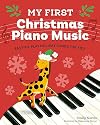
In a Nutshell: A beginner’s set of holiday songs for the piano. Easy enough, but basic music knowledge is required. Recommended to those who can sight-read notes on the two clefs.
~~~~~~~~~~~~~~~~~~~~~~~
I had read this author’s earlier book, ‘My First Piano Lessons’ last year and found it very helpful as a beginner’s guide to playing on the piano. This book, the third in her Beginners series, takes the journey to the next level.
The book contains music sheets for twenty-five show more Christmas songs. Many of the songs are classic carols, but there are a few relatively unknown inclusions as well. The carols are fairly divided between religious carols (Come to the manger, The First Noel,…) and generic holiday songs (We Wish You a Merry Christmas, The Holly and the Ivy,…) The overall variety is quite good.
The initial hand positions and note letters have been clearly indicated at the top of each song sheet. This is quite helpful for little learners. However, do keep in mind that this isn't not a “first piano book” but a “first Christmas piano music” book. The aspiring pianist is expected to have familiarity with the clefs, musical notations and time signatures. (The book has songs in 4/4, 3/4, and 2/4 timing.)
The latter songs are slightly greater in difficulty than the initial entries, as is standard in beginner music books. Most of the songs don’t have accompanying chords. (As far as I remember, Jingle Bells was the only one with chords, which have been clearly marked.)
Some songs have been shortened and the note timings slightly modified (a few quavers altered to crotchet timing) to better suit beginners. This doesn’t affect the mood of the song or the playing. But it might be a bit tricky to sing along in such cases when your head knows a tune but the music runs a teeny bit different from it.
I didn’t expect to find ‘Ding Dong Merrily On High’ and ‘Angels We Have Heard On High’ in a beginners’ book. The distinct “Glo-o-o-o-o-o-o-o-ria” in both those carols with the mix of quavers and crotchets could be tricky to play. But it is also good to have a challenge so that those who hit the right notes can feel happy about themselves.
(On an unrelated side note, I tried teaching my choir kids ‘Ding Dong Merrily On High’ last December for an inter-parish choral festival during Advent. The very first time they heard me sing the ‘Gloria’ refrain, they opened their eyes and mouths wide in horror and immediately whined, “Missssss!!!! Pleeeassssssseeee!!! Can we sing some other carol for the performance?!??” show less
~~~~~~~~~~~~~~~~~~~~~~~
I had read this author’s earlier book, ‘My First Piano Lessons’ last year and found it very helpful as a beginner’s guide to playing on the piano. This book, the third in her Beginners series, takes the journey to the next level.
The book contains music sheets for twenty-five show more Christmas songs. Many of the songs are classic carols, but there are a few relatively unknown inclusions as well. The carols are fairly divided between religious carols (Come to the manger, The First Noel,…) and generic holiday songs (We Wish You a Merry Christmas, The Holly and the Ivy,…) The overall variety is quite good.
The initial hand positions and note letters have been clearly indicated at the top of each song sheet. This is quite helpful for little learners. However, do keep in mind that this isn't not a “first piano book” but a “first Christmas piano music” book. The aspiring pianist is expected to have familiarity with the clefs, musical notations and time signatures. (The book has songs in 4/4, 3/4, and 2/4 timing.)
The latter songs are slightly greater in difficulty than the initial entries, as is standard in beginner music books. Most of the songs don’t have accompanying chords. (As far as I remember, Jingle Bells was the only one with chords, which have been clearly marked.)
Some songs have been shortened and the note timings slightly modified (a few quavers altered to crotchet timing) to better suit beginners. This doesn’t affect the mood of the song or the playing. But it might be a bit tricky to sing along in such cases when your head knows a tune but the music runs a teeny bit different from it.
I didn’t expect to find ‘Ding Dong Merrily On High’ and ‘Angels We Have Heard On High’ in a beginners’ book. The distinct “Glo-o-o-o-o-o-o-o-ria” in both those carols with the mix of quavers and crotchets could be tricky to play. But it is also good to have a challenge so that those who hit the right notes can feel happy about themselves.
(On an unrelated side note, I tried teaching my choir kids ‘Ding Dong Merrily On High’ last December for an inter-parish choral festival during Advent. The very first time they heard me sing the ‘Gloria’ refrain, they opened their eyes and mouths wide in horror and immediately whined, “Missssss!!!! Pleeeassssssseeee!!! Can we sing some other carol for the performance?!??” show less
G-Sharp the Giraffe takes wannabe musicians on an entertaining journey to learn everything you need to know to start on the piano — including fingering, musical notation, clefs and more. Author Emily Norris does yeoman’s work with both the colorful illustrations and the simple-to-understand language. What this slim book is not is a do-it-yourself guide to young learners; they’ll need an adult to help out, probably one with some musical background. That said, Norris has penned an show more excellent guide for the youngest learners.
In the interest of full disclosure, I received this book from NetGalley Zeitgeist and Z Press in exchange for an honest review. show less
In the interest of full disclosure, I received this book from NetGalley Zeitgeist and Z Press in exchange for an honest review. show less
My First Christmas Piano Music: Easy-to-Play Holiday Songs for Kids (My First Piano Books) by Emily Norris
G-Sharp the giraffe serves as the guide to the most popular Christmas carols, some of them shortened and adapted to make them easier for budding pianists. The songs increase in difficulty, with the earliest having only the treble clef part. ending with a simplified version of “Auld Lang Syne.”
Music teacher Emily Norris makes sure to include hand positions and note letters, although I don’t know that a child younger than 8 or 9 could use this book without a musical adult to help.
In show more the interest of full disclosure, I received this book from NetGalley, Sourcebooks Kids and Sourcebooks Jabberwocky in exchange for an honest review. show less
Music teacher Emily Norris makes sure to include hand positions and note letters, although I don’t know that a child younger than 8 or 9 could use this book without a musical adult to help.
In show more the interest of full disclosure, I received this book from NetGalley, Sourcebooks Kids and Sourcebooks Jabberwocky in exchange for an honest review. show less
Statistics
- Works
- 4
- Members
- 10
- Popularity
- #908,815
- Rating
- 4.0
- Reviews
- 4
- ISBNs
- 10