
Alex Anderson (3) (1920–2000)
Author of Hunter to Hunted: Surviving Hitler's Wolf Packs: Diaries of a Merchant Navy Radio Officer, 1939-45
For other authors named Alex Anderson, see the disambiguation page.
About the Author
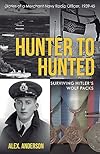
Image credit: Commissioned portrait of (author) Alex Anderson, aged 19 years as a recent graduate of Dundee Wireless College in 1939 and on his appointment as Radio Officer, taken in his home town of Perth, Scotland.
Works by Alex Anderson
Hunter to Hunted: Surviving Hitler's Wolf Packs: Diaries of a Merchant Navy Radio Officer, 1939-45 (2023) 16 copies, 11 reviews
Tagged
Common Knowledge
- Legal name
- Anderson, Alexander
- Birthdate
- 1920-01-02
- Date of death
- 2000-02-14
- Gender
- male
- Education
- Perth Academy, Dundee Wireless College,
- Occupations
- Radio Officer, Electrical Engineer,
- Nationality
- UK
- Birthplace
- Perth, Scotland
- Place of death
- Perth, Scotland
- Burial location
- Perth, Scotland, UK
- Map Location
- Scotland, UK
Members
Reviews
Hunter to Hunted - Surviving Hitler's Wolf Packs: Diaries of a Merchant Navy Radio Officer, 1939-45 by Alex Anderson
Hunter to Hunted recounts the experiences of a young Scot, Alexander “Sparks” Anderson, during his service as a marine radio operator in the Second World War. It is divided into seven chapters, one for each vessel on which the author served. The first three recount his participation in a whaling expedition in the South Atlantic (1939-40), the remaining four his service on merchant vessels convoying across the North Atlantic (1940-45).
The book is based on Anderson’s diaries, which he show more revised into memoir form later in life (with some subsequent editing by one of his sons), and the text reflects both the advantages and disadvantages of its original source material. On the one hand, the diaries’ temporal proximity to the events they describe increases their value as a historical source, undistorted by the increasing havoc time plays upon a person’s memory. Indeed, in a few places, when brief portions of his diaries are missing, Anderson freely admits to having forgotten what occurred during the gaps. On the other hand, a memoirist is free to omit the tedious days of good weather and clear sailing that a diarist faithfully records. Inevitably, not all of Anderson’s experiences are interesting.
That said, many of them are. His matter-of-fact account of mid-twentieth-century industrial whaling is eye-opening, and while he maintains a stiff upper lip throughout, one can readily imagine from his description just how terrifying the frequent rough seas, soon interspersed with U-boat and aerial attacks, must have been. Anderson’s service also took him to many countries on both sides of the Atlantic and in both hemispheres, where he met some colorful characters, who provide amusing anecdotes, while he himself emerges from his account as a likeable if rather ordinary young man, thrust into extraordinary circumstances.
Anderson’s revisions from diary to memoir are not always smooth, so that sometimes he tells us what happened “today,” but his book is worth reading for anyone interested in either whaling or the Battle of the Atlantic. More general readers will be bored at times but should also find enough worthwhile material to justify the time spent. The book is well illustrated with photographs and documents.
I received a free e-copy of this book in exchange for an honest review. show less
The book is based on Anderson’s diaries, which he show more revised into memoir form later in life (with some subsequent editing by one of his sons), and the text reflects both the advantages and disadvantages of its original source material. On the one hand, the diaries’ temporal proximity to the events they describe increases their value as a historical source, undistorted by the increasing havoc time plays upon a person’s memory. Indeed, in a few places, when brief portions of his diaries are missing, Anderson freely admits to having forgotten what occurred during the gaps. On the other hand, a memoirist is free to omit the tedious days of good weather and clear sailing that a diarist faithfully records. Inevitably, not all of Anderson’s experiences are interesting.
That said, many of them are. His matter-of-fact account of mid-twentieth-century industrial whaling is eye-opening, and while he maintains a stiff upper lip throughout, one can readily imagine from his description just how terrifying the frequent rough seas, soon interspersed with U-boat and aerial attacks, must have been. Anderson’s service also took him to many countries on both sides of the Atlantic and in both hemispheres, where he met some colorful characters, who provide amusing anecdotes, while he himself emerges from his account as a likeable if rather ordinary young man, thrust into extraordinary circumstances.
Anderson’s revisions from diary to memoir are not always smooth, so that sometimes he tells us what happened “today,” but his book is worth reading for anyone interested in either whaling or the Battle of the Atlantic. More general readers will be bored at times but should also find enough worthwhile material to justify the time spent. The book is well illustrated with photographs and documents.
I received a free e-copy of this book in exchange for an honest review. show less
 This review was written for LibraryThing Early Reviewers.
Hunter to Hunted - Surviving Hitler's Wolf Packs : Diaries of a Merchant Navy Radio Officer, 1939-45 by Alex Anderson

Hunter to Hunted - Surviving Hitler's Wolf Packs is a fascinating read, providing a window into the day-to-day life of a radio officer in the British Merchant Navy, just before and during World War II. Since the source is the author's diaries, the surfacing of the occasional dry passage and slow pacing are completely understandable, and didn't impact my enjoyment of the book. Some readers might be disturbed by the descriptions of some of the whaling industry activities, but that was the show more reality of the time. As both an amateur radio operator and a veteran, this book held my interest from start to finish. While technically correct, I thought the title was too narrow a description of the account as a whole. show less
This review was written for LibraryThing Early Reviewers.Hunter to Hunted - Surviving Hitler's Wolf Packs: Diaries of a Merchant Navy Radio Officer, 1939-45 by Alex Anderson
I received this book as part of LT’s Early Reviewers Program. A 'compelling read' hardly suffices to describe this memoir/diary. No neatly crafted plot-line here. Whaling was a dangerous and difficult occupation. But once the transition from hunter to hunted happens the author's sense of duty while surrounded daily by death and disaster draws you in and makes it a difficult book to put down. This book gets a full five stars.
This review was written for LibraryThing Early Reviewers.Hunter to Hunted - Surviving Hitler's Wolf Packs: Diaries of a Merchant Navy Radio Officer, 1939-45 by Alex Anderson
This book is a narrative compiled from the author's diaries of his time as a radio operator onboard merchant ships immediately before and up to shortly after the end of World War 2, including whaling in the South Atlantic and then convoys in the Atlantic. I thought it was a pretty good book overall; I enjoyed the descriptions of shipboard life and stories about his port visits; I especially his details about working on a whaling vessel. I found it somewhat unsatisfying in that it lacked show more enough detail about what was happening outside of his ship to understand the impact; I would have liked more details and footnotes added by an editor about when a ship was attacked, what ship was attacked and what the result was (information Anderson didn't have at the time or couldn't have written down if he did). As a former sailor, I can say that the naval jargon was pretty mild and easily approachable for anyone without familiarity. show less
This review was written for LibraryThing Early Reviewers.Statistics
- Works
- 1
- Members
- 16
- Popularity
- #679,946
- Rating
- 4.0
- Reviews
- 11
- ISBNs
- 64
- Languages
- 2
