
Bruno Schulz (1) (1892–1942)
Author of The Street of Crocodiles
For other authors named Bruno Schulz, see the disambiguation page.
Works by Bruno Schulz
The Complete Fiction of Bruno Schultz: The Street of Crocodiles, Sanatorium Under the Sign of the Hourglass (1985) 345 copies, 5 reviews
Oeuvres complètes : Les Boutiques de cannelle ; Le Sanatorium au croque-mort ; Essais critiques ; Correspondance (2004) 8 copies
Birds {story} 2 copies
Tailors' Dummies {story} 2 copies
Traité des mannequins 1 copy
Associated Works
Complicite Plays: Street of Crocodiles, The Three Lives of Lucie Cabrol, and Mnemonic (2003) — Contributor — 16 copies
Tagged
Common Knowledge
- Canonical name
- Schulz, Bruno
- Birthdate
- 1892-07-12
- Date of death
- 1942-11-19
- Gender
- male
- Occupations
- Auther
Painter - Nationality
- Poland
- Map Location
- Poland
Members
Reviews

Bruno Schulz spent most of his life as a school art teacher in the Galician town of Drohobycz (now Drohobych, Ukraine). He published two collections of Polish short stories in the 1930s, as well as a few uncollected stories, all included in this Penguin Classics collection, together with many of Schulz's own illustrations. His other unpublished manuscripts, said to have included a novel, were all lost during the war, but that small body of published work has been enough to make him an show more influential writer. Schulz was murdered by a Nazi officer in 1942.
I picked this up rather expecting quaint little stories of small-town life in Mitteleuropa, but it turns out to be something quite different. Schulz was clearly heavily influenced by (at least) Kafka, Thomas Mann, and the surrealists, and his stories, although they usually start out from the bourgeois domesticity of the Schulz family in Drohobycz ca. 1900, invariably branch away from realism into dream worlds in which the narrator's draper father becomes a heroic figure locked in a quixotic struggle against the constraints of sanity (on occasion turning into an arthropod or being sent to a Magic-Mountainish sanatorium), the maidservant Adela turns into every kind of female archetype, the narrator seems to switch constantly between adult, adolescent and small child (in one story he is an old-age pensioner who enrols in primary school), and the town itself shifts shape in all sorts of unpredictable ways.
This all comes with inventive (over-)rich visual descriptions, often seeming to borrow techniques from the cinema of the times, and all kinds of dreamlike category-changes, when seasons or places or trains develop personalities, waxwork figures and tailor's dummies come to life, and members of the Hapsburg family turn up uninvited.
Very strange and fascinating, definitely something I'm going to have to re-read soon.
But, once again, this makes me sad about what has happened to Penguin Classics. They still have the smart black cover designs I remember from forty years ago, but the insides have turned into a mush of smudgy ink crookedly printed on translucent paper that is creased before you even get the book home from the shop. What are they thinking? show less
I picked this up rather expecting quaint little stories of small-town life in Mitteleuropa, but it turns out to be something quite different. Schulz was clearly heavily influenced by (at least) Kafka, Thomas Mann, and the surrealists, and his stories, although they usually start out from the bourgeois domesticity of the Schulz family in Drohobycz ca. 1900, invariably branch away from realism into dream worlds in which the narrator's draper father becomes a heroic figure locked in a quixotic struggle against the constraints of sanity (on occasion turning into an arthropod or being sent to a Magic-Mountainish sanatorium), the maidservant Adela turns into every kind of female archetype, the narrator seems to switch constantly between adult, adolescent and small child (in one story he is an old-age pensioner who enrols in primary school), and the town itself shifts shape in all sorts of unpredictable ways.
This all comes with inventive (over-)rich visual descriptions, often seeming to borrow techniques from the cinema of the times, and all kinds of dreamlike category-changes, when seasons or places or trains develop personalities, waxwork figures and tailor's dummies come to life, and members of the Hapsburg family turn up uninvited.
Very strange and fascinating, definitely something I'm going to have to re-read soon.
But, once again, this makes me sad about what has happened to Penguin Classics. They still have the smart black cover designs I remember from forty years ago, but the insides have turned into a mush of smudgy ink crookedly printed on translucent paper that is creased before you even get the book home from the shop. What are they thinking? show less
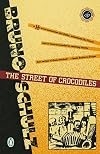
This book was first published, in Polish, in 1934. It began as a series of letters from the reclusive Schulz to a friend, Deborah Vogel. Only two books by Schultz were published before he was murdered by the Gestapo in 1942. His novel, The Messiah, and his unpublished writings were lost.
Schulz's descriptions are like paintings, but more, because the objects are active and sounds, movement and colours all play a part.
"The dark second-floor apartment of the house in Market Square was shot show more through each day by the naked heat of summer: the silence of the shimmering streaks of air, the squares of brightness dreaming their intense dreams on the floor; the sound of a barrel organ rising from the deepest golden vein of a day; two or three bars of a chorus, played on a distant piano over and over again, melting in the sun on the white pavement, lost in the fire of high noon."
It's impossible to classify this book. It is a comic memoir with Schulz as the young narrator and his eccentric father as the main character. It is a fantasy of the end of the world, an elegy to the death of a Galician town and its way of life. In parts it makes no sense, but if you let the words wash over you, there is meaning all the same.
I really enjoyed this book, though it is not at all the sort of thing I usually read. I got lost, and had to re-read many paragraphs and pages, but because the book is so short there is no rush to reach the end. show less
Schulz's descriptions are like paintings, but more, because the objects are active and sounds, movement and colours all play a part.
"The dark second-floor apartment of the house in Market Square was shot show more through each day by the naked heat of summer: the silence of the shimmering streaks of air, the squares of brightness dreaming their intense dreams on the floor; the sound of a barrel organ rising from the deepest golden vein of a day; two or three bars of a chorus, played on a distant piano over and over again, melting in the sun on the white pavement, lost in the fire of high noon."
It's impossible to classify this book. It is a comic memoir with Schulz as the young narrator and his eccentric father as the main character. It is a fantasy of the end of the world, an elegy to the death of a Galician town and its way of life. In parts it makes no sense, but if you let the words wash over you, there is meaning all the same.
I really enjoyed this book, though it is not at all the sort of thing I usually read. I got lost, and had to re-read many paragraphs and pages, but because the book is so short there is no rush to reach the end. show less

A gyermekkor olyan alapanyag, ami minden írónak rendelkezésére áll. A kérdés, hogy mit hoz ki belőle. Amit Schulz alkotott, az semmi máshoz nem fogható: metaforák fullasztó dzsungele, mágikus, abszurd szféra, ahol az apa hol megszállott madárbolond, hol deli tűzoltó, hol szegény haldokló (sőt időnként és újra meg újra: halott). Itt az utcák és terek képlékenyek, mint a gyurma, a színek tapinthatóak, az idő pedig kifolyik az ujjaink közül. És mindez minden show more látszólagos idegenségével együtt mégis lüktetően személyes. Egy külön világ: varázslatos, groteszk és elviselhetetlen. Épp ezért ellenáll annak, hogy a szokásos módon olvassuk – ebbe a könyvbe bele kell költözni.
És ha arra gondolok, hogy 1942-ben jött egy árja senki, és egy lövéssel kioltotta ezt a páratlan világot, ordítani támad kedvem. Ez az árja senki talán éppen arra gondolt, miközben hadonászott a pisztolyával, hogy ő most a kultúrát őrzi. Azt a kultúrát, ami bolha betört lábkörme ahhoz képest, amit Schulz a reggeli kávé előtt a kisujjából ki tudott rázni. Azt a kultúrát, amit azért kellett szögesdróttal körbezárni jó alaposan, mert különben mindenki látta volna, hogy egy málladozó, penészes betonkocka csak az egész, telefirkálva agybeteg jelszavakkal. Azt a kultúrát, ami valójában csak a kultúra hiánya – ennélfogva hamisítatlan, vegytiszta frusztráció. show less
És ha arra gondolok, hogy 1942-ben jött egy árja senki, és egy lövéssel kioltotta ezt a páratlan világot, ordítani támad kedvem. Ez az árja senki talán éppen arra gondolt, miközben hadonászott a pisztolyával, hogy ő most a kultúrát őrzi. Azt a kultúrát, ami bolha betört lábkörme ahhoz képest, amit Schulz a reggeli kávé előtt a kisujjából ki tudott rázni. Azt a kultúrát, amit azért kellett szögesdróttal körbezárni jó alaposan, mert különben mindenki látta volna, hogy egy málladozó, penészes betonkocka csak az egész, telefirkálva agybeteg jelszavakkal. Azt a kultúrát, ami valójában csak a kultúra hiánya – ennélfogva hamisítatlan, vegytiszta frusztráció. show less

A tragi-comic story of paternal loss, though what kind of loss is up for debate.
The family business has been liquidated and:
“A new age began - empty, sober and joyless, like a sheet of white paper.”
But there is surreal humour from the maid:
“She was so absent-minded that she sometimes made a white sauce from old letters and invoices: it was sickly and inedible.”
Things can only get worse?
“By dividing his death into instalments, Father had familiarized us with his demise. We became show more gradually indifferent to his returns - each one shorter, each one more pitiful. ”
Dying, death, return?
Mother finds “father” on the stairs. He’s now a crab, but “the resemblance was striking”. Joseph and his mother accept this and do their best for him, especially when Uncle Charles visits and wants to stamp him out.
Is the crab a metaphor for cancer, as in the zodiac? Many in the Short Story Club thought so.
After reading it a couple more times, I stick with my initial reaction: in the depth of bereavement, the widow sees her husband everywhere. He may or may not have died of cancer, but the story is about the delusion of grief. Joseph goes along with that, whether to humour his mother or because he believes it too.
The end is triggered by the widow’s decision. Is that because she’d worked through her grief and was ready for closure, because cancer took its inevitable course, or is it an analogy for euthanasia? If you’ve read the story, let me know what you think.
Image: Still Life by Pieter Claesz. (Source)
See also
• This is the concluding story in the novel Sanatorium Under the Sign of the Hourglass, which I’ve not yet read.
• Schulz was involved in a Polish translation of Kafka’s The Trial (see my review HERE) and strikingly uses the word Metamorphosis (see my review HERE) in this story.
• The third paragraph starts, “At that time my father was definitely dead”, which reminded me of “Marley was dead: to begin with” in Dickens’ A Christmas Carol, which I reviewed HERE.
Short story club
I read this in Black Water: The Anthology of Fantastic Literature, by Alberto Manguel, from which I’m reading one story a week with The Short Story Club, starting 4 September 2023.
You can read this story here.
You can join the group here. show less
The family business has been liquidated and:
“A new age began - empty, sober and joyless, like a sheet of white paper.”
But there is surreal humour from the maid:
“She was so absent-minded that she sometimes made a white sauce from old letters and invoices: it was sickly and inedible.”
Things can only get worse?
“By dividing his death into instalments, Father had familiarized us with his demise. We became show more gradually indifferent to his returns - each one shorter, each one more pitiful. ”
Dying, death, return?
Is the crab a metaphor for cancer, as in the zodiac? Many in the Short Story Club thought so.
After reading it a couple more times, I stick with my initial reaction: in the depth of bereavement, the widow sees her husband everywhere. He may or may not have died of cancer, but the story is about the delusion of grief. Joseph goes along with that, whether to humour his mother or because he believes it too.
The end is triggered by the widow’s decision. Is that because she’d worked through her grief and was ready for closure, because cancer took its inevitable course, or is it an analogy for euthanasia? If you’ve read the story, let me know what you think.
Image: Still Life by Pieter Claesz. (Source)
See also
• This is the concluding story in the novel Sanatorium Under the Sign of the Hourglass, which I’ve not yet read.
• Schulz was involved in a Polish translation of Kafka’s The Trial (see my review HERE) and strikingly uses the word Metamorphosis (see my review HERE) in this story.
• The third paragraph starts, “At that time my father was definitely dead”, which reminded me of “Marley was dead: to begin with” in Dickens’ A Christmas Carol, which I reviewed HERE.
Short story club
I read this in Black Water: The Anthology of Fantastic Literature, by Alberto Manguel, from which I’m reading one story a week with The Short Story Club, starting 4 September 2023.
You can read this story here.
You can join the group here. show less
Lists
1930s (1)
Reading Globally (1)
Awards


You May Also Like
Associated Authors
Statistics
- Works
- 46
- Also by
- 3
- Members
- 3,938
- Popularity
- #6,421
- Rating
- 4.2
- Reviews
- 80
- ISBNs
- 203
- Languages
- 25
- Favorited
- 9

