
Caroline Myss
Author of Anatomy of the Spirit: The Seven Stages of Power and Healing
About the Author
Caroline Myss was born on December 2, 1952 in Chicago, Illinois. She received a bachelor of arts degree in journalism from the Saint Mary-of-the-Woods College in Indiana in 1974. During her career as a journalist, she interviewed Elisabeth Kübler-Ross, the author of the book, On Death and Dying, show more which inspired her to pursue a master's degree in theology from Mundelein College, which she completed in 1979. She also studied intuition and energy medicine at Greenwich University. In 1982, she started giving medical intuitive readings and has been in the field of energy medicine and human consciousness for 20 years. She specializes in assisting people in understanding the emotional, psychological, and physical reasons why their bodies have developed an illness. She has written numerous books including Anatomy of the Spirit; Why People Don't Heal and How They Can; Sacred Contracts; Entering the Castle; and Defy Gravity: Healing Beyond the Bounds of Reason. (Bowker Author Biography) show less
Image credit: Photo courtesy of Hay House, Inc.
Series
Works by Caroline Myss
The Creation of Health: The Emotional, Psychological, and Spiritual Responses That Promote Health and Healing (1993) 177 copies, 1 review
The Science of Medical Intuition: Self-Diagnosis and Healing with Your Body's Energy Systems (2002) 20 copies
The Sacred Contract of America: Fulfilling the Vision of Our Mystic Founders (2007) 7 copies, 1 review
Cartas de los arquetipos. Descubre las fuerzas arquetipicas que rigen tu vida en cada momento (Spanish Edition) (2016) 2 copies
The Anatomy of Your Health: Essential Insights on the Hidden Causes of Illness and Healing (2016) 2 copies
Science of Medical Intuition Cassette Unabridged Set C. Norman Shealy, Caroline M. Myss, Norm ISBN 1564559904 (1999) 1 copy
Anatomie van de ziel de zeven stadia van persoonlijke kracht en zelfgenezing (2020) 1 copy, 1 review
Gamechangers Online Course 1 copy
Auch Du kannst Dich heilen: Emotionale, psychische und geistige Faktoren, die Gesundheit und Heilung fördern (1994) 1 copy
Archetype Cards: An 80-card Deck with instruction booklet by Myss, Caroline Crds/Bklt Edition (2004) 1 copy
The Anatomy of the Spirit 1 copy
Associated Works
Tagged
Common Knowledge
- Birthdate
- 1952-12-02
- Gender
- female
- Education
- Saint Mary-of-the-Woods College
Mundelein College (MA - Theology)
University of Greenwich (PhD - Intuition and Energy Medicine) - Nationality
- USA
- Places of residence
- Melrose Park, Illinois, USA
- Associated Place (for map)
- Illinois, USA
Members
Reviews
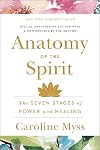
Having first read Anatomy of the Spirit in 2021, I was excited to revisit it in audiobook form—and it absolutely delivered. The narrator does a wonderful job, bringing clarity and calm to a text that’s dense with wisdom. Her voice made the listening experience smooth and engaging, making it easier to absorb the book’s profound spiritual insights.
Caroline Myss weaves together teachings from Christianity, Kabbalah, and Hinduism to explore the deep connection between our spiritual beliefs show more and physical health. The book is rich with information, yet accessible—offering practical ways to apply spiritual principles to the real, often messy circumstances of everyday life.
Listening to it this time around, I appreciated new layers I hadn’t noticed before. It’s the kind of book that rewards multiple readings—or listenings—and the audio format is an excellent way to take in the material, especially for anyone on a healing journey or seeking a more integrated view of body and spirit.
Highly recommended for those interested in mind-body-spirit healing, especially in audiobook format where the narration truly enhances the message.
Thank you to NetGalley and SoundsTrue Audiobooks for this ARC show less
Caroline Myss weaves together teachings from Christianity, Kabbalah, and Hinduism to explore the deep connection between our spiritual beliefs show more and physical health. The book is rich with information, yet accessible—offering practical ways to apply spiritual principles to the real, often messy circumstances of everyday life.
Listening to it this time around, I appreciated new layers I hadn’t noticed before. It’s the kind of book that rewards multiple readings—or listenings—and the audio format is an excellent way to take in the material, especially for anyone on a healing journey or seeking a more integrated view of body and spirit.
Highly recommended for those interested in mind-body-spirit healing, especially in audiobook format where the narration truly enhances the message.
Thank you to NetGalley and SoundsTrue Audiobooks for this ARC show less
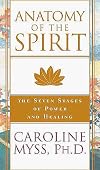
Having first read Anatomy of the Spirit in 2021, I was excited to revisit it in audiobook form—and it absolutely delivered. The narrator does a wonderful job, bringing clarity and calm to a text that’s dense with wisdom. Her voice made the listening experience smooth and engaging, making it easier to absorb the book’s profound spiritual insights.
Caroline Myss weaves together teachings from Christianity, Kabbalah, and Hinduism to explore the deep connection between our spiritual beliefs show more and physical health. The book is rich with information, yet accessible—offering practical ways to apply spiritual principles to the real, often messy circumstances of everyday life.
Listening to it this time around, I appreciated new layers I hadn’t noticed before. It’s the kind of book that rewards multiple readings—or listenings—and the audio format is an excellent way to take in the material, especially for anyone on a healing journey or seeking a more integrated view of body and spirit.
Highly recommended for those interested in mind-body-spirit healing, especially in audiobook format where the narration truly enhances the message.
Thank you to NetGalley and SoundsTrue Audiobooks for this ARC. show less
Caroline Myss weaves together teachings from Christianity, Kabbalah, and Hinduism to explore the deep connection between our spiritual beliefs show more and physical health. The book is rich with information, yet accessible—offering practical ways to apply spiritual principles to the real, often messy circumstances of everyday life.
Listening to it this time around, I appreciated new layers I hadn’t noticed before. It’s the kind of book that rewards multiple readings—or listenings—and the audio format is an excellent way to take in the material, especially for anyone on a healing journey or seeking a more integrated view of body and spirit.
Highly recommended for those interested in mind-body-spirit healing, especially in audiobook format where the narration truly enhances the message.
Thank you to NetGalley and SoundsTrue Audiobooks for this ARC. show less
i could rave forever about this book. the author is a medical intuitive (someone who can read someone's energy and determine their illness). she explores seven sacred truths and how each truth is related to a specific chakra, sacrament and tree of life. it was really interesting the way she weaves all of the spiritual information from different traditions to distill universal truths. the case histories were astounding. the first part of the book she gives her history, how she discovered her show more gift and the journey she has taken from the early days to the present. then each chapter focuses on one chakra. she delves deeply into the energy of each chakra and how it relates to its corresponding sacrament/tree of life and at the end of each chapter are self-examination questions. it was such an enlightening and life-changing book. she says our biography is our biology and we can't separate our spirits from our bodies or from our experiences. every experience, thought, emotion is stored in our energy, in our spirit and can create blocks, which are the source of our illnesses and dis-ease. show less
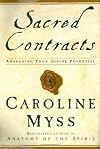
I am about to review a book that I have not read. Oh, I have read around in it many times, but I have never read it start to finish, and I’m quite sure I have never read it all. I have quarreled with it often, finding it a cross between pop psychology and New Age spirituality and not a particularly brilliant example of either. So why would I want to review it?
Because it led me to some very meaningful insights about myself, helping me view my life as a whole in new and reassuring ways. It show more has stimulated as much or more personal writing on my part than any book I own, personal writing that is especially significant to me. On a whole shelf of books that I have labeled personal mythology, I would count it as one of the two or three most provocative. The book is Sacred Contracts: Awakening Your Divine Potential by Caroline Myss (Harmony Books, 2001).
A sacred contract, if I understand Myss correctly, is simply a plan for one’s life, an active determination to fulfill one’s divine potential. “You are about to embark on a journey,” she says, “into the archetypal dimension of life, a dimension of consciousness that contains all of us collectively and yet somehow also individually.” And there, for me, is the key word to implementing Myss’s most helpful process of self-examination: “archetypal.” Clearly, she understands those archetypes as having been derived from one’s divine pre-existence, or perhaps in an earlier life before reincarnation. Never mind. As she admits early on, “If you do not choose to believe in a literal prebirth contract, or in reincarnation, or even in the power of grace, you might want to view your life metaphorically . . . ,” or one might say, as the working out of basic archetypes shaped by one’s genetic code, early childhood experiences, conscious decision-making, and/or intuitive grasp of one’s identity.
It’s her archetypes that are illuminating. Discovering or choosing one’s archetypes and having “conversations” with them is a powerful, insightful way to come to terms with one’s personal integrity—that is, the wholeness of one’s life experience and personal mission. She insists that you identify twelve archetypes, as in the twelve signs of the zodiac. What I found for myself were basic types that grew out of different phases of my life. I found her fourth and fifth chapters most enjoyable: “Speaking Archetypes: Your Four Principal Energy Companions” and “Identifying Your Archetypal Patterns.” At first, I thought of it simply as a game, a pastime to divert me attention from concerns of the day, like a crossword puzzle or solitaire. Then I began to feel the insights arising within my consciousness. As I look back now, some five years later, I am still amazed at the clarity with which I began to perceive the patterns in my life.
First, let me share with you a few of the archetypes Myss has identified in herself and/or her clients:
Addict (conspicuous consumer, glutton, workaholic)
Athlete (Olympian)
Child—an orphan child, or wounded child, or innocent child, or eternal child
Clown (court jester, fool, dummling)
Companion (sidekick, right arm, consort, friend)
Don Juan (Casanova, gigolo, seducer, sex addict)
Father or Mother (patriarch or matriarch, progenitor, Mother Nature, parent)
King or Queen (emperor or empress, ruler, leader, chief)
Midas (miser)
Seeker (wanderer, vagabond, nomad)
Trickster (Puck, provocateur)
Warrior ( soldier, crime fighter, Amazon, mercenary, soldier of fortune, gunslinger, Samurai)
The list goes on . . . . As you can see, these are indeed metaphors for basic personality types or dimensions of one’s character. Myss requires (if you follow the rules of her game) that four archetypes are universal and characterize all of us: child, victim, prostitute, saboteur. This was one spot where I quarreled with her generalizations. Except for Saboteur, which I found as definitely one of my most insistent archetypes (one that I had not consciously admitted to myself previously), I found myself redefining each of these. But, I have to confess, that the redefinitions worked very well: Orphan (not literally, you understand), Huckster (OK, maybe that’s just a cleaner way to say prostitute), and Exile (the nature of my victimhood).
The next step in Myss’s process is to hold—in one’s journal—a conversation with each “speaking” archetype. Again, she provides a host of helpful and revealing questions: historical questions, personal questions, energy and intuitive questions, and spiritual questions. For example,
Why did you choose this archetype? / “Why did I choose you?”
What fears and challenges do you associate with this archetype? / “What do you make me afraid of?”
How does this archetype factor into the unfinished business in your life? “How can you (or my understanding of you) help me take care of unfinished business?”
What have you come to know about yourself through this archetype? / “What are the most important lessons that you have taught me?”
Granted, these are simple, common-sense questions that one could ask oneself. But I found the division of myself into twelve basic persons helped me understand myself, appreciate myself, and yes, forgive myself and challenge myself.
Myss’s Sacred Contracts goes on into much more complex strategies: charting one’s chakras, reinventing the wheel of one’s life (like the zodiac again), using the wheel for everyday challenges or for self-healing. Maybe I will give that a shot one of these days. In the meantime, I have felt pleased and rewarded by the game she had me play.
Oh, yes, I discovered within myself an idolater, a hermit, a herald, a husbandman, even an emperor (with clothes on, I hope). But there is still that orphan and exile within me, to be dealt with every day; and the huckster and the saboteur, selling my soul and sabotaging my best efforts. Learning who they are, how they work, and why their efforts are sometimes in my best interests—that’s an archetypal pilgrimage that one needs to embark upon at least once in one’s life.
Bon voyage! show less
Because it led me to some very meaningful insights about myself, helping me view my life as a whole in new and reassuring ways. It show more has stimulated as much or more personal writing on my part than any book I own, personal writing that is especially significant to me. On a whole shelf of books that I have labeled personal mythology, I would count it as one of the two or three most provocative. The book is Sacred Contracts: Awakening Your Divine Potential by Caroline Myss (Harmony Books, 2001).
A sacred contract, if I understand Myss correctly, is simply a plan for one’s life, an active determination to fulfill one’s divine potential. “You are about to embark on a journey,” she says, “into the archetypal dimension of life, a dimension of consciousness that contains all of us collectively and yet somehow also individually.” And there, for me, is the key word to implementing Myss’s most helpful process of self-examination: “archetypal.” Clearly, she understands those archetypes as having been derived from one’s divine pre-existence, or perhaps in an earlier life before reincarnation. Never mind. As she admits early on, “If you do not choose to believe in a literal prebirth contract, or in reincarnation, or even in the power of grace, you might want to view your life metaphorically . . . ,” or one might say, as the working out of basic archetypes shaped by one’s genetic code, early childhood experiences, conscious decision-making, and/or intuitive grasp of one’s identity.
It’s her archetypes that are illuminating. Discovering or choosing one’s archetypes and having “conversations” with them is a powerful, insightful way to come to terms with one’s personal integrity—that is, the wholeness of one’s life experience and personal mission. She insists that you identify twelve archetypes, as in the twelve signs of the zodiac. What I found for myself were basic types that grew out of different phases of my life. I found her fourth and fifth chapters most enjoyable: “Speaking Archetypes: Your Four Principal Energy Companions” and “Identifying Your Archetypal Patterns.” At first, I thought of it simply as a game, a pastime to divert me attention from concerns of the day, like a crossword puzzle or solitaire. Then I began to feel the insights arising within my consciousness. As I look back now, some five years later, I am still amazed at the clarity with which I began to perceive the patterns in my life.
First, let me share with you a few of the archetypes Myss has identified in herself and/or her clients:
Addict (conspicuous consumer, glutton, workaholic)
Athlete (Olympian)
Child—an orphan child, or wounded child, or innocent child, or eternal child
Clown (court jester, fool, dummling)
Companion (sidekick, right arm, consort, friend)
Don Juan (Casanova, gigolo, seducer, sex addict)
Father or Mother (patriarch or matriarch, progenitor, Mother Nature, parent)
King or Queen (emperor or empress, ruler, leader, chief)
Midas (miser)
Seeker (wanderer, vagabond, nomad)
Trickster (Puck, provocateur)
Warrior ( soldier, crime fighter, Amazon, mercenary, soldier of fortune, gunslinger, Samurai)
The list goes on . . . . As you can see, these are indeed metaphors for basic personality types or dimensions of one’s character. Myss requires (if you follow the rules of her game) that four archetypes are universal and characterize all of us: child, victim, prostitute, saboteur. This was one spot where I quarreled with her generalizations. Except for Saboteur, which I found as definitely one of my most insistent archetypes (one that I had not consciously admitted to myself previously), I found myself redefining each of these. But, I have to confess, that the redefinitions worked very well: Orphan (not literally, you understand), Huckster (OK, maybe that’s just a cleaner way to say prostitute), and Exile (the nature of my victimhood).
The next step in Myss’s process is to hold—in one’s journal—a conversation with each “speaking” archetype. Again, she provides a host of helpful and revealing questions: historical questions, personal questions, energy and intuitive questions, and spiritual questions. For example,
Why did you choose this archetype? / “Why did I choose you?”
What fears and challenges do you associate with this archetype? / “What do you make me afraid of?”
How does this archetype factor into the unfinished business in your life? “How can you (or my understanding of you) help me take care of unfinished business?”
What have you come to know about yourself through this archetype? / “What are the most important lessons that you have taught me?”
Granted, these are simple, common-sense questions that one could ask oneself. But I found the division of myself into twelve basic persons helped me understand myself, appreciate myself, and yes, forgive myself and challenge myself.
Myss’s Sacred Contracts goes on into much more complex strategies: charting one’s chakras, reinventing the wheel of one’s life (like the zodiac again), using the wheel for everyday challenges or for self-healing. Maybe I will give that a shot one of these days. In the meantime, I have felt pleased and rewarded by the game she had me play.
Oh, yes, I discovered within myself an idolater, a hermit, a herald, a husbandman, even an emperor (with clothes on, I hope). But there is still that orphan and exile within me, to be dealt with every day; and the huckster and the saboteur, selling my soul and sabotaging my best efforts. Learning who they are, how they work, and why their efforts are sometimes in my best interests—that’s an archetypal pilgrimage that one needs to embark upon at least once in one’s life.
Bon voyage! show less
Lists
Awards

You May Also Like


Associated Authors
Statistics
- Works
- 97
- Also by
- 3
- Members
- 5,973
- Popularity
- #4,130
- Rating
- 3.8
- Reviews
- 62
- ISBNs
- 288
- Languages
- 17
- Favorited
- 9


