
Simon W. Bowmaker
Author of Economics Uncut: A Complete Guide to Life, Death and Misadventure
About the Author
Image credit: https://www.stern.nyu.edu/faculty/bio/simon-bowmaker
Works by Simon W. Bowmaker
Tagged
Common Knowledge
Members
Reviews
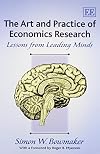
So incredibly interesting! And useful! It has researchers from all four major divisions, theoretical/empirical and micro/macro, represented. From this macro theorist’s point of view, highlights include Robert Lucas, Thomas Sargent, and Randy Wright, but there are tons of other economists from all over the map, e.g., Steven Levitt.
It is fascinating to see what almost everyone agrees on, e.g., the importance of social networks in the profession, as well as things that they don't all agree show more on, e.g., whether it's best to work on just one or two research projects at the same time, for focus, or whether it's better to have a lot of things going on so you can switch when you get bored with one paper (which, let's face it, happens after a while).
There is also some disagreement about the importance of technique, i.e., math, versus just generating interesting research questions and finding a way to come at them, e.g., finding good instruments for a variable or good natural experiments to get exogenous random variation in relevant variables. My overall impression is that the empirical crowd tends to focus less on the role of technique than theorists.
While we're on the subject, my opinion is that beyond the basics, your analytical toolkit should be driven by your questions. E.g., you're going to be using more fixed-point theorems if you do game theory; more dynamics if you do adaptive learning theory. So beyond the basics - calc and linear algebra - your toolkit should be assembled pragmatically, according to need. For example, I would ignore the commonly-heard advice to cram an analysis course into your time at grad school, unless you have specific reason to think it will actually help you in your particular research. And as I’ve said before, in my review of the Stokey-Lucas-Prescott textbook, don’t load up on the Bellman Equation stuff unless you have some reason to think you’ll actually use it.
Bonus: Reading other economists talking about their research gets you amped up; it makes you want to leap out of your chair and get back to work.
Overall, fantastic book; if you’re a researcher or grad student, buy it. show less
It is fascinating to see what almost everyone agrees on, e.g., the importance of social networks in the profession, as well as things that they don't all agree show more on, e.g., whether it's best to work on just one or two research projects at the same time, for focus, or whether it's better to have a lot of things going on so you can switch when you get bored with one paper (which, let's face it, happens after a while).
There is also some disagreement about the importance of technique, i.e., math, versus just generating interesting research questions and finding a way to come at them, e.g., finding good instruments for a variable or good natural experiments to get exogenous random variation in relevant variables. My overall impression is that the empirical crowd tends to focus less on the role of technique than theorists.
While we're on the subject, my opinion is that beyond the basics, your analytical toolkit should be driven by your questions. E.g., you're going to be using more fixed-point theorems if you do game theory; more dynamics if you do adaptive learning theory. So beyond the basics - calc and linear algebra - your toolkit should be assembled pragmatically, according to need. For example, I would ignore the commonly-heard advice to cram an analysis course into your time at grad school, unless you have specific reason to think it will actually help you in your particular research. And as I’ve said before, in my review of the Stokey-Lucas-Prescott textbook, don’t load up on the Bellman Equation stuff unless you have some reason to think you’ll actually use it.
Bonus: Reading other economists talking about their research gets you amped up; it makes you want to leap out of your chair and get back to work.
Overall, fantastic book; if you’re a researcher or grad student, buy it. show less
Statistics
- Works
- 4
- Members
- 28
- Popularity
- #471,396
- Rating
- 4.0
- Reviews
- 1
- ISBNs
- 13