
David Herbert Donald (1920–2009)
Author of Lincoln
About the Author
Pulitzer Prize-winning biographer and historian David Herbert Donald was born October 1, 1920 in Goodman, Miss. He married Aida DiPace in 1955, they had one child, Bruce Randall. He received an A.B. in 1941 from Millsaps College; an A.M. in 1942, and a Ph.D. from the University of Illinois in 1946. show more Donald has been an associate professor of history at Smith College and a professor of history at Columbia University; Princeton University and Johns Hopkins University. He was also Harry C. Warren Professor of American History, chair of the graduate program in American civilization, and professor emeritus at Harvard University. Much of Donald's work involves exploring and interpreting the American Civil War and its central figure, Abraham Lincoln. Some recent works includes Look Homeward: A Life of Thomas Wolfe, Lincoln, and Charles Sumner and the Coming of the Civil War, 1996. He received Pulitzer Prizes in biography for both Charles Sumner and Look Homeward. (Bowker Author Biography) show less
Disambiguation Notice:
This is the author page for David Herbert Donald, the historian and biographer. There is a separate author page for David Donald, the expert in military aviation history. Please do not combine the two. Thank you.
Series
Works by David Herbert Donald
Associated Works
Booknotes: America's Finest Authors on Reading, Writing, and the Power of Ideas (1997) — Contributor — 458 copies, 5 reviews
MHQ: The Quarterly Journal of Military History — Winter 1996 (1995) — Author "Lincoln Takes Charge" — 16 copies
Tagged
Common Knowledge
- Legal name
- Donald, David Herbert
- Other names
- Herbert, D. D.
- Birthdate
- 1920-10-01
- Date of death
- 2009-05-17
- Gender
- male
- Education
- University of Illinois (MA|1942|Ph.D|1946)
Milsaps College (BA|1941) - Occupations
- historian
professor - Organizations
- Harvard University
Johns Hopkins University
Columbia University
Smith College
American Historical Association
Society of American Historians (show all 8)
Organization of American Historians
Southern Historical Association - Awards and honors
- Pulitzer Prize (1961, 1988)
Bruce Catton Prize for Lifetime Achievement (2006)
Order of Lincoln (2008)
Golden Plate Award (1997)
Richard Nelson Current Award of Achievement (2000)
Lincoln Prize (1996) (show all 11)
Phi Kappa Phi
Pi Kappa Delta
Pi Kappa Alpha
Omicron Delta Kappa
Phi Beta Kappa - Relationships
- Donald, Bruce (son)
Donald, Aida D. (spouse) - Cause of death
- heart failure
- Nationality
- USA
- Birthplace
- Goodman, Mississippi, USA
- Places of residence
- Lincoln, Massachusetts, USA
Wellfleet, Massachusetts, USA
Key West, Florida, USA - Place of death
- Boston, Massachusetts, USA
- Burial location
- Lincoln Cemetery, Lincoln, Massachusetts, USA
- Disambiguation notice
- This is the author page for David Herbert Donald, the historian and biographer. There is a separate author page for David Donald, the expert in military aviation history. Please do not combine the two. Thank you.
- Associated Place (for map)
- Massachusetts, USA
Members
Reviews

Engaging biography of a man who was plucked from obscurity—though he liked to say he never lost a direct election, his most recent political adventure had been losing a senatorial race to Stephen Douglas—and evolved into one of our most revered presidents. Donald paints a picture of a man who had a strong core that enabled him to get past some initial missteps; a determined learner who always felt a little insecure about his lack of formal education, but would do as much work as show more necessary to master a task; and a gentle person who nonetheless survived a political culture so toxic that it actually turned into civil war. Bonus: as pundits have always done, pundits announced that his political career was over after he lost the Senate race to Douglas. In some ways the main lesson of American political history is: never listen to anyone who tells you “X’s career is over.” show less
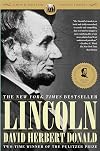
This was hailed as the biography for its generation when it appeared in 1995, but I waited until a generation elapsed (26 years) before reading it. It remains an impressive read.
In its outline, the book presents a familiar story. While still in grade school, in the years leading up to the centennial of the Civil War, I'd read Lincoln biographies in both the Childhood of Famous Americans and Landmark series, Jim Bishop's Night Lincoln Was Shot, and several books about the war. But Donald show more started fresh and researched thoroughly, emphasizing primary sources, including newly-available records from Lincoln's law practice. He combined this with a mastery of narrative flow so that the book, although detailed, makes a quick read.
More than half of the book is devoted to Lincoln's four years as president, which seems fitting. After all, it was those years that made the man memorable.
I increasingly feel that one's experience of a book depends on when one reads it. Of course, this is true of the time in one's personal life, but it was also poignant to read this book in light of the recent past's acrimonious political discourse. It's easy to forget the torrent of abuse that poured over Lincoln, given the apotheosis he underwent after his death. It helps put the unreasoning calumny we hear daily in perspective; nothing new under the sun. I'm not sure whether that's comforting, though.
Donald's conviction of Lincoln's greatness doesn't mislead him into whitewashing the man. It had never been so clear to me how Lincoln was hobbled by bringing no executive experience to the job of being president. He often seemed to be improvising, stumbling. The vexed relation with generals, which I had assumed was the generals' fault, turns out, on this reading, to have been a problem for which Lincoln was in part responsible. He wasn't very good at staffing and then meddled unhelpfully, all the while thinking he was loyal to his choices, even when they turned out not to have been good ones.
Donald not only presents a well-researched and smoothly-written narrative, but he also conveys a sense of Lincoln the man. I was fascinated by the character of Lincoln, with its mix of ambition and passivity. In addition, he manifests the paradox of genuine, folksy humility alongside an abiding conviction of his own superiority. I came to realize that this was no contradiction: it was precisely his belief in his own mental and moral excellence that permitted him to freely own up to his errors. Finally, I was struck that Lincoln, as a young man, chose politics and law as a career path simply because they were the last two options open to him after failing at everything else. Still, he proved a good fit at both.
The book ends with the sudden impact of an assassin's bullet. There is no recounting of the aftermath. This is in line with the author's overall narrative strategy: to write a sharply focused biography, filling in no more context than necessary to tell the life. show less
In its outline, the book presents a familiar story. While still in grade school, in the years leading up to the centennial of the Civil War, I'd read Lincoln biographies in both the Childhood of Famous Americans and Landmark series, Jim Bishop's Night Lincoln Was Shot, and several books about the war. But Donald show more started fresh and researched thoroughly, emphasizing primary sources, including newly-available records from Lincoln's law practice. He combined this with a mastery of narrative flow so that the book, although detailed, makes a quick read.
More than half of the book is devoted to Lincoln's four years as president, which seems fitting. After all, it was those years that made the man memorable.
I increasingly feel that one's experience of a book depends on when one reads it. Of course, this is true of the time in one's personal life, but it was also poignant to read this book in light of the recent past's acrimonious political discourse. It's easy to forget the torrent of abuse that poured over Lincoln, given the apotheosis he underwent after his death. It helps put the unreasoning calumny we hear daily in perspective; nothing new under the sun. I'm not sure whether that's comforting, though.
Donald's conviction of Lincoln's greatness doesn't mislead him into whitewashing the man. It had never been so clear to me how Lincoln was hobbled by bringing no executive experience to the job of being president. He often seemed to be improvising, stumbling. The vexed relation with generals, which I had assumed was the generals' fault, turns out, on this reading, to have been a problem for which Lincoln was in part responsible. He wasn't very good at staffing and then meddled unhelpfully, all the while thinking he was loyal to his choices, even when they turned out not to have been good ones.
Donald not only presents a well-researched and smoothly-written narrative, but he also conveys a sense of Lincoln the man. I was fascinated by the character of Lincoln, with its mix of ambition and passivity. In addition, he manifests the paradox of genuine, folksy humility alongside an abiding conviction of his own superiority. I came to realize that this was no contradiction: it was precisely his belief in his own mental and moral excellence that permitted him to freely own up to his errors. Finally, I was struck that Lincoln, as a young man, chose politics and law as a career path simply because they were the last two options open to him after failing at everything else. Still, he proved a good fit at both.
The book ends with the sudden impact of an assassin's bullet. There is no recounting of the aftermath. This is in line with the author's overall narrative strategy: to write a sharply focused biography, filling in no more context than necessary to tell the life. show less

David Herbert Donald earned a Pulitzer for some of his other works, and he should have earned it for this one. It is a great, grand biography of Lincoln, and probably the best single-volume biography of Lincoln extant. It is a better update of Sandburg's and better than Jon Meacham's recent volume. (My only caveat is that I have not yet read A. Lincoln by Ronald C. White.)
Donald has a big focus on politics, from the nitty gritty of campaigning to the ideas. It is well-written and covers show more everything in fine fashion. It endeavors o take things only from Lincoln's perspective, and thus ends abruptly with his death. (What happened to Robert? Tad? Mary? You must look elsewhere. Reconstruction? Elsewhere. Legacy? Elsewhere.) But, it was one of the first of the Lincoln biographies to cover his changing faith fairly well. Donald covers Lincoln's evolving ideas on slavery (and colonization), particularly his conservative, go-slow approach. A good bit too (more than Meacham, for instance) on his career a lawyer. Herndon and Sumner appear as major characters (Donald wrote books on them too, so it is only fitting he uses them as lenses to understand Lincoln.) show less
Donald has a big focus on politics, from the nitty gritty of campaigning to the ideas. It is well-written and covers show more everything in fine fashion. It endeavors o take things only from Lincoln's perspective, and thus ends abruptly with his death. (What happened to Robert? Tad? Mary? You must look elsewhere. Reconstruction? Elsewhere. Legacy? Elsewhere.) But, it was one of the first of the Lincoln biographies to cover his changing faith fairly well. Donald covers Lincoln's evolving ideas on slavery (and colonization), particularly his conservative, go-slow approach. A good bit too (more than Meacham, for instance) on his career a lawyer. Herndon and Sumner appear as major characters (Donald wrote books on them too, so it is only fitting he uses them as lenses to understand Lincoln.) show less
No American political figure, aside from perhaps Washington, is as revered as Lincoln. His steady stewardship through the country's darkest years, not to mention his successful implementation of the 13th amendment, has earned him a consistent place either at the top or near the top of historical rankings.
David Herbert Donald's biography does not shy away from the legend of Lincoln. Truly, his political leadership and humanity have earned him that distinction. However, Donald also adds more show more context and nuance to the man who has become myth. Everything from his depression, to his tempestuous relationship with Mary Todd Lincoln, to his tendency toward moderation, to his final year are laid bare in this book.
It's this dedication to understanding Lincoln as a person that helps make Lincoln such a compelling and important read. show less
David Herbert Donald's biography does not shy away from the legend of Lincoln. Truly, his political leadership and humanity have earned him that distinction. However, Donald also adds more show more context and nuance to the man who has become myth. Everything from his depression, to his tempestuous relationship with Mary Todd Lincoln, to his tendency toward moderation, to his final year are laid bare in this book.
It's this dedication to understanding Lincoln as a person that helps make Lincoln such a compelling and important read. show less
Lists
Awards


You May Also Like


Associated Authors
Statistics
- Works
- 24
- Also by
- 10
- Members
- 6,464
- Popularity
- #3,801
- Rating
- 4.1
- Reviews
- 47
- ISBNs
- 95
- Languages
- 1
- Favorited
- 8
