
Ethan Tapper
Author of How to Love a Forest: The Bittersweet Work of Tending a Changing World
Works by Ethan Tapper
Tagged
Common Knowledge
Members
Reviews

The title of Mr. Tapper's book was intriguing, though I wasn't quite sure what to expect...I read it straight through one afternoon when I "should" have been doing laundry! Having always considered myself y "Forest Liker" I'm now a Forest Lover. Mr. Tapper has written an informative and unique book on a subject that most authors likely wouldn't attempt, nor even think of. Thought provoking and a bit challenging as well...I came to understand that loving a Forest requires respect, yes. But show more also tough love, requiring difficult decisions made for the Forest's sake. For the future ecological success, sustenance and survival. The adaptation of ideas and practices, the ability to see just how and why they are necessary now. Today. To love his Forest properly Mr. Tapper must holdfast to his wooded truths, do today's work never loosing sight of the potential harm should he quit, stop caring or fail. What a beautifully written tribute to a part of nature I'd long taken for granted. Read it!! show less
 This review was written for LibraryThing Early Reviewers.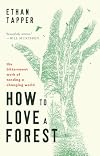
Summary: A forester buys a piece of Vermont forest that had been mismanaged and implements restorative practices.
Ethan Tapper is a consulting forester and service forester in Vermont. He’s worked with both public and privately owned land, consulting with landowners on the best management practices. He’s had to navigate the space between commercial loggers who will log all but the diseased trees and environmentalists who want nothing to be done. The reality is that forests have been show more mismanaged and won’t recover on their own.
In 2017, Tapper put his money where his mouth was and bought a piece of mismanaged forest on what he named Bear Island. In much of the book, he recounts his walks through the forest and his actions to care for it. Surprisingly, he has a chainsaw in hand much of the time. He writes, “I truly understand how the cutting of a tree could be an expression of compassion and humility an act of healing, an act of love.” So, we walk with him as he cuts down diseased beech trees and sprays invasive plants. Opening up the forest to new growth. Planting oaks and maples. And hunting does to reduce the deer population that ravages the forest.
He traces the history of the land from indigenous peoples to early settlers, farmers and herders, loggers, and the coming of the construction of subdivisions. Then he goes below ground and acquaints us with the Wood Wide Web, the network of roots and microorganisms underground, working as a communicative and life-restoring system. Along the way, we observe a fallen tree and the processes of decay that bring about new life. But not all is new. We encounter wolf trees, ancient survivors of the centuries. Finally, we walk with him as he plants acorn into a patch cut.
One of the most moving chapters is his visit to a landowner after a big windstorm. The wind blew down whole stand of pines. A favorite old maple–a wolf tree–has split in two. The owner can see only devastation of forest she loved. But Tepper tries to help her envision the new life that will run riot in this place, the resilience of the forest.
Resilience and responsibility. We learn that these two go hand in hand. On one hand, forests are marvelous ecosystems. Yet human mismanagement and disease invite Tapper to exercise responsible care. Cutting, killing, pruning, and planting intelligently, working with the ways of the forest. All of these are part of Tepper’s work as a member of perhaps the ultimate keystone species. Tepper does not write from a Christian perspective. Yet he exercises the responsible dominion and care of tending and guarding this forest garden (Genesis 2:15). Instead of leaving it alone, his care enables it to flourish. Tepper expresses it in this way:
“Someday I will teach my children that this world is not ours to hold but that we hold it anyway, that each of us is a steward for one brief and precious moment in time. In our short lives, we must learn to pair power and freedom with humility, to embody responsibility and relationship, even when it breaks our heart.”
Tepper writes eloquently, expressing knowledge in the form of deep compassion for the forests of Bear Island. Not only that, we read the commitment that tends for a future he will not see. But is not this the kind of thinking we all must embrace? Thus, Tepper’s story serves as a kind of parable for us all, whether it is forest or farm or suburban lot that we love and care for. show less
Ethan Tapper is a consulting forester and service forester in Vermont. He’s worked with both public and privately owned land, consulting with landowners on the best management practices. He’s had to navigate the space between commercial loggers who will log all but the diseased trees and environmentalists who want nothing to be done. The reality is that forests have been show more mismanaged and won’t recover on their own.
In 2017, Tapper put his money where his mouth was and bought a piece of mismanaged forest on what he named Bear Island. In much of the book, he recounts his walks through the forest and his actions to care for it. Surprisingly, he has a chainsaw in hand much of the time. He writes, “I truly understand how the cutting of a tree could be an expression of compassion and humility an act of healing, an act of love.” So, we walk with him as he cuts down diseased beech trees and sprays invasive plants. Opening up the forest to new growth. Planting oaks and maples. And hunting does to reduce the deer population that ravages the forest.
He traces the history of the land from indigenous peoples to early settlers, farmers and herders, loggers, and the coming of the construction of subdivisions. Then he goes below ground and acquaints us with the Wood Wide Web, the network of roots and microorganisms underground, working as a communicative and life-restoring system. Along the way, we observe a fallen tree and the processes of decay that bring about new life. But not all is new. We encounter wolf trees, ancient survivors of the centuries. Finally, we walk with him as he plants acorn into a patch cut.
One of the most moving chapters is his visit to a landowner after a big windstorm. The wind blew down whole stand of pines. A favorite old maple–a wolf tree–has split in two. The owner can see only devastation of forest she loved. But Tepper tries to help her envision the new life that will run riot in this place, the resilience of the forest.
Resilience and responsibility. We learn that these two go hand in hand. On one hand, forests are marvelous ecosystems. Yet human mismanagement and disease invite Tapper to exercise responsible care. Cutting, killing, pruning, and planting intelligently, working with the ways of the forest. All of these are part of Tepper’s work as a member of perhaps the ultimate keystone species. Tepper does not write from a Christian perspective. Yet he exercises the responsible dominion and care of tending and guarding this forest garden (Genesis 2:15). Instead of leaving it alone, his care enables it to flourish. Tepper expresses it in this way:
“Someday I will teach my children that this world is not ours to hold but that we hold it anyway, that each of us is a steward for one brief and precious moment in time. In our short lives, we must learn to pair power and freedom with humility, to embody responsibility and relationship, even when it breaks our heart.”
Tepper writes eloquently, expressing knowledge in the form of deep compassion for the forests of Bear Island. Not only that, we read the commitment that tends for a future he will not see. But is not this the kind of thinking we all must embrace? Thus, Tepper’s story serves as a kind of parable for us all, whether it is forest or farm or suburban lot that we love and care for. show less
A professional forester, Ethan Tapper provides a deeply personal account of his experiences caring for the 'Wood Wide Web'. Tapper has a fairly unique approach to environmental consciousness. He has accepted that returning forests, long abused by clear-cutting trees, invasion of non-native species, and severe encroachment of humans on ancient forests to their ancient and abundant existence is not possible. His approach to loving a forest includes trimming out the unhealthy and exterminating show more the invasive species so that the remaining native trees can thrive. He acts as nature's executive assistant by planting individual acorns so that new life will slowly but inevitably live well into the future after he is gone. Tapper's prose provides plenty of helpful hints like "... you should prune an apple tree until you can throw a cat through it..." The author introduces readers to a world few have experienced with a deep care for his work as a forester and a love of his forests. I hope Tapper will follow up with another volume that continues the chronicle of his land's progression toward a new level of natural forest. show less
This review was written for LibraryThing Early Reviewers.This book is beautiful. Read it slowly and savor it. There is the story, of course: a memoir of a man who chooses a place to love. It's an old story in nature writing - Thoreau's story, and Abbey's, and Dillard's, and Leopold's, and many others who did not become so famous. But much less often does someone tell us what it means to choose a place to both love and transform with their labor. To tend, to steward. So Tapper makes you think.
But what surprised me was the richness of the language show more he uses to tell that story. I read the introduction while drinking my morning coffee. And then I realized that this was not a book to read casually, but one to read slowly, pen and notebook in hand, to notice and ponder the beautiful sentences that appear so frequently. show less
But what surprised me was the richness of the language show more he uses to tell that story. I read the introduction while drinking my morning coffee. And then I realized that this was not a book to read casually, but one to read slowly, pen and notebook in hand, to notice and ponder the beautiful sentences that appear so frequently. show less
This review was written for LibraryThing Early Reviewers.Lists
Awards

You May Also Like
Associated Authors
Statistics
- Works
- 2
- Members
- 88
- Popularity
- #209,355
- Rating
- 4.1
- Reviews
- 12
- ISBNs
- 6
