
Robert S. Ridgely
Author of A Guide to the Birds of Panama: With Costa Rica, Nicaragua, and Honduras
Works by Robert S. Ridgely
A Guide to the Birds of Panama: With Costa Rica, Nicaragua, and Honduras (1976) 107 copies, 2 reviews
Tagged
Common Knowledge
- Birthdate
- 1946-01-14
- Gender
- male
Members
Reviews
The Birds of South America: Volume 1: The Oscine Passerines (Ridgely, Robert S//Birds of South America) by Robert S. Ridgely
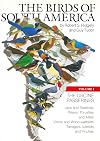
The South American continent supports an abundance of plant and animal species. Of the life forms, over 3,100 bird species are either resident or migrant. Many of them are endangered, and this volume provides a descriptive record of South American birds that will -- must -- encourage conservation of these magnificent species.
The volume takes, frankly, a museum approach. The authors have examined specimens of each subspecies, comparing them visually and trying to discern the patterns in their show more plumage variation, both intra- and inter-specifically. They look at bird systematics, reassessing relationships in light of new information. Perhaps most important, they combine morphological review and analysis with extensive field observations to give an accurate, incisive portrait of the birds in nature.
At a time when rapid development is devastating millions of acres of tropical habitat in South America, this record of an endangered resource becomes painful. We know and appreciate the suffering and extinctions our own migrations, predations, and breeding habits are causing. The Birds of South America is a major step toward correction.
Volume I includes the Jays and Swallows; Wrens, Thrushes, and Allies; Vireos and Wood-warblers; Tanagers, Icterids, and Finches. show less
The volume takes, frankly, a museum approach. The authors have examined specimens of each subspecies, comparing them visually and trying to discern the patterns in their show more plumage variation, both intra- and inter-specifically. They look at bird systematics, reassessing relationships in light of new information. Perhaps most important, they combine morphological review and analysis with extensive field observations to give an accurate, incisive portrait of the birds in nature.
At a time when rapid development is devastating millions of acres of tropical habitat in South America, this record of an endangered resource becomes painful. We know and appreciate the suffering and extinctions our own migrations, predations, and breeding habits are causing. The Birds of South America is a major step toward correction.
Volume I includes the Jays and Swallows; Wrens, Thrushes, and Allies; Vireos and Wood-warblers; Tanagers, Icterids, and Finches. show less
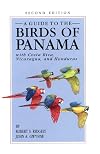
This is probably the most-used book for identifying birds in Panama. It's a large work because it also includes birds in other Central American countries: Nicaragua. Costa Rica, and Honduras.
This is my bread-and-butter guide, the first one I turn to when I am trying to identify birds. The coverage is extensive and the color plates are very good, although there are instances when the color does not match what you're seeing in your binoculars. But these divergences are rare.
Arrangement is as show more usual, by Order. Text pages include, for each bird listed: Description, Similar Species, Status and Distribution, Habitats, and Range. Of these, I would say that the Status and Distribution are not all that useful; the book was published in 1992, and there is much that needs updating. But it's still a start.
There are excellent introductory sections on Climate, Migration and Local Movements, a Checklist for Birds of Southern Middle America, and then a very helpful section (where it has not become out-of-date due to development in Chiriquí and around Panama City) on Finding Birds in Panama; this section gives directions for getting to places where listed birds can be found.
The Index has both scientific and English names, which is extremely useful.
Even though somewhat out-of-date, this is still the guide of choice for initial identification. It's too large and too heavy to be taken on outings, although many might want to put up with the incovenience because of a lack of other, smaller guides. show less
This is my bread-and-butter guide, the first one I turn to when I am trying to identify birds. The coverage is extensive and the color plates are very good, although there are instances when the color does not match what you're seeing in your binoculars. But these divergences are rare.
Arrangement is as show more usual, by Order. Text pages include, for each bird listed: Description, Similar Species, Status and Distribution, Habitats, and Range. Of these, I would say that the Status and Distribution are not all that useful; the book was published in 1992, and there is much that needs updating. But it's still a start.
There are excellent introductory sections on Climate, Migration and Local Movements, a Checklist for Birds of Southern Middle America, and then a very helpful section (where it has not become out-of-date due to development in Chiriquí and around Panama City) on Finding Birds in Panama; this section gives directions for getting to places where listed birds can be found.
The Index has both scientific and English names, which is extremely useful.
Even though somewhat out-of-date, this is still the guide of choice for initial identification. It's too large and too heavy to be taken on outings, although many might want to put up with the incovenience because of a lack of other, smaller guides. show less
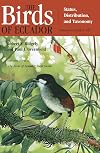
Unbelievably comprehensive book....now I just can't wait for my trip to Ecuador!
You May Also Like


Associated Authors
Statistics
- Works
- 12
- Members
- 370
- Popularity
- #65,127
- Rating
- 4.2
- Reviews
- 6
- ISBNs
- 22
- Languages
- 1
- Favorited
- 1