
Corinne J. Naden
Author of Ron's Big Mission
About the Author
Corinne J. Naden is the author, coauthor, or editor of more than 100 books, including Characters in Young Adult Literature (1997) and Romeo and Juliet: Shakespeare Explained (2009).
Series
Works by Corinne J. Naden
The Newbery Companion: Booktalk and Related Materials for Newbery Medal and Honor Books (1996) 16 copies
The Triangle Shirtwaist fire, March 25, 1911;: The blaze that changed an industry, (A Focus book) (1971) 12 copies
Chancellorsville to Appomattox: The Battles of 1863-1865 (The House Divided (The Civil War).) (1999) 10 copies
Civil War Ends: Assassination, Reconstruction, and the Aftermath (The House Divided (The Civil War).) (1999) 9 copies
The Haymarket Affair, Chicago, 1886: The Great Anarchist Riot and Trial (A Focus Book) (1968) 9 copies
The Newbery/Printz Companion: Booktalk and Related Materials for Award Winners and Honor Books Third Edition (Children's and Young Adult Literature Reference) (2006) 9 copies, 1 review
The Bloodiest Days: The Battles of 1861and 1862 (The House Divided (The Civil War).) (1999) 7 copies
Heroes Don't Just Happen: Biographies of Overcoming Bias and Building Character in Space (1996) 7 copies
Woodlands Around the World 3 copies
Heroes Don't Just Happen: Biographies of Overcoming Bias and Building Character in Sports (1995) 3 copies
Heroes Don't Just Happen: Biographies of Overcoming Bias and Building Character in Politics (1997) 3 copies
Rough Rider 2 copies
I CAN READ ABOUT CAVES 2 copies
Ancient Chinese and the Great Wall of China (Naden, Corinne J. Great Peoples and Their Claim to Fame.) (2003) 1 copy, 1 review
Heroes don't just happen : biographies of overcoming bias and building character in politics: my practice journal (1997) 1 copy
i can read about caves 1 copy
Heroes don't just happen : biographies of overcoming bias and building character: teacher's activity guide (1997) 1 copy
Heros Don't Just Happen: Biographies of Overcoming Bias and Building Character in Entertainment (1996) 1 copy
I Can Read About Caves 1 copy
Tagged
Common Knowledge
- Gender
- female
Members
Reviews

A fictionalized biographical account of an incident from the childhood of Ron McNair, scientist and astronaut, who, as a young African-American boy growing up in late 1950s South Carolina, was not allowed to check books out of the local public library (a privilege reserved only for whites), Ron's Big Mission enlightens and moves, with its story of bravery in the face of injustice. Although the sympathetic librarian is always friendly, and allows him to read to his heart's content, inside the show more library, and a kind local lady offers to check his books out for him, Ron is determined to get his own library card, and willing to go to extraordinary lengths, for a child of the 1950s, to get it...
A timely reminder that many of the most basic rights and privileges - things we now often take for granted - were unavailable to many American citizens (and not so long ago either) because of the color of their skin, this picture-book is inspiring! It is based upon a real incident in the life of a man who would grow up to be a physicist and astronaut, and one can't help but reflect that the same determination to learn that prompted him to defy his town's (and the nation's) unfair policies, must also have stood him in good stead, when pursuing an education and career. The illustrations here, done by Don Tate, are colorful and immediate, in a cartoon-like style. All in all, Ron's Big Mission is an excellent book, for introducing young readers to the wrongs of segregation, and the history of a brilliant man whose life was cut short in the tragic Challenger explosion. show less
A timely reminder that many of the most basic rights and privileges - things we now often take for granted - were unavailable to many American citizens (and not so long ago either) because of the color of their skin, this picture-book is inspiring! It is based upon a real incident in the life of a man who would grow up to be a physicist and astronaut, and one can't help but reflect that the same determination to learn that prompted him to defy his town's (and the nation's) unfair policies, must also have stood him in good stead, when pursuing an education and career. The illustrations here, done by Don Tate, are colorful and immediate, in a cartoon-like style. All in all, Ron's Big Mission is an excellent book, for introducing young readers to the wrongs of segregation, and the history of a brilliant man whose life was cut short in the tragic Challenger explosion. show less
Great story and lesson about integrity and spirit. Illustrations are clear and colorful. Story goes too quickly and feels like it could be developed more, but I really enjoyed the author's note and the history of Ron McNair at the end.
Rose Blue and Corinne J. Naden's picture book Ron's Big Mission, a fictionalised account of a real incident of space shuttle astronaut Ron McNair's childhood (Ron McNair was one of the seven astronauts who lost their lives in the 1986 Challenger explosion), shows how a simple, non-violent act of civil protest and courage against racially discriminatory regulations (and by a nine year old child, at that) can challenge racist attitudes, can change unjust and discriminatory rules and show more regulations.
I really enjoyed the narrative, the flow of this inspiring story; it is both engaging and informative, without being neither too melodramatic nor drily factual. Ron's Big Mission is also a loving and beautiful tribute to Ron McNair, who dreamed of becoming a pilot, an astronaut, and who started to make this dream start to become reality one day in 1959, when he boldly and confidently challenged the racially discriminatory policies of his local public library, making people realise and accept that all library patrons should be allowed to have a library card and be permitted to sign out books.
It is interesting and also somewhat heartening how a number of Lake City, South Carolina's white citizens, like Mrs. Fielding, for example, seem to be somewhat in agreement with Ron that the regulations not allowing African Americans to sign out library books are wrong and discriminatory, as they try to circumvent, to work around the rules by offering to sign out books for him. However, as positive, as caring as this might seem, Ron remains determined to obtain his very own library card (circumventing, working around discriminatory laws and rules might work as a temporary fix, but will not change the actual regulations, which remain in place and enforceable). Ron refusing to budge (even after the police has been called) finally causes Mrs. Scott, the librarian, to walk into her office and fill out a library card for him; the discriminatory regulations not allowing African Americans to sign books out of the library have thus not only been challenged, they have now been successfully challenged.
While, of course, it is Ron who originally challenges the discriminatory library rules of Lake City, standing up for what should be basic human rights (and literally, as he is standing on top of the library circulation desk), the role played by the librarian should also not be forgotten or underestimated. For it is Mrs. Scott who gives the discriminatory library rules their coup de grace by actually giving Ron McNair his very own library card. From now on, all library patrons, regardless of background or ethnicity, will be allowed to sign out books, will be permitted to take books home from the library.
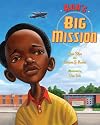
I'm a bit torn with regard to Don Tate's illustrations. I think that the colour scheme used and the general depiction of surroundings (buildings, cars, books, airplanes etc.) are descriptive, evocative and well executed, but that with Tate's human figures, the heads at times seem somewhat too large and round for the bodies (especially Ron and one of the policemen appear to have rather balloon-like heads balanced on very pencil-thin necks). I still quite enjoyed the illustrations and believe that they, for the most part, complement and mirror the narrative, but that some of the human figures do seem a bit disproportionate.
Finally, I also appreciate that while the text of Ron's Big Mission focuses on a particular episode in Ron McNair's childhood, the excellent author's note provides additional information, including the fact that Ron McNair was one of the Challenger astronauts. Parents reading this book with or to their children therefore have the option of discussing Ron McNair's career as an astronaut and the Challenger tragedy, or perhaps, simply focusing on the narrative itself and leaving that part for a later discussion, or for when their children are a bit older. show less
I really enjoyed the narrative, the flow of this inspiring story; it is both engaging and informative, without being neither too melodramatic nor drily factual. Ron's Big Mission is also a loving and beautiful tribute to Ron McNair, who dreamed of becoming a pilot, an astronaut, and who started to make this dream start to become reality one day in 1959, when he boldly and confidently challenged the racially discriminatory policies of his local public library, making people realise and accept that all library patrons should be allowed to have a library card and be permitted to sign out books.
It is interesting and also somewhat heartening how a number of Lake City, South Carolina's white citizens, like Mrs. Fielding, for example, seem to be somewhat in agreement with Ron that the regulations not allowing African Americans to sign out library books are wrong and discriminatory, as they try to circumvent, to work around the rules by offering to sign out books for him. However, as positive, as caring as this might seem, Ron remains determined to obtain his very own library card (circumventing, working around discriminatory laws and rules might work as a temporary fix, but will not change the actual regulations, which remain in place and enforceable). Ron refusing to budge (even after the police has been called) finally causes Mrs. Scott, the librarian, to walk into her office and fill out a library card for him; the discriminatory regulations not allowing African Americans to sign books out of the library have thus not only been challenged, they have now been successfully challenged.
While, of course, it is Ron who originally challenges the discriminatory library rules of Lake City, standing up for what should be basic human rights (and literally, as he is standing on top of the library circulation desk), the role played by the librarian should also not be forgotten or underestimated. For it is Mrs. Scott who gives the discriminatory library rules their coup de grace by actually giving Ron McNair his very own library card. From now on, all library patrons, regardless of background or ethnicity, will be allowed to sign out books, will be permitted to take books home from the library.
I'm a bit torn with regard to Don Tate's illustrations. I think that the colour scheme used and the general depiction of surroundings (buildings, cars, books, airplanes etc.) are descriptive, evocative and well executed, but that with Tate's human figures, the heads at times seem somewhat too large and round for the bodies (especially Ron and one of the policemen appear to have rather balloon-like heads balanced on very pencil-thin necks). I still quite enjoyed the illustrations and believe that they, for the most part, complement and mirror the narrative, but that some of the human figures do seem a bit disproportionate.
Finally, I also appreciate that while the text of Ron's Big Mission focuses on a particular episode in Ron McNair's childhood, the excellent author's note provides additional information, including the fact that Ron McNair was one of the Challenger astronauts. Parents reading this book with or to their children therefore have the option of discussing Ron McNair's career as an astronaut and the Challenger tragedy, or perhaps, simply focusing on the narrative itself and leaving that part for a later discussion, or for when their children are a bit older. show less
Summary:
This biography gives us a glimpse into the childhood of the astronaut Ron McNair. As a child Ron loved going to the library to read books about pilots, but because he was an African American he was never able to receive a library card to check out books. One morning Ron wakes up on a mission. We don not know what that mission is until he gets to the library and demands to check out some books. He is told he can't so he stands on the desk at the library until the librarian agrees to show more give him a library card.
Personal Summary:
I really enjoyed reading this book. I had no idea what Ron's mission was until he got to the library. I like that even though Ron grew up to be an astronaut, it really doesn't mention that in the book. I liked that the focus of this biography was on Ron's love for books.
Classroom Extension Ideas:
1. After reading the book with students tell them to imagine that they have been denied a library card and they can no longer check out books from the school library. Then have students write a paragraph or two trying to convince you why they should be allowed to have a library card.
2. Discuss with class how the story and Ron's life might have been different if he had never gotten that library card. show less
This biography gives us a glimpse into the childhood of the astronaut Ron McNair. As a child Ron loved going to the library to read books about pilots, but because he was an African American he was never able to receive a library card to check out books. One morning Ron wakes up on a mission. We don not know what that mission is until he gets to the library and demands to check out some books. He is told he can't so he stands on the desk at the library until the librarian agrees to show more give him a library card.
Personal Summary:
I really enjoyed reading this book. I had no idea what Ron's mission was until he got to the library. I like that even though Ron grew up to be an astronaut, it really doesn't mention that in the book. I liked that the focus of this biography was on Ron's love for books.
Classroom Extension Ideas:
1. After reading the book with students tell them to imagine that they have been denied a library card and they can no longer check out books from the school library. Then have students write a paragraph or two trying to convince you why they should be allowed to have a library card.
2. Discuss with class how the story and Ron's life might have been different if he had never gotten that library card. show less
Lists
Awards


You May Also Like


Associated Authors
Statistics
- Works
- 118
- Members
- 2,954
- Popularity
- #8,640
- Rating
- 4.1
- Reviews
- 53
- ISBNs
- 187
- Languages
- 1