
Alexander Afanasyev (1826–1871)
Author of Russian Fairy Tales
About the Author
Series
Works by Alexander Afanasyev
Russian Folktales from the Collection of A. Afanasyev: A Dual-Language Book (Dover Dual Language Russian) (2014) 24 copies
Os Melhores Contos de Fadas Eslavos (Coleção Áurea de Contos de Fadas) (Portuguese Edition) 8 copies
Поэтические воззрения славян на природу: Опыт сравнительного изучения славянских преданий и… (1995) 7 copies, 1 review
Das goldmähnige Pferd: Russische Zaubermärchen : aus der Sammlung von Alexander Afanasjew (Reclams Universal-Bibliothek) (German Edition) (1988) 6 copies
Sprookjes uit het oude Rusland 4 copies
Народные русские сказки 2 copies
The Flying Ship: A Russian Story 2 copies
Vassilissa e la Baba Jaga 1 copy
Le grandi fiabe russe 1 copy
Afanasjew 1 copy
Russian Fairy Tales. 1 copy
Народные русские сказки не для печати, заветные пословицы и поговорки, собранные и обработанные и… (1997) 1 copy
Народные Русские Сказки 1 copy
Народные русские сказки 1 copy
Русские сказки 1 copy
Русские народные сказки : Большое собрание народных русских сказок в одном томе / Александр… (2022) 1 copy
Trois Royaumes : contes populaires russes ; extraits du recueil d'Alexandre Afanassiev (1985) 1 copy
Cuentos fantásticos eslavos 1 copy
Baba Yaga e Vasilisa, A Bela 1 copy
Skazki 1 copy
Fiabe sul potere 1 copy
As mais belas fábulas russas 1 copy
Antiche Fiabe Russe. 1 copy
L'oiseau de feu 1 copy
Fiabe popolari russe 1 copy
Zaveštani tetreb 1 copy
Ruske narodne bajke 1 copy
Lisa i zhuravl' 1 copy
Associated Works
Russian Tales: Traditional Stories of Quests and Enchantments (2021) — Contributor — 132 copies, 1 review
Tales of the Sea: Traditional Stories of Magic and Adventure from around the World (2022) — Contributor — 70 copies, 1 review
The Princess Who Had Never Laughed [1986 Faerie Tale Theatre TV episode] (1986) — Original story — 5 copies
Tagged
Common Knowledge
- Canonical name
- Afanasyev, Alexander
- Legal name
- Афанасьев, Александр Николаевич
- Other names
- Афанасьев, А.Н.
Afanasyev, Alexander Nikolayevich - Birthdate
- 1826-07-23
- Date of death
- 1871-10-05
- Gender
- male
- Education
- Moscow University (Law)
- Occupations
- writer
journalist
folklorist - Short biography
- Alexander Nikolayevich Afanasyev was a Russian folklorist who recorded and published over 600 Russian folktales and fairytales. His first collection was published in eight volumes from 1855–67, earning him the reputation of a Russian counterpart to the Brothers Grimm.
Born in 1826 in Boguchar, in Voronezh Governate, he grew up in Bobrov. He was educated at the Voronezh gymnasium and from 1844-48 he studied law at the University of Moscow.
Afanasyev worked for thirteen years at the Moscow's Main Archive Directorate under the Ministry of Foreign Affairs of the Russian Empire. In 1862 he was fired from his position, eventually finding work as a secretary at the Moscow City Duma and at the Moscow Congress of Justices of the Peace.
He died in poverty in 1871, at the age of forty-five.
(source: Wikipedia) - Cause of death
- tuberculosis
- Nationality
- Russia
- Birthplace
- Boguchar, Voronezh Oblast, Russia
- Places of residence
- Boguchar, Voronezh Oblast, Russia (birth)
- Place of death
- Moscow, Russia
- Burial location
- Pyatnitskoye Cemetery, Moscow, Russia
- Associated Place (for map)
- Russia
Members
Reviews

Taken from the collection of Alexander Afanasyev, the famed nineteenth-century Russian folklorist, The Fool and the Fish relates the story of lazy Ivan, the youngest of three brothers, who consider him a fool. When Ivan spares the life of a magical pike, his every wish is granted, and he ends up married to the Tsar's daughter...
The tale of the lucky fool is one that can be found in many cultures, and the theme of three brothers - the youngest of whom turns out to be the hero - is show more particularly prevalent in the Russian folk tradition. I have encountered this specific tale, in which the hero rides to see the Tsar on his enchanted stove, a number of times before, sometimes under this title, and sometimes as Emelya and the Pike. This lovely picture-book adaptation features Gennady Spirin's beautiful illustrations, with their medieval, tapestry-like sensibility. Well worth the time of any Russian folklore devotee. show less
The tale of the lucky fool is one that can be found in many cultures, and the theme of three brothers - the youngest of whom turns out to be the hero - is show more particularly prevalent in the Russian folk tradition. I have encountered this specific tale, in which the hero rides to see the Tsar on his enchanted stove, a number of times before, sometimes under this title, and sometimes as Emelya and the Pike. This lovely picture-book adaptation features Gennady Spirin's beautiful illustrations, with their medieval, tapestry-like sensibility. Well worth the time of any Russian folklore devotee. show less

When Prince Ivan finds himself married to a frog, he becomes an object of scorn to his two older brothers and their wives. But when his frog-wife outperforms her sisters-in-law at the tasks set by the Tsar, and then attends a feast as a beautiful young woman, the prince knows that he is married to a sorceress, and he finds and burns her frog-skin. But his rash action does not free his wife, the enchanted Vasilisa the Wise, and he must set off on a quest to free her from show more Koschei-the-Deathless, seeking the help of the formidable witch, Baba Yaga, along the way...
Taken from the work of poet and folklorist Alexandr Pushkin, who retold many traditional tales, The Frog Princess is part of the rich Russian folk-tradition, in which the characters of Baba Yaga, Prince Ivan, and Vasilisa frequently appear. This edition was printed in the former Soviet Union, and features the gorgeous illustrations of Ivan Biliban, whose folk-art is instantly recognizable. Visually stunning and eminently readable, these editions are a delight! show less
Taken from the work of poet and folklorist Alexandr Pushkin, who retold many traditional tales, The Frog Princess is part of the rich Russian folk-tradition, in which the characters of Baba Yaga, Prince Ivan, and Vasilisa frequently appear. This edition was printed in the former Soviet Union, and features the gorgeous illustrations of Ivan Biliban, whose folk-art is instantly recognizable. Visually stunning and eminently readable, these editions are a delight! show less

Mistreated by his brother, who is a successful general but who refuses to recognize him as kin, a common soldier runs away and seeks shelter in the forest in this Russian folktale. The Tsar, meanwhile, becomes lost in this forest after chasing a stag, and the two meet up. The soldier, more wise to the ways of both forest and robbers, finds them shelter for the night and defends them both against a band of cutthroats. Eventually, when the two men are reunited in the capital, the soldier show more discovers that his erstwhile companion is the Tsar, and he is rewarded...
Although no credit is given on the cover of this picture-book from 1972, the colophon here lists this as tale #340 in Alexander Afanasyev's three-volume collection of Russian tales, and gives the further information that the story was translated by Richard Lourie. The tale itself is a fairly entertaining adventure story, one that is engaged both with a moral theme—although the soldier isn't depicted as being particularly virtuous here, he is certainly kind, in helping a stranger—and with the idea of luck. Events fall out the way they do, and fortunately the man the soldier helps is both a powerful Tsar and a person capable of gratitude, despite the soldier's sometimes rough treatment of him. I enjoyed Uri Shulevitz' illustrations here, which have a lovely palette, and a nice folk-art feeling to it. Recommended to young folklore lovers. show less
Although no credit is given on the cover of this picture-book from 1972, the colophon here lists this as tale #340 in Alexander Afanasyev's three-volume collection of Russian tales, and gives the further information that the story was translated by Richard Lourie. The tale itself is a fairly entertaining adventure story, one that is engaged both with a moral theme—although the soldier isn't depicted as being particularly virtuous here, he is certainly kind, in helping a stranger—and with the idea of luck. Events fall out the way they do, and fortunately the man the soldier helps is both a powerful Tsar and a person capable of gratitude, despite the soldier's sometimes rough treatment of him. I enjoyed Uri Shulevitz' illustrations here, which have a lovely palette, and a nice folk-art feeling to it. Recommended to young folklore lovers. show less
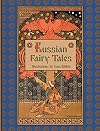
This book contains five Russian fairy tales and features a couple of quintessential characters: the Baby Yaga, living in her hut on hens' legs, and the firebird. While there are echoes to the collected tales by the brothers Grimm, I don't believe that these stories were modelled after them, as one reviewer remarked; I think that some of these tales represent archetypal stories that have their roots in the deep past, when they were shared around campfires and travelled vast distances, and show more then evolved into the recognisable tales we find today, albeit with local and regional variations.
Three of the stories ('Vasilisa the Beautiful', 'The Feather of Finist the Falcon' and 'The Frog-Tsarevna') offer a commendable variation to most fairy tales: they have as their main character a woman, whereas the man is very much on the sidelines and has to be rescued or assisted, if he appears at all. The latter two tales made a very deep impression on me when I was growing up, and I still remembered a couple of plot points more than thirty years later!
As some reviewers have already mentioned, the illustrations by Ivan Bilibin are stunning: intricate, highly detailed, atmospheric and very colourful, they enhance the stories no end and provide a flavour of Russian folklore and culture. show less
Three of the stories ('Vasilisa the Beautiful', 'The Feather of Finist the Falcon' and 'The Frog-Tsarevna') offer a commendable variation to most fairy tales: they have as their main character a woman, whereas the man is very much on the sidelines and has to be rescued or assisted, if he appears at all. The latter two tales made a very deep impression on me when I was growing up, and I still remembered a couple of plot points more than thirty years later!
As some reviewers have already mentioned, the illustrations by Ivan Bilibin are stunning: intricate, highly detailed, atmospheric and very colourful, they enhance the stories no end and provide a flavour of Russian folklore and culture. show less
Lists
Awards


You May Also Like


Associated Authors
Statistics
- Works
- 160
- Also by
- 14
- Members
- 2,867
- Popularity
- #8,942
- Rating
- 4.1
- Reviews
- 44
- ISBNs
- 218
- Languages
- 14
- Favorited
- 3
