
Crystal Gail Fraser
Author of Talk Treaty to Me: Understanding the Basics of Treaties and Land in Canada
Works by Crystal Gail Fraser
Tagged
Common Knowledge
- Gender
- female
Members
Reviews
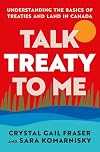
This is an essential guide to treaties in Canada. It’s thought-provoking, educational, and a sobering reminder of how much learning we have to do beyond the confines of our institutions. Growing up, I heard about treaties in the context of Canada's expansion and consolidation, but they were never framed this starkly in history class. Lest we forget that our first prime minister was a real supervillain. Many points throughout were familiar from other reading, but I really appreciated the show more specific calls to action. I feel genuinely inspired by the reframing of land acknowledgements, they should make us uncomfortable as settlers. We shouldn't be parroting out the specifics, we should be reflecting on our personal commitments and obligations. I want to be a good guest on this land. We all come from the land, and this earth is all we have.
I am a settler who has moved across many territories in my life: born in Belleville, on the territory of the Huron-Wendat, Anishinaabeg, and Haudenosaunee peoples; raised in Oshawa, within the traditional and treaty territory of the Michi Saagiig and Chippewa Anishinaabeg and the signatories of the Williams Treaties; educated in Ottawa on the unceded territory of the Algonquin nation; and in London, on the territories of the Anishinaabek, Haudenosaunee, Lūnaapéewak, and Chonnonton Nations, where I conducted research into fetal alcohol spectrum disorder, a condition inseparable from the violence of residential schools and child removal. That work brought me into rare contact with FASD families and communities, and those encounters changed how I think about research. I now work at the Douglas in Montreal, on land long recognized as a site of meeting and exchange among the Haudenosaunee and Anishinaabeg nations. It’s an institution with a troubling history in its treatment of Indigenous patients that I hold consciously. These places have all shaped me. I owe them, and the people whose territories they are, active accountability by supporting Indigenous communities and businesses, and reading more Indigenous stories and authors. This book is part of that commitment.
Thanks to NetGalley and HarperCollins Canada for access to this book. show less
I am a settler who has moved across many territories in my life: born in Belleville, on the territory of the Huron-Wendat, Anishinaabeg, and Haudenosaunee peoples; raised in Oshawa, within the traditional and treaty territory of the Michi Saagiig and Chippewa Anishinaabeg and the signatories of the Williams Treaties; educated in Ottawa on the unceded territory of the Algonquin nation; and in London, on the territories of the Anishinaabek, Haudenosaunee, Lūnaapéewak, and Chonnonton Nations, where I conducted research into fetal alcohol spectrum disorder, a condition inseparable from the violence of residential schools and child removal. That work brought me into rare contact with FASD families and communities, and those encounters changed how I think about research. I now work at the Douglas in Montreal, on land long recognized as a site of meeting and exchange among the Haudenosaunee and Anishinaabeg nations. It’s an institution with a troubling history in its treatment of Indigenous patients that I hold consciously. These places have all shaped me. I owe them, and the people whose territories they are, active accountability by supporting Indigenous communities and businesses, and reading more Indigenous stories and authors. This book is part of that commitment.
Thanks to NetGalley and HarperCollins Canada for access to this book. show less
Lists
Awards

Statistics
- Works
- 2
- Members
- 8
- Popularity
- #1,038,910
- Rating
- 4.0
- Reviews
- 1
- ISBNs
- 4