
James Henry Daugherty (1889–1974)
Author of The Landing of the Pilgrims
About the Author
Image credit: James Daugherty, circa 1917 By Copyright: International Film Service - New-York Tribune. (New York [N.Y.]), 14 Jan. 1917. *https://chroniclingamerica.loc.gov/lccn/sn83030214/1917-01-14/ed-1/seq-55/, Public Domain, https://commons.wikimedia.org/w/index.php?curid=76832486
Works by James Henry Daugherty
Associated Works
A promise to our country: "I pledge allegiance ..." (1961) — Illustrator, some editions — 23 copies, 2 reviews
The Connecticut Cookbook, being a collection of recipes from Connecticut kitches, equally adapted for wartime and peacetime — Illustrator, some editions — 2 copies
Tagged
Common Knowledge
- Birthdate
- 1889-06-01
- Date of death
- 1974-02-21
- Gender
- male
- Education
- Corcoran Art School
- Occupations
- painter
children's book illustrator - Nationality
- USA
- Birthplace
- Asheville, North Carolina, USA
- Places of residence
- Indiana, USA
Ohio, USA
Washington, D.C., USA
London, Middlesex, England, UK - Place of death
- Boston, Massachusetts, USA
- Map Location
- North Carolina, USA
Members
Reviews
Daugherty’s heroically illustrated biography of Boone is a paean to his subject’s resourcefulness, skill, and determination and to life of English pioneers and settlers as they became Americans and expanded the bounds of the United States westward beyond the Appalachian mountains. Or to put it in contemporary terms, a poetically phrased saga of settler colonialism, white supremacy, and genocide. The indigenous inhabitants of the land are portrayed as brutal enemies in both prose and show more portraiture, unless they are aiding an explorer, and as noble savages but only after they have been extinguished. In this book when Indians attack and butcher whites, it was barbaric, but when whites employ exactly the same tactics on Indians it is heroic.
Putting this book in its historical context, Daniel Boone was awarded the Newbery medal in 1940, a time when Americans feared a war with, ironically, some white skinned savages in the process of conquering large parts of Europe, and their oriental allies where doing much the same in Asia, and in a time when the ideology of racism and eugenics was a large part of white America’s ideaology. Not surprisingly, the book is currently out of print. show less
Putting this book in its historical context, Daniel Boone was awarded the Newbery medal in 1940, a time when Americans feared a war with, ironically, some white skinned savages in the process of conquering large parts of Europe, and their oriental allies where doing much the same in Asia, and in a time when the ideology of racism and eugenics was a large part of white America’s ideaology. Not surprisingly, the book is currently out of print. show less

It was an interesting read, but really brought home the fact that the winners write the history. Given the time it was written, the perspectives brought forth in the book about the settling of Kentucky and Ohio, with respect to Native Americans was understandable. Today a book written this way would (or should) never be published.
The whites were lauded as being civilized and the Native peoples as savages. The native warriors were criticized heavily for attempting to burn out the settlements show more of the white people, but the (let us be fair) white warriors were lauded for burning the villages of the native peoples. show less
The whites were lauded as being civilized and the Native peoples as savages. The native warriors were criticized heavily for attempting to burn out the settlements show more of the white people, but the (let us be fair) white warriors were lauded for burning the villages of the native peoples. show less
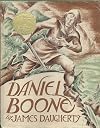
I'm sure this was intended to inspire children and get them interested in history. James Daugherty hero-worshipped Daniel Boone, and this is clearly intended to be a story of the legend, not the man. He describes Boone's burning of Indian towns and villages as if they are heroic actions. The description of an Indian woman with a bow and arrow trying to protect her loved ones in a long house was particularly disturbing. The white men shot her 20 times and set the building on fire, burning show more alive the 46 men inside. The burning child dragging himself through the street didn't seem to be a problem for him either. The nearly constant references to "red varmints,""red dogs," "savage demons," etc. made the book extremely difficult to read.
In 1940 this was deemed the best of the best of children's literature. Thank goodness times have changed. This does not belong in any children's classroom. show less
In 1940 this was deemed the best of the best of children's literature. Thank goodness times have changed. This does not belong in any children's classroom. show less
Completely unacceptable book today in its representation of Native Americans as savages in the way of American progress. Even Daniel Boone recognized that there were too many settlers pouring in and destroying the land into Kentucky after he made his way through the Cumberland Gap. Another reviewer said it best in describing this as hero worship of Boone as the great god of the American West who outsmarted or outweaponed the Native people to make room for more and more settlers. Truly, a show more tragic story of American terrorism, but I am sure this was a hit with the idealistic Northern boys of the 1940's, as the United States prepared to enter World War II and playing Cowboys and Indians - in which the Indians were always the bad guys - was seen as acceptable and common form of play. The story is also a slog, boring and confusing and is not the best choice for teaching children how the nation was settled. There are many other books about Daniel Boone and the settling of the Middle West, but this Newbery should not be on it. show less
Lists
Newbery Adjacent (11)
Ambleside Year 5 (1)
Five in a Row (1)
Sonlight Books (1)
Ambleside Y3 (1)
Five in a Row (1)
Ambleside Books (1)
Ambleside Year 3 (1)
Awards


You May Also Like


Associated Authors
Statistics
- Works
- 31
- Also by
- 12
- Members
- 7,087
- Popularity
- #3,465
- Rating
- 3.9
- Reviews
- 40
- ISBNs
- 59
- Languages
- 1
- Favorited
- 1