
Jane Jensen (1)
Author of Dante's Equation
For other authors named Jane Jensen, see the disambiguation page.
Series
Works by Jane Jensen
The Temptation 1 copy
Tagged
Common Knowledge
- Gender
- female
Members
Reviews

A techno-psycho-theological thriller that starts out strong enough as a skeptical Catholic priest begins to have doubts after signs of The Apocalypse start manifesting themselves around the globe...manifestations whose origins may or may not be divine. Jensen's characters are clearly drawn and the action flows smoothly with very few snags---even with its credibility stretches (it's an "end-of-the-world thriller" after all) it had me hooked. She also did her homework, drawing upon prophecies show more from various creeds, native mythology, Nostradamus, and 19th century spiritualists. And then she loses it all in the last 50 pages when she gives readers a finale dripping with pseudo-spiritual claptrap and a moral/ethical hypocrisy so glaring it burned my eyes---one can't help but question where she is coming from when you start to see a pattern to the destruction. So what is it? A high-handed "cautionary tale" aimed at our wasteful lifestyle? Or a jet black satire on environmentalism run amok (introducing us to some of the foulest, most revolting psychopaths in contemporary literature)? Fans of Dan Brown might enjoy the conspiracy theory angle but I closed the book feeling as if I had been conned. show less
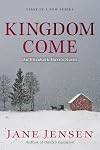
After a thirteen-year hiatus from publishing fiction under her own name, Jane Jensen returned to prose fiction with gusto in 2016, publishing two mystery novels in a new series about a Detective Elizabeth Harris. Kingdom Come is the first of this new series, introducing Elizabeth Harris as a detective returning home to rural Lancaster County, Pennsylvania. After the brutal and random murder of her husband, Terry, in New York City, Elizabeth is escaping the complexity and the purported show more darkness of her urban lifestyle. It’s her hope that the simplicity and nostalgia of a rural community with an integrated Amish population would be enough to pull her out of her shell.
[N.B. This review includes images, and was formatted for my site, dendrobibliography -- located here.]
Brutality is everywhere, unfortunately, and Kingdom Come opens with the murder of a teenage girl named Jessica. Her body’s carried through the freezing snow — and through a freezing creek — and dumped in the barn of an Amish family of no relation. Jessica was an ‘English’ — an outsider seemingly disconnected from the Amish community. Her body is arranged to imply a sex-related murder, but none of the finer details of her murder seem to fit that arrangement: Why was she dumped there? why was her body stored in and by the creek for a period of hours? Jessica was hit from behind — not too hard — and then suffocated while remaining unconscious, which also seems to contradict the context of sexual assault, so why the prepared arrangement?
The Amish community is hesitant to help — not out of guilt or suspicion being cast, but due to the community’s beliefs in privacy and God’s will. Their apparent indifference to a young woman’s murder is infuriating to Harris, who juggles respect for the community and individuals with a sense of being challenged and disrespected both as an English and a woman. Not only do they not seem to care for the dead English woman, but they imply she was asking for it by living dangerously and engaging in sex.
Kingdom Come carries a lot of similarities to David Lynch’s classic TV show, Twin Peaks. As the story of Jessica’s death unfolds, the body of a missing Amish girl is found miles away; the lives of these young girls, initially painted as sweet and innocent, start uncovering dark and disturbing revelations within and outside Lancaster’s Amish community. The quaint idyll dissolves under the weight of our cultures’ cruel realities.
Jensen draws her characters very well. Elizabeth Harris is written as Jensen herself, embittered by the recent tragedies in her life, she’s a snarky, sharp-witted voice, always quick to outpace her co-workers and counter the sexist expectations of the culture she inhabits. She and her co-workers, like her boss Grady, share a close rapport, which contributes a sense of humor to the novel and helps lighten the dark events they’re investigating. Elizabeth, too, falls for one of the Amish — a hunk of a man named Ezra who’s battling his own demons and on the verge of leaving the Amish way of life. Their relationship is, to put it bluntly, adorable, and the romance between their personalities feels genuine and touching on its own. In the context of the mystery, however, the romance feels out of place, and it leaps ahead over Ezra’s attractive body and Elizabeth’s devotion to the case to be shockingly unprofessional and poorly-paced. I loved these two together, but their relationship lacked definition and clashes with the narrative’s short length.
Also, while the mystery is compelling and well-written, at roughly the two-thirds point, I felt like the entire investigative team gave up in the face of overwhelming evidence, and performed leaps in logic in order to avoid investigating, discussing, or acknowledging in any way a conclusion that was all too obvious. The villain was clear by this point — though a few more twists are still to come! — and it felt like Harris and Grady disregarded good evidence as bad, and instead took bad evidence as good, which only padded out the length of the investigation and gave more narrative time to the romantic storyline.
The mystery is benefited by Jensen’s background in the video game industry. As part of Sierra On-Line in the ’90s, she became known for the Gabriel Knight series of point-and-click adventures — a series which was defined by a breadth of research on the parts of Jensen, Gabriel Knight, and the players themselves, in order to uncover complex conspiracies mired in exotic cultural and social histories. Jensen pays her respect to the Amish community with Kingdom Come, using her research to paint the community as they are. By definition, it’s always from an outsider’s perspective, but a respectful one that avoids condescension or cultural appropriation.
Kingdom Come carries with it many issues — unusual pacing, a dichotomy between characters’ logic and actions, and a romantic angle that sometimes gets awkward — but it’s the best kind of brain candy. The lead characters all shine with personality, the rural community of Lancaster County brings with it a warm sense of nostalgia for simpler times (despite the falsity of such feelings), and the mystery proves mostly compelling. Once the mystery was solved, Lancaster Co. was hard to leave behind, and I can’t wait to see where the series and characters go next. show less
[N.B. This review includes images, and was formatted for my site, dendrobibliography -- located here.]
Brutality is everywhere, unfortunately, and Kingdom Come opens with the murder of a teenage girl named Jessica. Her body’s carried through the freezing snow — and through a freezing creek — and dumped in the barn of an Amish family of no relation. Jessica was an ‘English’ — an outsider seemingly disconnected from the Amish community. Her body is arranged to imply a sex-related murder, but none of the finer details of her murder seem to fit that arrangement: Why was she dumped there? why was her body stored in and by the creek for a period of hours? Jessica was hit from behind — not too hard — and then suffocated while remaining unconscious, which also seems to contradict the context of sexual assault, so why the prepared arrangement?
The Amish community is hesitant to help — not out of guilt or suspicion being cast, but due to the community’s beliefs in privacy and God’s will. Their apparent indifference to a young woman’s murder is infuriating to Harris, who juggles respect for the community and individuals with a sense of being challenged and disrespected both as an English and a woman. Not only do they not seem to care for the dead English woman, but they imply she was asking for it by living dangerously and engaging in sex.
Kingdom Come carries a lot of similarities to David Lynch’s classic TV show, Twin Peaks. As the story of Jessica’s death unfolds, the body of a missing Amish girl is found miles away; the lives of these young girls, initially painted as sweet and innocent, start uncovering dark and disturbing revelations within and outside Lancaster’s Amish community. The quaint idyll dissolves under the weight of our cultures’ cruel realities.
Jensen draws her characters very well. Elizabeth Harris is written as Jensen herself, embittered by the recent tragedies in her life, she’s a snarky, sharp-witted voice, always quick to outpace her co-workers and counter the sexist expectations of the culture she inhabits. She and her co-workers, like her boss Grady, share a close rapport, which contributes a sense of humor to the novel and helps lighten the dark events they’re investigating. Elizabeth, too, falls for one of the Amish — a hunk of a man named Ezra who’s battling his own demons and on the verge of leaving the Amish way of life. Their relationship is, to put it bluntly, adorable, and the romance between their personalities feels genuine and touching on its own. In the context of the mystery, however, the romance feels out of place, and it leaps ahead over Ezra’s attractive body and Elizabeth’s devotion to the case to be shockingly unprofessional and poorly-paced. I loved these two together, but their relationship lacked definition and clashes with the narrative’s short length.
Also, while the mystery is compelling and well-written, at roughly the two-thirds point, I felt like the entire investigative team gave up in the face of overwhelming evidence, and performed leaps in logic in order to avoid investigating, discussing, or acknowledging in any way a conclusion that was all too obvious. The villain was clear by this point — though a few more twists are still to come! — and it felt like Harris and Grady disregarded good evidence as bad, and instead took bad evidence as good, which only padded out the length of the investigation and gave more narrative time to the romantic storyline.
The mystery is benefited by Jensen’s background in the video game industry. As part of Sierra On-Line in the ’90s, she became known for the Gabriel Knight series of point-and-click adventures — a series which was defined by a breadth of research on the parts of Jensen, Gabriel Knight, and the players themselves, in order to uncover complex conspiracies mired in exotic cultural and social histories. Jensen pays her respect to the Amish community with Kingdom Come, using her research to paint the community as they are. By definition, it’s always from an outsider’s perspective, but a respectful one that avoids condescension or cultural appropriation.
Kingdom Come carries with it many issues — unusual pacing, a dichotomy between characters’ logic and actions, and a romantic angle that sometimes gets awkward — but it’s the best kind of brain candy. The lead characters all shine with personality, the rural community of Lancaster County brings with it a warm sense of nostalgia for simpler times (despite the falsity of such feelings), and the mystery proves mostly compelling. Once the mystery was solved, Lancaster Co. was hard to leave behind, and I can’t wait to see where the series and characters go next. show less

Gabriel Knight is a New Orleans bookseller and horror novelist. He wants to make it big as an author, but everything he's written so far has flopped. He has high hopes for his next novel, which he plans to base on the recent killings the media has dubbed the Voodoo Murders. First, though, he wants to figure out as much as possible about what's really going on. The police think all the voodoo stuff is fake, a smokescreen meant to hide mob activity, but Gabriel's not so sure. He finds his show more investigation mixing strangely and uncomfortably with the horrifying dreams he keeps having, in which a woman is burned at the stake.
Okay, I'll start this off with a few questions: Have you ever played the Gabriel Knight computer games, and do you have fond memories of them? Are you a fan of point-and-click adventure games? If you answered “yes” to any of this but don't particularly want to play/replay Gabriel Knight: Sins of the Fathers, then this book might be for you. Everyone else is probably better off moving on to something else.
I played the second and third Gabriel Knight games around the time they first came out (1995 and 1999), but I never got around to playing the first one, the one on which this book is based. Even so, I found this to be an enormously nostalgia-filled read. The dialogue, the characters, the way Gabriel went about his investigation, all of it felt familiar. It was wonderful and fun. And also terrifically bad.
Although I haven't played the original game, I suspect the novel is very closely based on it, right down to its depiction of the puzzles players would have had to solve. This is great for nostalgia but otherwise not good, because adventure game logic and book logic are not the same thing.
In an adventure game, a player's inventory can hold all manner of things for however long they're needed. Players pick up all kinds of random junk, even if they don't know how or why it might be useful, because anything that can be picked up is guaranteed to eventually be useful. And just because players think a particular inventory item should be able to accomplish a task doesn't mean that it actually will. For example, a screwdriver is never going to be able to pry open a cheap locked box if the game designers decided that players need to find and use a key instead.
While book logic isn't necessarily exactly like real world logic, it's closer to real world logic than game logic, which is why some of the things Gabriel did and some of the ways characters reacted to him were absolutely bizarre. For example, at one point he decided he wanted to steal Detective Mosely's badge. I would never have guessed that the best and most foolproof way for him to do this would be for him to complain about the heat, wait for Mosely to feel sympathetically hot and take off his jacket, and then ask for a cup of coffee (who asks for coffee immediately after complaining about the heat?), prompting Mosely to leave the office and his jacket, with his badge still in it, unattended. It didn't help that readers weren't told what his goal was until after he'd achieved it.
There were so many weird things. Like the mask with the $100 price tag that cost exactly $100 (no sales tax!). Or the journals from hundreds of years ago that were inexplicably written in English, even though the people writing them were German. Jensen should probably have left that one alone, but instead she drew attention to its strangeness by trying to explain it. The best she could come up with was that the journal writers must have somehow sensed that Gabriel would one day read their entries and therefore wrote them in English, to which I can only say “huh?”
Even back when I was playing the games, I enjoyed them more for their stories and puzzles than for their characters. The same held true for this novelization. Although Gabriel could have been worse, any time he was in a scene with a woman I cringed a little. Nearly every single younger woman was described in terms of how physically appealing she was to Gabriel. In one of my least favorite scenes, Gabriel essentially harassed Malia Gedde, a woman he was interested in, at her mother's grave, telling her not to belittle his love for her. He'd spoken to her maybe twice by that point. Not long after that, the two of them had sex. The only reason I could accept any of that was because it seemed fairly obvious that Gabriel's feelings were being magically manipulated by Malia.
The way Grace was handled could have been better. She was a better logical thinker than Gabriel, and yet he never sat down and bounced ideas off her or even told her much about what was really going on. Mostly, she was there to provide Gabriel with someone he needed to save near the end of the book, and to do Gabriel's research, even when that "research" amounted to no more than checking the phone book for a particular name. I gritted my teeth when she first appeared in the book and Gabriel described her by basically calling her "exotic" without ever actually using that word. For example:
"And beyond all that, Grace was Japanese or, rather, Japanese-American. Although she spoke and acted as American as a native (well, she was a native), there were subtle things about her that Gabriel found incomprehensible. Her loyalty to her parents, for example. She called them daily and they still seemed to run her life to an extent that Gabriel could not comprehend any grown person putting up with. Hell, his gran had never been that bad, and he'd still moved out when he was sixteen." (7)
I'm not sure why some of that info was included, considering that Grace was never shown calling her parents. In fact, at the end of the book she made a decision, all on her own and without even mentioning her parents, that could have an enormous effect on her future. Meanwhile, Gabriel spent a portion of the book at his grandmother's house.
Jensen's writing could have been better. "Relinquished" was one of her top favorite words, used even when other word choices might have been more appropriate, and Gabriel frequently described attractive women using the word "creamy" (there were "creamy" legs and even a bizarre instance of a "creamy" face). There was also a lot of infodumping, although that was probably at least partly an artifact of the original game: lots of instances of Gabriel reading about drumming, voodoo lore, or other subjects in books, or receiving a long lecture from another character.
This was one of those strange reads that I both thought was terrible and thoroughly enjoyed. Here's hoping Gabriel Knight: The Beast Within manages to be similarly appealing. I expect the nostalgia aspect to be even stronger in that one, since I've actually played the game.
Rating Note:
If I could, I'd give this book multiple star ratings: 4 stars for entertainment value, 4.5 stars for nostalgia, 1 star for issues with the writing, either 2.5 or 3 stars for the story. Instead, I've settled on 3 stars. It was a fun read and I kind of loved it even when I hated it, but I wouldn't recommend it to most people.
(Original review posted on A Library Girl's Familiar Diversions.) show less
Okay, I'll start this off with a few questions: Have you ever played the Gabriel Knight computer games, and do you have fond memories of them? Are you a fan of point-and-click adventure games? If you answered “yes” to any of this but don't particularly want to play/replay Gabriel Knight: Sins of the Fathers, then this book might be for you. Everyone else is probably better off moving on to something else.
I played the second and third Gabriel Knight games around the time they first came out (1995 and 1999), but I never got around to playing the first one, the one on which this book is based. Even so, I found this to be an enormously nostalgia-filled read. The dialogue, the characters, the way Gabriel went about his investigation, all of it felt familiar. It was wonderful and fun. And also terrifically bad.
Although I haven't played the original game, I suspect the novel is very closely based on it, right down to its depiction of the puzzles players would have had to solve. This is great for nostalgia but otherwise not good, because adventure game logic and book logic are not the same thing.
In an adventure game, a player's inventory can hold all manner of things for however long they're needed. Players pick up all kinds of random junk, even if they don't know how or why it might be useful, because anything that can be picked up is guaranteed to eventually be useful. And just because players think a particular inventory item should be able to accomplish a task doesn't mean that it actually will. For example, a screwdriver is never going to be able to pry open a cheap locked box if the game designers decided that players need to find and use a key instead.
While book logic isn't necessarily exactly like real world logic, it's closer to real world logic than game logic, which is why some of the things Gabriel did and some of the ways characters reacted to him were absolutely bizarre. For example, at one point he decided he wanted to steal Detective Mosely's badge. I would never have guessed that the best and most foolproof way for him to do this would be for him to complain about the heat, wait for Mosely to feel sympathetically hot and take off his jacket, and then ask for a cup of coffee (who asks for coffee immediately after complaining about the heat?), prompting Mosely to leave the office and his jacket, with his badge still in it, unattended. It didn't help that readers weren't told what his goal was until after he'd achieved it.
There were so many weird things. Like the mask with the $100 price tag that cost exactly $100 (no sales tax!). Or the journals from hundreds of years ago that were inexplicably written in English, even though the people writing them were German. Jensen should probably have left that one alone, but instead she drew attention to its strangeness by trying to explain it. The best she could come up with was that the journal writers must have somehow sensed that Gabriel would one day read their entries and therefore wrote them in English, to which I can only say “huh?”
Even back when I was playing the games, I enjoyed them more for their stories and puzzles than for their characters. The same held true for this novelization. Although Gabriel could have been worse, any time he was in a scene with a woman I cringed a little. Nearly every single younger woman was described in terms of how physically appealing she was to Gabriel. In one of my least favorite scenes, Gabriel essentially harassed Malia Gedde, a woman he was interested in, at her mother's grave, telling her not to belittle his love for her. He'd spoken to her maybe twice by that point. Not long after that, the two of them had sex. The only reason I could accept any of that was because it seemed fairly obvious that Gabriel's feelings were being magically manipulated by Malia.
The way Grace was handled could have been better. She was a better logical thinker than Gabriel, and yet he never sat down and bounced ideas off her or even told her much about what was really going on. Mostly, she was there to provide Gabriel with someone he needed to save near the end of the book, and to do Gabriel's research, even when that "research" amounted to no more than checking the phone book for a particular name. I gritted my teeth when she first appeared in the book and Gabriel described her by basically calling her "exotic" without ever actually using that word. For example:
"And beyond all that, Grace was Japanese or, rather, Japanese-American. Although she spoke and acted as American as a native (well, she was a native), there were subtle things about her that Gabriel found incomprehensible. Her loyalty to her parents, for example. She called them daily and they still seemed to run her life to an extent that Gabriel could not comprehend any grown person putting up with. Hell, his gran had never been that bad, and he'd still moved out when he was sixteen." (7)
I'm not sure why some of that info was included, considering that Grace was never shown calling her parents. In fact, at the end of the book she made a decision, all on her own and without even mentioning her parents, that could have an enormous effect on her future. Meanwhile, Gabriel spent a portion of the book at his grandmother's house.
Jensen's writing could have been better. "Relinquished" was one of her top favorite words, used even when other word choices might have been more appropriate, and Gabriel frequently described attractive women using the word "creamy" (there were "creamy" legs and even a bizarre instance of a "creamy" face). There was also a lot of infodumping, although that was probably at least partly an artifact of the original game: lots of instances of Gabriel reading about drumming, voodoo lore, or other subjects in books, or receiving a long lecture from another character.
This was one of those strange reads that I both thought was terrible and thoroughly enjoyed. Here's hoping Gabriel Knight: The Beast Within manages to be similarly appealing. I expect the nostalgia aspect to be even stronger in that one, since I've actually played the game.
Rating Note:
If I could, I'd give this book multiple star ratings: 4 stars for entertainment value, 4.5 stars for nostalgia, 1 star for issues with the writing, either 2.5 or 3 stars for the story. Instead, I've settled on 3 stars. It was a fun read and I kind of loved it even when I hated it, but I wouldn't recommend it to most people.
(Original review posted on A Library Girl's Familiar Diversions.) show less
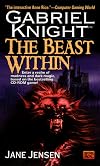
The events of the previous book/game left Gabriel Knight somewhat wealthy and in possession of a drafty castle in Germany. His writing career has finally taken off, but he's having trouble with his latest book, so the werewolf case that the local villagers bring him is a welcome distraction. The police think the killings are being done by wolves that escaped from the zoo. Gabriel, who found a giant paw print at one of the crime scenes, feels differently. His investigation gets him involved show more in a private hunting club whose members appear to have a lot of secrets.
Meanwhile, Grace has gotten tired of being Gabriel's shopkeeper. She put off getting her PhD for Gabriel and his supernatural investigations, so she's darn well going to make him involve her in his latest case. She flies off to Germany and, since Gabriel's off doing his own thing, devotes herself to the research she's so good at. She discovers that Gabriel's current case may have its roots in the events surrounding King Ludwig II's apparent descent into madness and his mysterious death.
The first book, Gabriel Knight: Sins of the Fathers, managed to be both terrible and enjoyable, even though I'd never played the game. I had played The Beast Within but never finished it, so I was especially looking forward to this novelization. Unfortunately, it turned out to be a disappointment.
I will say this: it was nice to finally learn how the story ended. I can't remember if I got stuck during the chase in the forest or the chase at the opera, but I do know that I died a lot and finally just couldn't take it anymore (this was in the days of slow phone-line-hogging internet, so I probably didn't look for a walkthrough). This was a much less stressful way to get the whole story.
And that story was kind of amazing. Jensen wove together a hunting club that was engaged in various illegal activities, Ludwig II, Wagner, opera, and gay (or possibly bisexual) werewolves. How often do you get to read something in which opera literally helps save the day?
I remember liking the original game a lot. I vaguely recall having some problems with the characters and story, but they were generally overshadowed by my enjoyment of the well-integrated puzzles, gorgeous locations, and impressive-looking cutscenes (or at least they were impressive to the me of the late '90s).
Unfortunately, The Beast Within's novelization left a lot to be desired. Unlike the Sins of the Fathers novelization, it felt a lot more like an original novel than a game novelization, but this didn't turn out to be a good thing. I kind of missed the cheesy/silly “game logic” moments. Sure, Gabriel made use of his trusty tape recorder a little more than was believable, and he still picked up the occasional random item that he didn't immediately know would be useful, but he rarely did truly off-the-wall stuff like using mud from a freaking river bank to make a usable bracelet mold.
The most off-the-wall thing Gabriel did was talk to people and actually expect them to tell him what he wanted to know. And sometimes they did! He was completely out of his element in Germany – hardly any contacts, no German language skills, little-to-no knowledge of the country. The main thing he had going for him was the Ritter family name and the money he had leftover from the fistfuls he grabbed at the end of the previous book/game. I suppose you could say game logic was in play any time anyone took him into their confidence.
Gabriel managed to be slightly more annoying this time around. He was painfully American in his lack of knowledge about anything around him (Grace was more prepared to visit Germany than he was), and he somehow still managed to find time to ogle the ladies (including a weird scene in which Von Glower, the head of the hunting club, basically let him borrow his girlfriend for sex).
Grace was a huge disappointment. She was underutilized in the previous story, so I thought her having a larger role would be an improvement. However, her instant jealousy and cattiness towards Gerde, who she assumed Gabriel was sleeping with, made it hard to like her. Grace and Gabriel weren't a couple, he hadn't even treated her all that well in the previous book, and Gerde had done literally nothing other than exist to indicate that she and Gabriel were together. If Grace was going to be mad at someone, it should have been Gabriel...but he wasn't around and refused to tell her where she could find him. I could maybe see the allure of being a supernatural investigator and putting up with Gabriel for that reason, but I couldn't understand Grace's romantic interest in him.
You know who Gabriel did have chemistry with? Von Glower. Jensen had a few missed opportunities in this book, all of which had to do with character sexuality. Several characters were identified as being gay, when it might have been more accurate to say at least one of them was bisexual. Gabriel was almost magnetically drawn to Von Glower, who he described as having “effortless charm” (134) and “shoulders broad enough to take on the world” (219). It wouldn't have taken much to write Gabriel as bisexual as well. Instead, Jensen tried to set Von Glower up as a father or older brother figure and threw in the girlfriend-sharing to remind readers that Gabriel was a bit of a womanizer. Bah.
Anyway, most of the big adrenaline-filled moments near the end of the book wouldn't have needed to happen if Gabriel hadn'tbeen so caught up in Von Glower. Gabriel saw nothing wrong with his instant acceptance of him and confided in him to an extent he hadn't confided in Grace in the previous book. Von Glower, too, was kind of silly, going on a dangerous mission with Gabriel, who refused to carry a gun and was on a horse he didn't know how to ride.
I was hoping for some of the same “so bad it's kind of good” fun of the previous book, and instead I got something that was just bad. It was nice to finally find out how the story ended, years after getting stuck in the game, but can't recommend this book for any other reason.
(Original review posted on A Library Girl's Familiar Diversions.) show less
Meanwhile, Grace has gotten tired of being Gabriel's shopkeeper. She put off getting her PhD for Gabriel and his supernatural investigations, so she's darn well going to make him involve her in his latest case. She flies off to Germany and, since Gabriel's off doing his own thing, devotes herself to the research she's so good at. She discovers that Gabriel's current case may have its roots in the events surrounding King Ludwig II's apparent descent into madness and his mysterious death.
The first book, Gabriel Knight: Sins of the Fathers, managed to be both terrible and enjoyable, even though I'd never played the game. I had played The Beast Within but never finished it, so I was especially looking forward to this novelization. Unfortunately, it turned out to be a disappointment.
I will say this: it was nice to finally learn how the story ended. I can't remember if I got stuck during the chase in the forest or the chase at the opera, but I do know that I died a lot and finally just couldn't take it anymore (this was in the days of slow phone-line-hogging internet, so I probably didn't look for a walkthrough). This was a much less stressful way to get the whole story.
And that story was kind of amazing. Jensen wove together a hunting club that was engaged in various illegal activities, Ludwig II, Wagner, opera, and gay (or possibly bisexual) werewolves. How often do you get to read something in which opera literally helps save the day?
I remember liking the original game a lot. I vaguely recall having some problems with the characters and story, but they were generally overshadowed by my enjoyment of the well-integrated puzzles, gorgeous locations, and impressive-looking cutscenes (or at least they were impressive to the me of the late '90s).
Unfortunately, The Beast Within's novelization left a lot to be desired. Unlike the Sins of the Fathers novelization, it felt a lot more like an original novel than a game novelization, but this didn't turn out to be a good thing. I kind of missed the cheesy/silly “game logic” moments. Sure, Gabriel made use of his trusty tape recorder a little more than was believable, and he still picked up the occasional random item that he didn't immediately know would be useful, but he rarely did truly off-the-wall stuff like using mud from a freaking river bank to make a usable bracelet mold.
The most off-the-wall thing Gabriel did was talk to people and actually expect them to tell him what he wanted to know. And sometimes they did! He was completely out of his element in Germany – hardly any contacts, no German language skills, little-to-no knowledge of the country. The main thing he had going for him was the Ritter family name and the money he had leftover from the fistfuls he grabbed at the end of the previous book/game. I suppose you could say game logic was in play any time anyone took him into their confidence.
Gabriel managed to be slightly more annoying this time around. He was painfully American in his lack of knowledge about anything around him (Grace was more prepared to visit Germany than he was), and he somehow still managed to find time to ogle the ladies (including a weird scene in which Von Glower, the head of the hunting club, basically let him borrow his girlfriend for sex).
Grace was a huge disappointment. She was underutilized in the previous story, so I thought her having a larger role would be an improvement. However, her instant jealousy and cattiness towards Gerde, who she assumed Gabriel was sleeping with, made it hard to like her. Grace and Gabriel weren't a couple, he hadn't even treated her all that well in the previous book, and Gerde had done literally nothing other than exist to indicate that she and Gabriel were together. If Grace was going to be mad at someone, it should have been Gabriel...but he wasn't around and refused to tell her where she could find him. I could maybe see the allure of being a supernatural investigator and putting up with Gabriel for that reason, but I couldn't understand Grace's romantic interest in him.
You know who Gabriel did have chemistry with? Von Glower. Jensen had a few missed opportunities in this book, all of which had to do with character sexuality. Several characters were identified as being gay, when it might have been more accurate to say at least one of them was bisexual. Gabriel was almost magnetically drawn to Von Glower, who he described as having “effortless charm” (134) and “shoulders broad enough to take on the world” (219). It wouldn't have taken much to write Gabriel as bisexual as well. Instead, Jensen tried to set Von Glower up as a father or older brother figure and threw in the girlfriend-sharing to remind readers that Gabriel was a bit of a womanizer. Bah.
Anyway, most of the big adrenaline-filled moments near the end of the book wouldn't have needed to happen if Gabriel hadn't
I was hoping for some of the same “so bad it's kind of good” fun of the previous book, and instead I got something that was just bad. It was nice to finally find out how the story ended, years after getting stuck in the game, but can't recommend this book for any other reason.
(Original review posted on A Library Girl's Familiar Diversions.) show less
Lists
Awards


Statistics
- Works
- 11
- Members
- 949
- Popularity
- #27,106
- Rating
- 3.5
- Reviews
- 22
- ISBNs
- 42
- Languages
- 3