

Marc Campos
Author of Rann-Thanagar War
Works by Marc Campos
Associated Works
Superman/Batman Secret Files & Origins — Inker, some editions — 2 copies
Tagged
Common Knowledge
There is no Common Knowledge data for this author yet. You can help.
Members
Reviews

Access a version of the below that includes illustrations on my blog in two parts here and here.
Justice League America #86-88
Oh God make it stop.
I really struggled with this one. Ice is mopey and emotional; Marc Campos's art is incapable of nuance, so everyone is shouting at each other all the time. Captain Atom is a stupid jarhead who gets into argument with an ineffectual Wonder Woman; he's nothing like the guy who lead the JLE back in their Paris days. The story is about some cultists who show more build a transmitter tower or something that somehow brings back Dreamslayer of the Extremists; the resulting story is as unappealing as every Extremists story. Wait, no, moreso. How all this hangs together is left as an exercise for the reader, because neither art nor story are doing the work. At one point you have to turn the book sideways to read a page; this strikes me as the kind of power move that only works if your art is good enough to justify the effort. Campos's is not.
Bad bad bad. I hated every page of it, every panel.
Justice League America #89-91, Justice League Task Force #13-14, and Justice League International vol. 2 #65-66
Judgment Day was a six-part story that rotated through all three Justice League monthlies: the American branch, international branch, and Task Force all teamed up to deal with a world-threatening menace. This is the Overmaster. Unsurprisingly, this story has all the negatives of all the recent stories from all three titles: bad art, especially by Marc Campos, over-the-top melodrama, incoherent plotting. Much of the story is never really explained. What is the connection between this Overmaster and the one that threatened the Detroit-era League? How did he cause all the disasters around the Earth before he even got there? Why was he going around empowering random people? Why doesn't he just destroy the Earth right away instead of imposing this countdown?
There are some nuggets of a good concept here. I liked the idea that Booster encountered a situation where he knew things were going to turn out fine in the future... but then the events of Zero Hour meant that his future knowledge actually wasn't right. But all the stuff about Booster being dead and not dead was painted with way too broad a brush. I did like the stuff between Booster and Beetle, though; I feel like their friendship was largely not utilized during Dan Vado's run so it was good to see it in play here. The idea no one was being born or dying is creepy.
On the other hand, we once again get an ineffectual Wonder Woman up against a rash Captain Atom when it comes to command of the League. I don't know why we needed to see this play out three stories in a row; it's insulting to both characters. (And when and how did Atom even become a League member again?) This time we get the added layer of a UN-threatened League shutdown from Maxwell Lord. I'm not sure why Max was kept on as a lead character after Breakdowns when he has done so very little of interest except occasionally be the face of UN interference.
The big aspect of this story is the death of Ice. It comes across as a bit of a Chewbacca moment: "kill the family dog." That is to say, kill the nicest character because it will garner the most sympathy. In execution, it doesn't work very well. Ice had been absent from the League for a long time, and since her return, hasn't even really felt like Ice in any meaningful sense. She spends most of Judgment Day under the Overmaster's mind control, which is not really an interesting way for a character to spend their final appearance. Surely an effective character death should remind you of why you liked someone before they get killed off, but there's none of that here.
The one thing I did like about the death of Ice was the actual issue in which it happened, JLTF #14, certainly the best issue of the whole crossover. As the League acts to stop the Overmaster, we keep cutting to T. O. Morrow and a couple other villains; every time the League does something, we see Morrow cross it off of a list of things he knows are going to happen. The culminates in him crossing Ice's death off the list. It's a surprisingly effective mechanic from writer Mark Waid, giving the death of Ice some impact.
Lastly, Dan Vado and Marc Campos's run finishes out with a coda issue about how the death of Ice affected the team. The characters snarl and posture a lot; the potential drama of Fire dealing with this is of course squandered by bad writing and worse art. show less
Justice League America #86-88
Oh God make it stop.
I really struggled with this one. Ice is mopey and emotional; Marc Campos's art is incapable of nuance, so everyone is shouting at each other all the time. Captain Atom is a stupid jarhead who gets into argument with an ineffectual Wonder Woman; he's nothing like the guy who lead the JLE back in their Paris days. The story is about some cultists who show more build a transmitter tower or something that somehow brings back Dreamslayer of the Extremists; the resulting story is as unappealing as every Extremists story. Wait, no, moreso. How all this hangs together is left as an exercise for the reader, because neither art nor story are doing the work. At one point you have to turn the book sideways to read a page; this strikes me as the kind of power move that only works if your art is good enough to justify the effort. Campos's is not.
Bad bad bad. I hated every page of it, every panel.
Justice League America #89-91, Justice League Task Force #13-14, and Justice League International vol. 2 #65-66
Judgment Day was a six-part story that rotated through all three Justice League monthlies: the American branch, international branch, and Task Force all teamed up to deal with a world-threatening menace. This is the Overmaster. Unsurprisingly, this story has all the negatives of all the recent stories from all three titles: bad art, especially by Marc Campos, over-the-top melodrama, incoherent plotting. Much of the story is never really explained. What is the connection between this Overmaster and the one that threatened the Detroit-era League? How did he cause all the disasters around the Earth before he even got there? Why was he going around empowering random people? Why doesn't he just destroy the Earth right away instead of imposing this countdown?
There are some nuggets of a good concept here. I liked the idea that Booster encountered a situation where he knew things were going to turn out fine in the future... but then the events of Zero Hour meant that his future knowledge actually wasn't right. But all the stuff about Booster being dead and not dead was painted with way too broad a brush. I did like the stuff between Booster and Beetle, though; I feel like their friendship was largely not utilized during Dan Vado's run so it was good to see it in play here. The idea no one was being born or dying is creepy.
On the other hand, we once again get an ineffectual Wonder Woman up against a rash Captain Atom when it comes to command of the League. I don't know why we needed to see this play out three stories in a row; it's insulting to both characters. (And when and how did Atom even become a League member again?) This time we get the added layer of a UN-threatened League shutdown from Maxwell Lord. I'm not sure why Max was kept on as a lead character after Breakdowns when he has done so very little of interest except occasionally be the face of UN interference.
The big aspect of this story is the death of Ice. It comes across as a bit of a Chewbacca moment: "kill the family dog." That is to say, kill the nicest character because it will garner the most sympathy. In execution, it doesn't work very well. Ice had been absent from the League for a long time, and since her return, hasn't even really felt like Ice in any meaningful sense. She spends most of Judgment Day under the Overmaster's mind control, which is not really an interesting way for a character to spend their final appearance. Surely an effective character death should remind you of why you liked someone before they get killed off, but there's none of that here.
The one thing I did like about the death of Ice was the actual issue in which it happened, JLTF #14, certainly the best issue of the whole crossover. As the League acts to stop the Overmaster, we keep cutting to T. O. Morrow and a couple other villains; every time the League does something, we see Morrow cross it off of a list of things he knows are going to happen. The culminates in him crossing Ice's death off the list. It's a surprisingly effective mechanic from writer Mark Waid, giving the death of Ice some impact.
Lastly, Dan Vado and Marc Campos's run finishes out with a coda issue about how the death of Ice affected the team. The characters snarl and posture a lot; the potential drama of Fire dealing with this is of course squandered by bad writing and worse art. show less

I like DC's space heroes a lot-- they combine two of my favorite genres into one, after all-- but I didn't like this. For some reason, whenever DC does a space hero story, they feel compelled to chuck in all the space heroes. Captain Comet, Adam Strange, Hawkman, Hawkgirl, Hawkwoman, Starman, Tigorr, multiple Green Lanterns are all here, and I challenge you to get a grasp on any of their characters or personalities. The story in particular wants you to care about Adam Strange and family, but show more I don't; I'm not even interested in Captain Comet or Starman, and I've read and enjoyed other stories featuring them. These are just a bunch of people shouting exposition loudly at one another, fighting against a villain I don't really care about to protect a group of people that aren't interesting. This is the kind of stuff I should love: desperate battles against deadly villains. But the plotting feels arbitrary (there are, like, twelve last stands) and when major characters die, it doesn't even seem to matter. God, I wanted to like this so so much, and that makes its failure all the more disappointing.
DC Comics Space Heroes: « Previous in sequence | Next in sequence »
DC Comics Crises: « Previous in sequence | Next in sequence » show less
DC Comics Space Heroes: « Previous in sequence | Next in sequence »
DC Comics Crises: « Previous in sequence | Next in sequence » show less
Wonder Woman & the Justice League America Vol. 2 (Wonder Woman and Justice League America) by Mark Waid
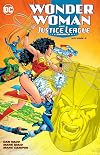
This was bought for me as an anniversary gift by my ex. He knows I'm a fan of Wonder Woman, so he thought this would be a good purchase. It also happens to be from the time I was still heavily into comics, but includes stories I had not read.
So, here we have a post Death of Superman/Return of Superman Justice League storyline that sees the return of a previously seen Justice League villain called "The Overmaster," a strangely all-powerful being known for completely destroying civilizations show more and taking a single specimen as remembrance. How is this a Wonder Woman story? Well, she's just taken over as the leader of the League, much to the chagrin of one Captain Atom. It's interesting how much disrespect WW receives in this story because it's in the Post-Crisis timeline where she has only been in "Man's World" for just under ten years. In this continuity, it is Queen Hippolytta's tenure as Wonder Woman that make up the Golden Age adventures.
The over-arching story is okay, but it feels like Mark Waid, Gerard Jones, and Dan Vado didn't have as much time to tell the story as they wanted. Some of the happenings feel rushed, like panels had to be cut for space and leave a few holes in the storytelling, which is unfortunate, because it's a decent story, including an important moment in minor-Leaguer Ice. A lot of this story deals with friendships, both the Fire and Ice and Blue Beetle and Booster Gold friendships are tested during the battle with the Overmaster. Also, the art in the earlier issues seems lacking to me.
Overall a fine story, just wish the writers had a few more issues in which to space it out, which is saying something when you consider that they were using the three existing Justice League titles to tell it. Still, worth the read for someone tracking the Pre-Crisis versus Post-Crisis changes like I am at the moment. A good gift, I think, just a pity he couldn't find the first volume as well. show less
So, here we have a post Death of Superman/Return of Superman Justice League storyline that sees the return of a previously seen Justice League villain called "The Overmaster," a strangely all-powerful being known for completely destroying civilizations show more and taking a single specimen as remembrance. How is this a Wonder Woman story? Well, she's just taken over as the leader of the League, much to the chagrin of one Captain Atom. It's interesting how much disrespect WW receives in this story because it's in the Post-Crisis timeline where she has only been in "Man's World" for just under ten years. In this continuity, it is Queen Hippolytta's tenure as Wonder Woman that make up the Golden Age adventures.
The over-arching story is okay, but it feels like Mark Waid, Gerard Jones, and Dan Vado didn't have as much time to tell the story as they wanted. Some of the happenings feel rushed, like panels had to be cut for space and leave a few holes in the storytelling, which is unfortunate, because it's a decent story, including an important moment in minor-Leaguer Ice. A lot of this story deals with friendships, both the Fire and Ice and Blue Beetle and Booster Gold friendships are tested during the battle with the Overmaster. Also, the art in the earlier issues seems lacking to me.
Overall a fine story, just wish the writers had a few more issues in which to space it out, which is saying something when you consider that they were using the three existing Justice League titles to tell it. Still, worth the read for someone tracking the Pre-Crisis versus Post-Crisis changes like I am at the moment. A good gift, I think, just a pity he couldn't find the first volume as well. show less
You May Also Like
Associated Authors
Statistics
- Works
- 3
- Also by
- 5
- Members
- 157
- Popularity
- #133,742
- Rating
- 3.4
- Reviews
- 4
- ISBNs
- 4