
Robin Hanson (1) (1959–)
Author of The Age of Em: Work, Love, and Life when Robots Rule the Earth
For other authors named Robin Hanson, see the disambiguation page.
Works by Robin Hanson
The Future of Work (Cato Unbound) 2 copies
Associated Works
Taking the Red Pill: Science, Philosophy and Religion in The Matrix (2003) — Contributor — 311 copies, 4 reviews
Singularity Hypotheses: A Scientific and Philosophical Assessment (The Frontiers Collection) (2013) — Contributor — 19 copies, 1 review
Tagged
Common Knowledge
- Birthdate
- 1959-08-28
- Gender
- male
- Nationality
- USA
- Associated Place (for map)
- USA
Members
Reviews
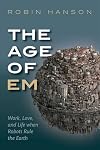
An expose of a world in which emulated minds (ems) has become reality and the life the ems will live and the consequences for society at large. Definitely interesting. Although I can't shake the feeling that if a random 10% of his assumptions turn out to be wrong 90%+ of his, often very detailed, predictions will fail.
Note that the author tries to predict how an em world will be, not how it should be. Hanson is a neoliberal though and he very often assumes market forces will be dominating in show more an em world. Whether this is his own (hopeful) bias, a necessary simplification to make predictions or just a correct description of the future em world I leave to other readers to judge for themselves. show less
Note that the author tries to predict how an em world will be, not how it should be. Hanson is a neoliberal though and he very often assumes market forces will be dominating in show more an em world. Whether this is his own (hopeful) bias, a necessary simplification to make predictions or just a correct description of the future em world I leave to other readers to judge for themselves. show less
Fittingly published on the 1st of April this book can be read in two ways. One is to treat it like an RPG setting book. An imaginative world with highly detailed descriptions, complete with cool potential plots for your campaign. The second way to read it is as a book trying to predict the future in much the same way as The Flintstones is recording history. Everything is strange yet it's all mimicking the current world with superficial differences.
I particularly enjoyed the chapter about show more computational reversibility - good luck with that if you're not a CS academic. I'm a software engineer and I only have a vague idea what it is and unless you know already you're out of luck as the author will not explain anything.
The rest is ridiculously specific descriptions of a future world - a bit like trying to forecast weather 20 years in advance by trying to get the exact temperature, rainfall, etc. on a particular Thursday in March, in your back garden. This is why I'm going with the former way of reading this book. Maybe someone will write a fiction book based on this setting - could be interesting.
One last thing: the author mentions that economists often predict the future correctly but the irrational uncoordinated populace fails to realise the correct prediction (a comment I've read before made by other economists), implying that the only way he can be wrong about his predictions in this book is if we all somehow conspire against him, at which point it's all our fault. AI research must be a traumatising field. show less
I particularly enjoyed the chapter about show more computational reversibility - good luck with that if you're not a CS academic. I'm a software engineer and I only have a vague idea what it is and unless you know already you're out of luck as the author will not explain anything.
The rest is ridiculously specific descriptions of a future world - a bit like trying to forecast weather 20 years in advance by trying to get the exact temperature, rainfall, etc. on a particular Thursday in March, in your back garden. This is why I'm going with the former way of reading this book. Maybe someone will write a fiction book based on this setting - could be interesting.
One last thing: the author mentions that economists often predict the future correctly but the irrational uncoordinated populace fails to realise the correct prediction (a comment I've read before made by other economists), implying that the only way he can be wrong about his predictions in this book is if we all somehow conspire against him, at which point it's all our fault. AI research must be a traumatising field. show less

Отново серията на Cato Institute, отново четирима академици и отново спор с интелектуални есета.
Този път темата е експертите по всякакви въпроси, защо те толкова често грешат и никой не им търси сметка и най-вече защо аджеба хората, медиите и най-вече правителствата продължават show more да им вярват, при условие, че тия експерти познават точно толкова, колкото и ако хвърляха монета и в общия случай по-рядко, отколкото обикновена екстраполация, а статистическите модели са в пъти по-точни.
Любопитен поглед в сферата на "експертизата", полезен за всеки, който слуша някой да се изказва компетентно "по телевизора" или чете предсказанията за икономика/политика/каквото и да е във вестника. show less
Този път темата е експертите по всякакви въпроси, защо те толкова често грешат и никой не им търси сметка и най-вече защо аджеба хората, медиите и най-вече правителствата продължават show more да им вярват, при условие, че тия експерти познават точно толкова, колкото и ако хвърляха монета и в общия случай по-рядко, отколкото обикновена екстраполация, а статистическите модели са в пъти по-точни.
Любопитен поглед в сферата на "експертизата", полезен за всеки, който слуша някой да се изказва компетентно "по телевизора" или чете предсказанията за икономика/политика/каквото и да е във вестника. show less
This is an interesting idea taken to an autistic extreme which made it uninteresting. The core idea is that for a (to humans, brief) period, the first AIs might be emulated humans, and based on physics and logical extrapolations, one can make some interesting predictions about how they will be individually and as groups. The problem is the author went overboard on some very uninteresting areas, and didn't really have enough interesting projections to fill a book, so it ended up both long and show more devoid of content. The concept is great, and a 20-30 page treatment would be great, but not this. show less
Awards

You May Also Like
Associated Authors
Statistics
- Works
- 6
- Also by
- 3
- Members
- 203
- Popularity
- #108,638
- Rating
- 3.6
- Reviews
- 10
- ISBNs
- 8
- Languages
- 1