
Edwin Thompson Denig (1812–1858)
Author of Five Indian Tribes of the Upper Missouri: Sioux, Arickaras, Assiniboines, Crees, Crows
About the Author
Works by Edwin Thompson Denig
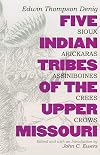
Five Indian Tribes of the Upper Missouri: Sioux, Arickaras, Assiniboines, Crees, Crows (1961) 73 copies, 1 review
Tagged
Common Knowledge
- Birthdate
- 1812-03-10
- Date of death
- 1858-09-04
- Gender
- male
- Occupations
- trader
factor
Indian scout - Nationality
- USA
- Birthplace
- McConnellstown, Philadelphia, USA
- Place of death
- Red River Settlement, Manitoba, Canada
- Burial location
- Anglican Church cemetery at Headingley, Manitoba, Canada
- Associated Place (for map)
- Manitoba, Canada
Members
Reviews

I read this for research, and yet, Denig is a pretty good writer as well. I never thought that it'd be a funny book, and yet, at some points, the way he turns a phrase had me cracking up with laughter.
Five Indian Tribes of the Upper Missouri: Sioux, Arickaras, Assiniboines, Crees, Crows (Volume 59) (The Civilization of the American Indian Series) by Edwin Thompson Denig
Denig was a capable man. He arrived at Fort Union, where he spent most of his career as a trader, in 1833. Like Larpenteur, he served as a clerk there, but, by 1849, he was in charge of the post. When he retired from trading in 1856, he was a partner in the company.
But Denig was also a scholar. He helped John James Audubon obtain specimens – not only of birds and mammals but also the skull of an Indian chief. At the request of his friend Alexander Culbertson, he obtained other animal show more specimens that ended up in the Smithsonian. At the request of his friend, the peripatetic Jesuit missionary Pierre De Smet, the Swedenborgian Denig wrote up his observations on the manners and customs of the tribes he dealt with. He prepared an Assiniboine vocabulary for Henry Schoolcraft of the Bureau of Indian Affairs as well as answering a long questionnaire from him about Indian matters.
All this material found its way into works by De Smet and Schoolcraft as well, acknowledged and unacknowledged, in the work of geologist and ethnologist Ferdinand Hayden.
This work incorporates much of that and more. Denig seems to have started it around 1856, but he hadn’t finished when he died. It passed into the Culbertson family’s possession then and was known, for many years, as the “Culbertson Manuscript” with Denig’s authorship of it finally established in 1849.
Denig’s plan was to write about the tribes he had traded with and in two sections. One section was to talk about the commonalities in the religious practices, customs, and ways of life among all five tribes. The other section was to look at the peculiarities of each tribe. The latter is the only section he seems to have completed and what this book is.
As anthropologist and historian Ewers says in his introduction, this is simply the best account we have of these five tribes as their way of life was fading away under the influence of trade and contact with whites. Traders had written about the tribes of the Upper Missouri since 1738, but Denig’s account is the most complete.
Traders didn’t come to the area to fight or settle. They were there for business and tried to keenly observe their potential customers.
Denig caustically noted that somebody who just spent a few days or months in the area wasn’t qualified to write about Indians, and most of the people who spent decades there didn’t have the education to do it well.
These outsiders presented the Indians in two ways: noble savages or “below the level of the brute creation”. Ewers speculates that Denig was probably thinking of George Catlin and Maximillian, prince of Wied-Neuwied, respectively. Denig’s object was to present his subjects as human in their peculiarities and good and bad points.
There is very little of Denig himself in this account though he does mention some episodes in the fur trade. Each tribe gets their own section. They cover the tribe’s current and historical geographical distributions, its relation to other tribes, and how they met their needs of food, shelter, and clothing. He sometimes mentions religious ceremonies. (Denig had a keen interest in religion and philosophy and had books on those subjects brought to him on the steamboats that came to Fort Union.) The personalities and leadership qualities – good and bad – of particular Indian chiefs are sometimes covered as well as episodes of intertribal warfare. He also talks about the various bands that made up particular tribes and provides demographic estimates sometimes.
Denig was the son of a doctor and sometimes provided medical assistance at trading posts, so he also had an interest in medical matters and provides an account of the 1837 smallpox epidemic that hit the Upper Missouri
It’s all presented in a quite readable style, and Ewers provides some useful annotations which correct some of Denig’s mistaken dates and understanding of geology as well as other traders’ accounts which confirm some of his observations. A useful map of the area covered is also provided.
It’s a 204-page book, so I’m only going to mention some of the memorable details of each tribe.
When discussing the Sioux, he actually delineates the experiences of each band as determined by their location. Skilled warriors, the ones who lived in the area of the Oregon Trail really only became hostile to whites when their game started to be diminished and they started to suffer from epidemics brought by the pilgrims going west. (However, at another point in the book, Denig notes that Indians always blamed whites for epidemics they suffered even when that wasn’t true.)
Since he was writing after the Grattan Massacre, the intermittent war between the United States and the Sioux, which wouldn’t end until 1890, was ongoing, and Denig correctly predicts what would need to be done for the US to bring the tribe to heel.
I don’t recall Denig calling the Arickaras “the horrid tribe”, but many traders did. They were a sedentary tribe on the Missouri that often tried to interfere with traders going up the river. Denig describes them as an unpleasant, dirty lot, outmatched in fighting other tribes. The men lay about, but the women are industrious. Neither is good looking. They are the only tribe where incest is not taboo. Of some of their religious rites, "they are too indelicate for insertion in a work intended for the general reader, or even if recorded, would serve only to show man in the lowest state of animal degradation."
On the plus side, he noted they were the most skilled potters of any tribe and even manufactured beads. They were also very good swimmers and, during the spring melt, would go among the ice floes to get the meat of dead buffaloes and eat them with no ill effect.
After the Arikara War of 1823, the Arikara were forced to eventually settle with the Mandan and Hidatsa, and Denig notes their sad state, not even liked by their neighbors. Once the option to be warriors was closed off to them, the only path to status for an Indian male, the men became a degraded lot.
Denig married into the Assiniboine tribe. In fact, he had two wives from it, a decision he defended by stating his first wife was sickly and mother of his first child and she was a companion to his second wife with whom he had three other children. He noted the Assinibone had “few handsome women” though they were “sly and modest” if not particularly virtuous with none of the vulgarity of Crow or Arikara women and their marriages tended to be long lasting.
The tribe were good hunters with both gun and bow and arrow but “lazy and improvident”. They were technologically conservative and didn’t alter, unlike the Blackfeet and Crow, their manufacture of items. Nor, unlike those other tribes, did they immediately see the benefits of trade. However, contact with traders did make the tribes cleaner and better in their housing. But they still lag behind other tribes in those areas despite their greater contact with whites.
Of the Cree, ranging to the north of the other tribes, Denig notes they had access to a greater variety of game for food and furs. He also deems them the most mechanically innovative tribe in devising and modifying devices for transport, trapping, hunting as well as in their clothes. He suspects, given the Hudson Bay Company’s rotating trapping areas to preserve fur animals, that their way of life may persist longer than the other tribes. They are unusually monogamous. He deems them more peaceful and smarter than the other tribes he covers.
The section of the Crow is the book’s longest. The Crow men are handsome. The women are ugly. The children are unruly. Besides noted horse stealers, the Crow were thieving and abusive among themselves. On the other hand, compared to other tribes, they seldom committed homicide against their fellow tribe members.
Their noted peculiarities are the women’s extensive practice of self-maiming as part of grieving rituals, the institution of “hermaphrodites”, and the rare instance of a female war chief.
Given that the tribe was riddled more than any other with venereal disease and practiced abortion and infanticide, Denig thinks they might vanish. Indeed, Ewers quotes a Blackfoot informant of his stating that, without white intervention, either the Sioux or Blackfeet would have wiped the Crow out.
With an eye for business, Denig notes that trade with the Crow isn’t very profitable. They were very finicky in what they bought and would only take high-quality goods. (While he doesn’t mention it, other sources note that the Crow were said to produce the best quality goods made from buffalo hides.)
If you have an interest in Indian history or that of the fur trade, this book definitely earns its reputation, and it’s easy to see why it shows up in so many bibliographies.
Share this: show less
But Denig was also a scholar. He helped John James Audubon obtain specimens – not only of birds and mammals but also the skull of an Indian chief. At the request of his friend Alexander Culbertson, he obtained other animal show more specimens that ended up in the Smithsonian. At the request of his friend, the peripatetic Jesuit missionary Pierre De Smet, the Swedenborgian Denig wrote up his observations on the manners and customs of the tribes he dealt with. He prepared an Assiniboine vocabulary for Henry Schoolcraft of the Bureau of Indian Affairs as well as answering a long questionnaire from him about Indian matters.
All this material found its way into works by De Smet and Schoolcraft as well, acknowledged and unacknowledged, in the work of geologist and ethnologist Ferdinand Hayden.
This work incorporates much of that and more. Denig seems to have started it around 1856, but he hadn’t finished when he died. It passed into the Culbertson family’s possession then and was known, for many years, as the “Culbertson Manuscript” with Denig’s authorship of it finally established in 1849.
Denig’s plan was to write about the tribes he had traded with and in two sections. One section was to talk about the commonalities in the religious practices, customs, and ways of life among all five tribes. The other section was to look at the peculiarities of each tribe. The latter is the only section he seems to have completed and what this book is.
As anthropologist and historian Ewers says in his introduction, this is simply the best account we have of these five tribes as their way of life was fading away under the influence of trade and contact with whites. Traders had written about the tribes of the Upper Missouri since 1738, but Denig’s account is the most complete.
Traders didn’t come to the area to fight or settle. They were there for business and tried to keenly observe their potential customers.
Denig caustically noted that somebody who just spent a few days or months in the area wasn’t qualified to write about Indians, and most of the people who spent decades there didn’t have the education to do it well.
These outsiders presented the Indians in two ways: noble savages or “below the level of the brute creation”. Ewers speculates that Denig was probably thinking of George Catlin and Maximillian, prince of Wied-Neuwied, respectively. Denig’s object was to present his subjects as human in their peculiarities and good and bad points.
There is very little of Denig himself in this account though he does mention some episodes in the fur trade. Each tribe gets their own section. They cover the tribe’s current and historical geographical distributions, its relation to other tribes, and how they met their needs of food, shelter, and clothing. He sometimes mentions religious ceremonies. (Denig had a keen interest in religion and philosophy and had books on those subjects brought to him on the steamboats that came to Fort Union.) The personalities and leadership qualities – good and bad – of particular Indian chiefs are sometimes covered as well as episodes of intertribal warfare. He also talks about the various bands that made up particular tribes and provides demographic estimates sometimes.
Denig was the son of a doctor and sometimes provided medical assistance at trading posts, so he also had an interest in medical matters and provides an account of the 1837 smallpox epidemic that hit the Upper Missouri
It’s all presented in a quite readable style, and Ewers provides some useful annotations which correct some of Denig’s mistaken dates and understanding of geology as well as other traders’ accounts which confirm some of his observations. A useful map of the area covered is also provided.
It’s a 204-page book, so I’m only going to mention some of the memorable details of each tribe.
When discussing the Sioux, he actually delineates the experiences of each band as determined by their location. Skilled warriors, the ones who lived in the area of the Oregon Trail really only became hostile to whites when their game started to be diminished and they started to suffer from epidemics brought by the pilgrims going west. (However, at another point in the book, Denig notes that Indians always blamed whites for epidemics they suffered even when that wasn’t true.)
Since he was writing after the Grattan Massacre, the intermittent war between the United States and the Sioux, which wouldn’t end until 1890, was ongoing, and Denig correctly predicts what would need to be done for the US to bring the tribe to heel.
I don’t recall Denig calling the Arickaras “the horrid tribe”, but many traders did. They were a sedentary tribe on the Missouri that often tried to interfere with traders going up the river. Denig describes them as an unpleasant, dirty lot, outmatched in fighting other tribes. The men lay about, but the women are industrious. Neither is good looking. They are the only tribe where incest is not taboo. Of some of their religious rites, "they are too indelicate for insertion in a work intended for the general reader, or even if recorded, would serve only to show man in the lowest state of animal degradation."
On the plus side, he noted they were the most skilled potters of any tribe and even manufactured beads. They were also very good swimmers and, during the spring melt, would go among the ice floes to get the meat of dead buffaloes and eat them with no ill effect.
After the Arikara War of 1823, the Arikara were forced to eventually settle with the Mandan and Hidatsa, and Denig notes their sad state, not even liked by their neighbors. Once the option to be warriors was closed off to them, the only path to status for an Indian male, the men became a degraded lot.
Denig married into the Assiniboine tribe. In fact, he had two wives from it, a decision he defended by stating his first wife was sickly and mother of his first child and she was a companion to his second wife with whom he had three other children. He noted the Assinibone had “few handsome women” though they were “sly and modest” if not particularly virtuous with none of the vulgarity of Crow or Arikara women and their marriages tended to be long lasting.
The tribe were good hunters with both gun and bow and arrow but “lazy and improvident”. They were technologically conservative and didn’t alter, unlike the Blackfeet and Crow, their manufacture of items. Nor, unlike those other tribes, did they immediately see the benefits of trade. However, contact with traders did make the tribes cleaner and better in their housing. But they still lag behind other tribes in those areas despite their greater contact with whites.
Of the Cree, ranging to the north of the other tribes, Denig notes they had access to a greater variety of game for food and furs. He also deems them the most mechanically innovative tribe in devising and modifying devices for transport, trapping, hunting as well as in their clothes. He suspects, given the Hudson Bay Company’s rotating trapping areas to preserve fur animals, that their way of life may persist longer than the other tribes. They are unusually monogamous. He deems them more peaceful and smarter than the other tribes he covers.
The section of the Crow is the book’s longest. The Crow men are handsome. The women are ugly. The children are unruly. Besides noted horse stealers, the Crow were thieving and abusive among themselves. On the other hand, compared to other tribes, they seldom committed homicide against their fellow tribe members.
Their noted peculiarities are the women’s extensive practice of self-maiming as part of grieving rituals, the institution of “hermaphrodites”, and the rare instance of a female war chief.
Given that the tribe was riddled more than any other with venereal disease and practiced abortion and infanticide, Denig thinks they might vanish. Indeed, Ewers quotes a Blackfoot informant of his stating that, without white intervention, either the Sioux or Blackfeet would have wiped the Crow out.
With an eye for business, Denig notes that trade with the Crow isn’t very profitable. They were very finicky in what they bought and would only take high-quality goods. (While he doesn’t mention it, other sources note that the Crow were said to produce the best quality goods made from buffalo hides.)
If you have an interest in Indian history or that of the fur trade, this book definitely earns its reputation, and it’s easy to see why it shows up in so many bibliographies.
Share this: show less
You May Also Like
Associated Authors
Statistics
- Works
- 6
- Members
- 97
- Popularity
- #194,531
- Rating
- 5.0
- Reviews
- 2
- ISBNs
- 8