
Donald J. Robertson
Author of How to Think Like a Roman Emperor: The Stoic Philosophy of Marcus Aurelius
About the Author
Donald Robertson is a cognitive-behavioural psychotherapist, writer, and trainer. He specializes in the treatment of anxiety and in the relationship between ancient philosophy and modern psychotherapy. He is the author of six books on philosophy and psychotherapy, including The Practice of show more Cognitive-Behavioural Hypnotherapy: A Manual for Evidence-Based Clinical Hypnosis (2013). show less
Works by Donald J. Robertson
How to Think Like a Roman Emperor: The Stoic Philosophy of Marcus Aurelius (2019) 580 copies, 9 reviews
How to Think Like Socrates: Ancient Philosophy as a Way of Life in the Modern World (2024) 98 copies, 4 reviews
The Philosophy of Cognitive Behavioural Therapy: Stoic Philosophy as Rational and Cognitive Psychotherapy (2010) 71 copies
The Practice of Cognitive-Behavioural Hypnotherapy: A Manual for Evidence-Based Clinical Hypnosis (2012) 8 copies
Build Your Resilience: CBT, Mindfulness and Stress Management to Survive and Thrive in Any Situation (Teach Yourself) (2019) 7 copies
Associated Works
Tagged
Common Knowledge
- Gender
- male
- Nationality
- United Kingdom
- Associated Place (for map)
- United Kingdom
Members
Reviews
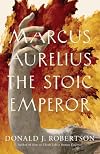
The Man behind the [book:Meditations|30659]
Review of the Yale University Press hardcover (February 6, 2024).
I had previously read author Donald J. Robertson's How to Think Like a Roman Emperor: The Stoic Philosophy of Marcus Aurelius (2019). That was during my intermittent reviewing days so although I rated it 5 stars I never got around to writing a review about it. I was definitely interested when I read that he was writing a further biography for Yale's Ancient Lives series.
See photograph at https://i.pinimg.com/originals/e4/24/d7/e424d7970d13d6249ad7e1e19cf5365c.jpg
A statue of Marcus Aurelius. A cropped photo of the arm of this statue has been used for the cover of this book. Image sourced from Pinterest.
Robertson lives up to his planned goal by tracing the influence of various individuals on the life of the young Marcus Aurelius (121-180 AD/CE), especially from his mother and the various Roman emperors and Stoic philosophers who he encountered prior to becoming emperor at the age of 40 in 161 CE. He actually grew up thinking to become a philosopher rather than the ruler of Rome. Circumstances and the odd manner of Roman adoption led him to the imperial role, which was initially a co-emperor rule with adoptive brother Lucius Verus (130-169 CE).
The Meditations were written towards the end of his life during campaigns against the various warring Parthian and Germanic tribes. It is often the absence of comment in the Mediations about certain individuals, such as the emperor Hadrian (76-138 CE), that we understand those whom Marcus Aurelius didn't respect. From the description of Hadrian's rule and his pathological obsession with dead lover Antinous (111-130 CE), it is actually surprising that he is considered one of the 5 so-called "Good Emperors" of Rome.
There was a excellent amount of background to the life of Marcus Aurelius in this book and I learned various other interesting bits of trivia about Ancient Rome in the process. For instance I didn't understand previously that the title "Caesar" was actually given to the designated heir and not to the emperor themselves. "Imperator" was an honorary title granted upon the success of a military campaign. "Memento mori" meaning "Remember that you are mortal and will die" was an expression whispered by accompanying slaves into the ear of a victorious emperor or general as they rode chariots in a triumphal procession after a military victory, in an effort to undermine any thoughts of grandeur.
I enjoyed reading this further book in the Yale University Press' Ancient Lives series. I had previously read and reviewed Vergil: The Poet's Life, Cleopatra: Her History, Her Myth and Demetrius: Sacker of Cities.
Other Books
Donald J. Robertson is also the author of the forthcoming How to Think Like Socrates: Ancient Philosophy as a Way of Life in the Modern World (expected publication November 19, 2024).
Trivia and Links
Read an article by author Donald Roberson at Marcus Aurelius and How to Cope with Anxiety at Yale University Press.
There is also a Q&A about Marcus Aurelius with author Donald Robertson which can read at Who was Marcus Aurelius?.
Marcus Aurelius: The Stoic Emperor is part of Yale University Press's Ancient Lives series. show less
Review of the Yale University Press hardcover (February 6, 2024).
I had previously read author Donald J. Robertson's How to Think Like a Roman Emperor: The Stoic Philosophy of Marcus Aurelius (2019). That was during my intermittent reviewing days so although I rated it 5 stars I never got around to writing a review about it. I was definitely interested when I read that he was writing a further biography for Yale's Ancient Lives series.
There areshow more
already several biographies of Marcus Aurelius but I had been asked to write one that focused more on his character as an individual. It’s unusual that a non-academic would be asked to author one of these books. My background is in psychotherapy and philosophy rather than classics or history. I felt that previous attempts could have said a lot more about how Stoic philosophy guided his actions, and so I approached writing this book as if it were more like what I’d describe as a philosophical biography. - excerpt quoted from the author's substack.
See photograph at https://i.pinimg.com/originals/e4/24/d7/e424d7970d13d6249ad7e1e19cf5365c.jpg
A statue of Marcus Aurelius. A cropped photo of the arm of this statue has been used for the cover of this book. Image sourced from Pinterest.
Robertson lives up to his planned goal by tracing the influence of various individuals on the life of the young Marcus Aurelius (121-180 AD/CE), especially from his mother and the various Roman emperors and Stoic philosophers who he encountered prior to becoming emperor at the age of 40 in 161 CE. He actually grew up thinking to become a philosopher rather than the ruler of Rome. Circumstances and the odd manner of Roman adoption led him to the imperial role, which was initially a co-emperor rule with adoptive brother Lucius Verus (130-169 CE).
The Meditations were written towards the end of his life during campaigns against the various warring Parthian and Germanic tribes. It is often the absence of comment in the Mediations about certain individuals, such as the emperor Hadrian (76-138 CE), that we understand those whom Marcus Aurelius didn't respect. From the description of Hadrian's rule and his pathological obsession with dead lover Antinous (111-130 CE), it is actually surprising that he is considered one of the 5 so-called "Good Emperors" of Rome.
There was a excellent amount of background to the life of Marcus Aurelius in this book and I learned various other interesting bits of trivia about Ancient Rome in the process. For instance I didn't understand previously that the title "Caesar" was actually given to the designated heir and not to the emperor themselves. "Imperator" was an honorary title granted upon the success of a military campaign. "Memento mori" meaning "Remember that you are mortal and will die" was an expression whispered by accompanying slaves into the ear of a victorious emperor or general as they rode chariots in a triumphal procession after a military victory, in an effort to undermine any thoughts of grandeur.
I enjoyed reading this further book in the Yale University Press' Ancient Lives series. I had previously read and reviewed Vergil: The Poet's Life, Cleopatra: Her History, Her Myth and Demetrius: Sacker of Cities.
Other Books
Donald J. Robertson is also the author of the forthcoming How to Think Like Socrates: Ancient Philosophy as a Way of Life in the Modern World (expected publication November 19, 2024).
Trivia and Links
Read an article by author Donald Roberson at Marcus Aurelius and How to Cope with Anxiety at Yale University Press.
There is also a Q&A about Marcus Aurelius with author Donald Robertson which can read at Who was Marcus Aurelius?.
Marcus Aurelius: The Stoic Emperor is part of Yale University Press's Ancient Lives series. show less
How to Think Like Socrates: Ancient Philosophy as a Way of Life in the Modern World by Donald J. Robertson
Socrates was, in many ways, the originator in the West of both self-help and philosophy as a form of therapy. It’s only fitting, then, that a licensed cognitive-behavioral psychotherapist would try his hand at updating the dialogues of Socrates for the modern world using contemporary examples and language.
Socrates has much to teach us (and every generation), not in the form of answers, but in the form of questions more complex than we’re used to asking ourselves. In the process, we show more learn to live up to the philosophical maxim “know thyself” by exploring foundational questions regarding the true nature of love, wisdom, friendship, justice, and more.
It turns out that the key to Socratic reasoning is the search for exceptions to your own definitions, beliefs, and moral principles. The process of questioning your own beliefs—the antithesis of arrogant, dogmatic thinking—cultivates the same kind of “cognitive flexibility” that modern psychologists instill in their patients to eradicate false or destructive beliefs. Socratic reasoning is, therefore, therapeutic in the deepest sense.
You might ask, however, that if you want to think like Socrates, why not just read Plato’s dialogues directly, the original and most authoritative source of Socratic thinking? You certainly can do this (and should), but in writing the dialogues, Plato did presuppose that his readers had firsthand knowledge of the people, places, and events in ancient Greece that permeate his dialogues.
Since most modern readers will lack this knowledge, they’ll appreciate the author’s effort in explaining—in great detail—the people, places, and events that form the background of Socrates’s world. In fact, this is a major selling point of the book: The author narrates the life and thought of Socrates in a way that transports you back in time and allows you to walk in the shoes of philosophy’s most important thinker. What you’ll come away with (hopefully) is what everyone else who interacted with Socrates ultimately discovered—the limits of their own knowledge and a deeper sense of intellectual humility. It’s hard to think of something the world could need more of.
Note: I received a free copy of this book from NetGalley in exchange for an honest review. show less
Socrates has much to teach us (and every generation), not in the form of answers, but in the form of questions more complex than we’re used to asking ourselves. In the process, we show more learn to live up to the philosophical maxim “know thyself” by exploring foundational questions regarding the true nature of love, wisdom, friendship, justice, and more.
It turns out that the key to Socratic reasoning is the search for exceptions to your own definitions, beliefs, and moral principles. The process of questioning your own beliefs—the antithesis of arrogant, dogmatic thinking—cultivates the same kind of “cognitive flexibility” that modern psychologists instill in their patients to eradicate false or destructive beliefs. Socratic reasoning is, therefore, therapeutic in the deepest sense.
You might ask, however, that if you want to think like Socrates, why not just read Plato’s dialogues directly, the original and most authoritative source of Socratic thinking? You certainly can do this (and should), but in writing the dialogues, Plato did presuppose that his readers had firsthand knowledge of the people, places, and events in ancient Greece that permeate his dialogues.
Since most modern readers will lack this knowledge, they’ll appreciate the author’s effort in explaining—in great detail—the people, places, and events that form the background of Socrates’s world. In fact, this is a major selling point of the book: The author narrates the life and thought of Socrates in a way that transports you back in time and allows you to walk in the shoes of philosophy’s most important thinker. What you’ll come away with (hopefully) is what everyone else who interacted with Socrates ultimately discovered—the limits of their own knowledge and a deeper sense of intellectual humility. It’s hard to think of something the world could need more of.
Note: I received a free copy of this book from NetGalley in exchange for an honest review. show less
- He believed that true strength consisted of one’s ability to show kindness, not violence or aggression.
- Stoic speech as counter rhetoric
- A dog tethered to a moving cart can either pull on his leash and be
- “It is impossible to make men exactly as one would wish them to be; we must use them such as they are.”
- When you point your finger in anger at someone else, remember that three fingers on the same hand point back in your own direction.
- First we must follow the guidance of our own higher nature, submitting ourselves to reason’s dictates. Second, we must deal wisely and dispassionately with whatever universal Nature sends to be our fate, whether pleasure or pain, praise or censure, life or death.
- What matters is how I face this moment, which shall soon be gone, for I can already feel my very self evaporating, slipping gradually into extinction as if into a dream.
How to Think Like Socrates: Ancient Philosophy as a Way of Life in the Modern World by Donald J. Robertson
Socrates 101
A review of the St. Martin's Press Kindle ARC via NetGalley, obtained in advance of the official hardcover/ebook/audiobook (November 19, 2024).
I thoroughly enjoyed this latest philosophy/self-help mashup from author Donald J. Robertson who also works as a Cognitive Behavioral Psychotherapist. This current book follows the life of Ancient Greek philosopher Socrates (c470-399BC) by paraphrasing / retelling his teachings & dialogues from the later writings of his students / show more followers such as Plato (428-348BC) and Xenophon (430-355BC).
See image at https://scontent-ord5-2.xx.fbcdn.net/v/t39.30808-6/467017410_28547567894841958_4...
Socrates in the Modern World. Image sourced from an AI creation.
There are no surviving writings by Socrates himself, so what we have are his so-called Socratic dialogues with various historical characters as later recorded by his followers. Reading the translations of works such as Plato's Apology (Socrates' defense at his trial before his verdict, sentencing and execution for impiety and corruption of youth) and other works can sometimes be pretty hard going (see Project Gutenberg for examples).
Robertson has distilled those thorny tracts into a reader user-friendly life-story which incorporates the then current historical events of the struggles of Greek democracy in the age of Pericles, Alcibiades and the Peloponnesian War between Athens and Sparta and then the later period of the Thirty Tyrants. Periodically there are interludes where the question and answer methods of Socratic dialogue are shown as reflected in the methods of modern behavioral therapy.
My thanks to the author, the publisher St. Martin's Press and NetGalley for the opportunity to read this preview ARC, in exchange for which I provide this honest review.
Quotes
I know they say that you shouldn't use quotes from advance reading copies, but I just couldn't resist noting these passages about the autocratic general Cleon (? - 422 BC) because they seem to presciently forecast a certain politician and even current events in 2024.
Trivia and Link
If you are reading this before the November 19, 2024 release date and can still pre-order the book, you can also register for a free Zoom session with the author on the release date and for promotional materials which will follow via email on November 20, 2024 at the author's substack website here. show less
A review of the St. Martin's Press Kindle ARC via NetGalley, obtained in advance of the official hardcover/ebook/audiobook (November 19, 2024).
I thoroughly enjoyed this latest philosophy/self-help mashup from author Donald J. Robertson who also works as a Cognitive Behavioral Psychotherapist. This current book follows the life of Ancient Greek philosopher Socrates (c470-399BC) by paraphrasing / retelling his teachings & dialogues from the later writings of his students / show more followers such as Plato (428-348BC) and Xenophon (430-355BC).
See image at https://scontent-ord5-2.xx.fbcdn.net/v/t39.30808-6/467017410_28547567894841958_4...
Socrates in the Modern World. Image sourced from an AI creation.
There are no surviving writings by Socrates himself, so what we have are his so-called Socratic dialogues with various historical characters as later recorded by his followers. Reading the translations of works such as Plato's Apology (Socrates' defense at his trial before his verdict, sentencing and execution for impiety and corruption of youth) and other works can sometimes be pretty hard going (see Project Gutenberg for examples).
Robertson has distilled those thorny tracts into a reader user-friendly life-story which incorporates the then current historical events of the struggles of Greek democracy in the age of Pericles, Alcibiades and the Peloponnesian War between Athens and Sparta and then the later period of the Thirty Tyrants. Periodically there are interludes where the question and answer methods of Socratic dialogue are shown as reflected in the methods of modern behavioral therapy.
My thanks to the author, the publisher St. Martin's Press and NetGalley for the opportunity to read this preview ARC, in exchange for which I provide this honest review.
Quotes
I know they say that you shouldn't use quotes from advance reading copies, but I just couldn't resist noting these passages about the autocratic general Cleon (? - 422 BC) because they seem to presciently forecast a certain politician and even current events in 2024.
Cleon, a businessman whose wealth came from his family's tannery, emerged as a political outsider, a demagogue who quickly gained popularity by attacking the ruling elite. He evolved into a radical populist, appealing to the lower classes with a distinctive approach in the Assembly, characterized by his cynicism, aggression, and forthrightness.
...
In the aftermath of the plague, as Athens tried to reassert herself, Cleon's rhetoric became more violent, crude, and aggressive, as he attacked his critics rather than refuting them, but most often he carried the Assembly with him. Soon, this kind of outlandish behavior became normalized, and the political climate at Athens degenerated into partisan bickering.
...
Genuine statesmen gave way to demagogues, who stoked the fear and anger of the citizens and pandered to their greed and other vices.
Trivia and Link
If you are reading this before the November 19, 2024 release date and can still pre-order the book, you can also register for a free Zoom session with the author on the release date and for promotional materials which will follow via email on November 20, 2024 at the author's substack website here. show less
Lists
You May Also Like


Associated Authors
Statistics
- Works
- 20
- Also by
- 1
- Members
- 1,273
- Popularity
- #20,146
- Rating
- 4.2
- Reviews
- 21
- ISBNs
- 49
- Languages
- 6