
Hubert Parry (1848–1918)
Author of Studies of Great Composers
About the Author
Image credit: Courtesy of the NYPL Digital Gallery (image use requires permission from the New York Public Library)
Works by Hubert Parry
Dear Lord and Father 7 copies
Parry: Piano Concerto in F sharp Major / Stanford: Piano Concerto No. 1 [sound recording] (1995) — Composer — 5 copies
Jerusalem 5 copies
Elgar : Dream of Gerontius + Parry : Blest Pair of Sirens + I Was Glad {sound recording} {Hickox/LSO} (1988) — Composer — 2 copies
Music, When Soft voices die 2 copies
Overture to an unwritten tragedy ; An English suite ; Bridal march : (The birds) ; Lady Radnor's suite ; Symphonic variations. {Sound recording: CD} (2007) 2 copies, 1 review
Seven Chorale Preludes, Set I 2 copies
Johann Sebastian Bach G.P. Putnam's Sons, New York and London, The Knickerbocker Press, 1909 2 copies
Shulbrede Tunes for Pianoforte 2 copies
Beethoven, su vida y sus obras — Composer — 1 copy
Songs By Sir Hubert Parry 1 copy
Hubert Parry - Gebundeld 1 copy
Symphony No. 4 in E minor 1 copy
Land of Hope and Glory [sound recording] — Composer — 1 copy
O Praise Ye The Lord 1 copy
Piano Sonata no. 2 (1876) 1 copy
O for the Wings of a Dove 1 copy
Sir Hubert Parry 1 copy
Organ Album, book 1 1 copy
Voces Clamantium 1 copy
Classic Football Scores 1 copy
My delight and thy delight 1 copy
Ye thrilled me once 1 copy
Motet. " At the round Earth's imagined Corners, " for the group called " Songs of Farewell " ... Words by J. Donne (1917) 1 copy
Summary of the History and Development of Medieval and Modern European Music (Cambridge Library Collection - Music) (2009) 1 copy
Overture to an unwritten tragedy. Symphony No. 2 in F major "Cambridge". Symphonic Variations in E. {Sound recording: CD} 1 copy, 1 review
Symphony No. 5 in b minor. From death to life. Elegy for Brahms. {Sound recording: CD} 1 copy, 1 review
English Lyrics (9th Set) 1 copy
Johann Sebastian Bach 1 copy
6 songs of farewell 1 copy
The Pied Piper of Hamelin 1 copy
Come, Pretty Wag, and Sing 1 copy
Associated Works
Music for the Last Night of the Proms [sound recording] — Composer — 3 copies
The Best of British [sound recording] — Composer — 2 copies
BBC Proms 2021 : Prom 46 : Last Night of the Proms 2021 [sound recording] (2021) — Composer — 1 copy
Tagged
Common Knowledge
- Canonical name
- Parry, Sir Hubert
- Legal name
- Parry, Sir Charles Hubert Hastings, 1st Baronet
- Birthdate
- 1848-02-27
- Date of death
- 1918-10-07
- Gender
- male
- Education
- Eton College, Eton, Berkshire, England, UK
Twyford School, Twyford, Hampshire, England, UK
University of Oxford (Exeter College) - Occupations
- composer
professor
historian of music - Organizations
- Royal College of Music (Director, 1895-1918)
Oxford University (Professor of Music, 1900-08) - Awards and honors
- Knight Bachelor (1898)
Baronet (1902) - Nationality
- UK
- Birthplace
- Richmond Hill, Bournemouth, England, UK
- Places of residence
- Highnam Court, Gloucestershire, England, UK
London, England, UK
Stuttgart, Germany - Place of death
- Knightscroft, Rustington, West Sussex, England, UK
- Burial location
- St. Paul's Cathedral, London, England, UK
- Associated Place (for map)
- England, UK
Members
Reviews

As may be discerned elsewhere in myRreviews, I am a great admirer of Parry's work, and I am grateful to the various recording compoanies (HNH, Chandos, and Nimbus) for helping to restore him to music-listeners who might otherwise dismiss him as the composer of "Jerusalem", and/or the unhappy viction of Bernard Shaw's persistent pissiness. Now, that sentence is long, not simply -- not at-all, in fact -- because I can't write any better, but as a subtle suggestion of what one encounters in show more Parry's symophonies: a lot of idea, big breaths, big structures, but also clear purpose. In all those aspects, he resembles Brahms, whom we know he esteemed highly. At the same time his harmonic and orchestral pallette is -- dare I say it? -- broader than that of the German master, in that he has a greater self-indulgence in some of the sounds of Wagner, Liszt, and even the Russians, than Brahms would ever have considered. This G--Major First Symphony -- recorded here for the first time -- is of interest in that light, but also, of-course, for its own beauty, perhaps not a fully fleshed-out beauty, but beauty nonetheless. The late work FROM DEATH TO LIFE -- whose Latin title is botched on the jewel-case label -- is likewise beautiful, but this time one doesn't seen the bones below the skin. It is a perfectly realized evocation of the mood of a man who had endured personal crisis and was, at the time oif composing this, sharing the horror of "the Great War". In this particular performance, conductor Boughton makes a much more radical break in tempo between the two main sections than does Mattias Bamert in the Chandos version. Without benefit of the score, I won't venture which is the more "authentic". Both are convincing, and both reveal this to be a masterpiece well worth a place in the satndard repertory. Nimbus recording and accompanying notes are up to the highest standards. show less
Symphony No. 5 in b minor. From death to life. Elegy for Brahms. {Sound recording: CD} by Charles Hubert Hastings Parry
My favourite of the various Bamert-conducted Chandos recordings of Parry's works. The Fifth Symphony, which Parry subtitled "Symphonic Fantasia 1912", has a combination of sweep and tenderness which should open a place for this work besides several much-overprogrammed late-Romantic symphonies by Brahms, Dvorak, Chaikovsky, and Mahler. Its four interlinked movements are marked "Stress", "Love", "Play", and (remarkably) "Now". As little as I like to identify non-musical elements in pure music, show more the companion piece FROM DEATH TO LIFE unquestionably reflects -- as the title suggests -- the horrors of the World War, not to mention at-least a little contemplation of his own mortality: he would die in 1918, weeks before the Armistice. The final piece, the ELEGY FOR BRAHMS is a tender homage to the recently-dead master, in much the language of Brahms, but without slavishness imitation. show less
Overture to an unwritten tragedy. Symphony No. 2 in F major "Cambridge". Symphonic Variations in E. {Sound recording: CD} by Charles Hubert Hastings Parry
See my review of Parry's First Symphony for some general remarks about Parry. Suffice it to say of this recording that te energy and accuracy of the playing is exemplary, as is this 1995 recording produced and engineered by Tim Handley. I say "accuracy" for the specific reason that Parry' sound includes a whack of high, fast lines for the violins, and they are not for the faint of heart. Incdentally, as to the OVERTURE TO AN UNWRITTEN TRAGEDY, what was going-on with those Victorians? Landor show more wrote his IMAGINARY CONVERSATIONS, Rolfe wrote his reviews of unwritten books, and now we have Parry. Maybe it was all that coal dust in the heady days of industrial expansion. Who knows? show less
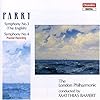
I will say this up-front, and will probably repeat it in other reviews of Parry's music, but I am a great admirer of Parry's music. This recording is part of Chandos Records' series of recordings condcuted by Matthias Bamert, who has become a specialist in Parry's music. The performances and recording are first-class. To my taste, the Fourth Symphony, recorded here for the first time, is of mostly historic interest to Parry-maniacs like myself and Bammert. The Third, called "The English" is show more another story: expansive, jaunty, infectiously good-natured. show less
You May Also Like


Associated Authors
Statistics
- Works
- 101
- Also by
- 6
- Members
- 223
- Popularity
- #100,549
- Rating
- 4.1
- Reviews
- 5
- ISBNs
- 28