
Greg Costikyan
Author of Another Day, Another Dungeon
About the Author
Series
Works by Greg Costikyan
And Still She Sleeps 2 copies
Bright Light Big City 1 copy
The West Is Red 1 copy
Star Wars : juego de rol 1 copy
Bug-eyed Monsters 1 copy
DeathMaze 1 copy
Complete Short Fiction 1 copy
High On Life 1 copy
Associated Works
Second Person: Role-Playing and Story in Games and Playable Media (2007) — Contributor — 113 copies, 1 review
Isaac Asimov's Science Fiction Magazine: Vol. 16, No. 8 [July 1992] (1992) — Contributor — 14 copies
Tagged
Common Knowledge
- Canonical name
- Costikyan, Greg
- Legal name
- Costikyan, Gregory John
- Other names
- Designer X
- Birthdate
- 1959
- Gender
- male
- Education
- Brown University (1982)
- Occupations
- game designer
science fiction author - Nationality
- USA
- Places of residence
- New York, New York, USA
- Associated Place (for map)
- New York, USA
Members
Discussions
Sci-fi: Economic, 80's. in Name that Book (September 2012)
Reviews

I work for a game developer and our office purchased this book for our library. I was very pleased they did, this is an excellent analysis as to why a little bit of uncertainty, randomness and unexpected results can be positive influences on nearly all popular games. I liked the specific examples Costikyan gave for Chess, Poker, Ticket to Ride, Risk, Super Mario Bros and dozens of other games across a myriad of influences, history and genres. Clearly well researched and well written.

I've always enjoyed my science fiction steeped in dark humor and satire, so it's no wonder that Paranoia was the first role-playing game I really got into. Set in a dystopian future in which vast underground complexes are run by an insane computer, Paranoia satirizes not only the "Big Brother" totalitarian element of the science fiction genre, but also the communal team building element of role-playing games as a whole.
As most RPG gamers know too well, playing immersive fantasy games like show more Dungeons & Dragons or Top Secret (showing my age here) with a large group of people will more often than not result in personality clashes within the game itself, often leading to backstabbing and bitter rivalries. Paranoia takes the extra step towards chaos by not just embracing the backstabbing and bitter rivalries, but making them an integral part of the game.
As Troubleshooters (they, you know, shoot trouble), player characters are dedicated to fighting underground elements that threaten the integrity of The Computer's rule, such as citizens with mutant abilities and members of secret societies. Needless to say, all Troubleshooter player characters have mutant abilities and belong to secret societies. The web of lies, deceptions, alternate mission goals, and dual allegiances adds countless conflicts adds to the dangers already inherent in an environment rife with incompetence, madness, and... you guessed it, paranoia. In fact, life is so perilous as a Troubleshooter in Alpha Complex that players start every game with six clones of their character just so they have a chance at surviving until the end of the game. It isn't uncommon for a player to lose one or two clones to misfortune - either deliberate or accidental - before their mission even begins. Actually, it's very common.
Paranoia is the ideal game for role-players who enjoy a little self-aware humor and chaotic mischief in their dungeon (complex) crawls. Just remember. The Computer is your friend. show less
As most RPG gamers know too well, playing immersive fantasy games like show more Dungeons & Dragons or Top Secret (showing my age here) with a large group of people will more often than not result in personality clashes within the game itself, often leading to backstabbing and bitter rivalries. Paranoia takes the extra step towards chaos by not just embracing the backstabbing and bitter rivalries, but making them an integral part of the game.
As Troubleshooters (they, you know, shoot trouble), player characters are dedicated to fighting underground elements that threaten the integrity of The Computer's rule, such as citizens with mutant abilities and members of secret societies. Needless to say, all Troubleshooter player characters have mutant abilities and belong to secret societies. The web of lies, deceptions, alternate mission goals, and dual allegiances adds countless conflicts adds to the dangers already inherent in an environment rife with incompetence, madness, and... you guessed it, paranoia. In fact, life is so perilous as a Troubleshooter in Alpha Complex that players start every game with six clones of their character just so they have a chance at surviving until the end of the game. It isn't uncommon for a player to lose one or two clones to misfortune - either deliberate or accidental - before their mission even begins. Actually, it's very common.
Paranoia is the ideal game for role-players who enjoy a little self-aware humor and chaotic mischief in their dungeon (complex) crawls. Just remember. The Computer is your friend. show less
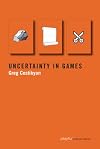
A book that sticks with its argument and can be read in two hours, Uncertainty in Games is an interesting exposure of the underbelly of games—I won’t call it “dark.” According to Costikyan, human life is a series of attempts to minimize uncertainty: we buy insurance, open 401Ks, and save for those rainy days. Games are a way for us to enjoy uncertainty in safe and controlled environments. The argument is convincing and bolstered by the long middle section of the book where Costikyan show more analyzes a number of popular games according to the kinds of uncertainty they foster for their players' satisfaction. Chess and poker score unsurprisingly high and Candy Land unsurprisingly low—but there are some interesting surprises, such as Costikyan’s argument that Monopoly is “ultimately dull” because of its “excruciatingly extended endgame.” He continues:
"Almost all of the game’s uncertainty lies in the unpredictability of the dice and, to a lesser degree, card draws—random elements. Only the theme and the paraphernalia of properties and houses and hotels and money hides from the players that they might as well be playing roulette, and without the real-money risk and reward that makes roulette of interest to those who play it. The appeal of Monopoly lies in its color, and not in its gameplay."
The reader may agree or disagree or, like my son, become a little outraged by this idea. But the idea, like others of Costikyan’s, sticks in one’s head. Part of the book’s value lies in its ability to prompt a reader to think of games not mentioned in its pages and apply Costikyan’s rules to them. What would he say about Munchkin? About Carsiconne? If this were a hundred pages longer or more technical concerning the algorithms used in computer games, I might have abandoned it, but the light touch keeps the reader interested. Plus, after reading it, you’ll better understand why Chutes and Ladders is so fascinating to a five-year-old but an endurance test for adults. show less
"Almost all of the game’s uncertainty lies in the unpredictability of the dice and, to a lesser degree, card draws—random elements. Only the theme and the paraphernalia of properties and houses and hotels and money hides from the players that they might as well be playing roulette, and without the real-money risk and reward that makes roulette of interest to those who play it. The appeal of Monopoly lies in its color, and not in its gameplay."
The reader may agree or disagree or, like my son, become a little outraged by this idea. But the idea, like others of Costikyan’s, sticks in one’s head. Part of the book’s value lies in its ability to prompt a reader to think of games not mentioned in its pages and apply Costikyan’s rules to them. What would he say about Munchkin? About Carsiconne? If this were a hundred pages longer or more technical concerning the algorithms used in computer games, I might have abandoned it, but the light touch keeps the reader interested. Plus, after reading it, you’ll better understand why Chutes and Ladders is so fascinating to a five-year-old but an endurance test for adults. show less
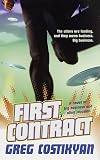
Life is going well for Johnson Mukerjii: he's the CEO of a prosperous high-tech firm and he only expects it to get more prosperous from here on out. That is until aliens arrive. They have vastly superior technology and they're practically giving it away. Pretty soon 50% of Americans are out of work, including Mukerjii. All he knows is sales and business, but what could he possibly sell to the aliens?
I really enjoyed this book and I didn't expect to. First off, I misread the title and didn't show more realize it for a few chapters. That sneaky little "r" really makes a difference. Second, the back copy is completely hokey and ridiculous. But it also completely works with the story. The main character Muckerjii is very cool and he's got a great vocabulary. Always a bonus for this Reading teacher. I know I categorized this as middle school but I might consider using it as a read aloud for some verbally acquisitive 4th or 5th graders. There are some terrific wordplays going on. Take the name of the law firm for example: Captious, Invidious, Conniving & Cruik. That's a nice variation on the standard "Dewey, Cheatum & Howe."
This book barely qualifies as science fiction. Yes, there are aliens and even some space travel but it is very light on the science. Which you could view as a good thing; it could lure some new fans into the genre. I love Heinlein but he could get a little heavy with the vectors and trajectories and three dimensional chess. I can't even play one dimensional chess. show less
I really enjoyed this book and I didn't expect to. First off, I misread the title and didn't show more realize it for a few chapters. That sneaky little "r" really makes a difference. Second, the back copy is completely hokey and ridiculous. But it also completely works with the story. The main character Muckerjii is very cool and he's got a great vocabulary. Always a bonus for this Reading teacher. I know I categorized this as middle school but I might consider using it as a read aloud for some verbally acquisitive 4th or 5th graders. There are some terrific wordplays going on. Take the name of the law firm for example: Captious, Invidious, Conniving & Cruik. That's a nice variation on the standard "Dewey, Cheatum & Howe."
This book barely qualifies as science fiction. Yes, there are aliens and even some space travel but it is very light on the science. Which you could view as a good thing; it could lure some new fans into the genre. I love Heinlein but he could get a little heavy with the vectors and trajectories and three dimensional chess. I can't even play one dimensional chess. show less
Lists
You May Also Like


Associated Authors
Statistics
- Works
- 33
- Also by
- 23
- Members
- 1,197
- Popularity
- #21,451
- Rating
- 3.8
- Reviews
- 16
- ISBNs
- 32
- Languages
- 4