
Tony Hillerman (1925–2008)
Author of A Thief of Time
About the Author
Tony Hillerman was born in Sacred Heart, Oklahoma on May 27, 1925. During World War II, he enlisted in the Army and was awarded the Silver Star, the Bronze Star and the Purple Heart after being severely injured during a raid behind German lines. He received a bachelor's degree from the University show more of Oklahoma in 1948. From 1948 to 1962, he covered crime and politics for newspapers in Texas, Oklahoma, and New Mexico, eventually working his way up to the position of editor of the Santa Fe New Mexican. He taught at the University of Mexico and went on to chair the journalism department for more than 20 years. He retired in 1985. His first novel, The Blessing Way, was published in 1971. During his lifetime, he wrote 29 books, including the popular 18-book mystery series featuring Navajo police officers Jim Chee and Joe Leaphorn, two non-series novels, two children's books, and nonfiction works. He received numerous awards during his lifetime including the Edgar Allan Poe Award for Best Mystery Novel for Dance Hall of the Dead in 1974, the Western Writers of America's Golden Spur Award for Skinwalkers in 1987, the Mystery Writers of America's Grand Master Award in 1991, the Navajo tribe's Special Friend Award, France 's Grand Prix de Litterature Policiere, the 2002 Malice Domestic Lifetime Achievement Award, the Agatha Award for Best Nonfiction Book for Seldom Disappointed, and the Wister Award for Lifetime achievement in 2008. He died from pulmonary failure on October 26, 2008 at the age of 83. (Bowker Author Biography) show less
Series
Works by Tony Hillerman
The Best American Mystery Stories of the Century (2000) — Editor; Introduction — 517 copies, 7 reviews
The Best of the West: An Anthology of Classic Writing from the American West (1991) — Editor — 289 copies, 1 review
Leaphorn and Chee: Skinwalkers / A Thief of Time / Talking God (1992) — Author — 87 copies, 2 reviews
The Tony Hillerman Audio Collection: Skinwalkers [and] Talking God [Abridged Audiobook] (1992) — Author & Narrator — 5 copies
First Lead Gasser [short story] 4 copies
[unidentified works] 3 copies
American West 3 copies
Livros Condensados: Segunda Oportunidade | Uma Aliança Feita no Inferno | Uma Promessa Para Toda a Vida | O Homem Esqueleto (2005) 3 copies
The Great Taos Bank Robbery and Other Indian County Affairs (audio, abridged) (1973) — Author & Narrator — 2 copies, 1 review
Rethinking Columbus: Teaching about the 500th anniversary of Columbus's arrival in America. A special issue of Rethinking Schools (1991) 2 copies
Jim Chee 02: The Ghostway 1 copy
Reader's Digest: Catherine courage | Un cabinet au-dessus de tout soupçon | La lande musicienne | Coyote attend (1992) — Author — 1 copy
Livros Condensados: Sedução fatal | À primeira vista | Diamantes e ossos | Trilha do perdão (2010) 1 copy
Rencontre avec 1 copy
The Darkwind 1 copy
The Shape Shifetr 1 copy
Cry Wolf 1 copy
The Tony Hillerman Companion 1 copy
Das Tabu der Totengräber 1 copy
Joe Leaphorn 1 copy
The Lone Eagle 1 copy
Mr̲ka vinden 1 copy
Nonfiction Collection 1 copy
Talking God 1 copy
Associated Works
The Perfect Murder: Five Great Mystery Writers Create the Perfect Crime (1991) — Contributor — 107 copies, 2 reviews
These United States: Original Essays by Leading American Writers on Their State within the Union by John Leonard (1995) — Contributor — 101 copies, 1 review
A Modern Treasury of Great Detective and Murder Mysteries (1994) — Contributor — 63 copies, 1 review
A Taste of Murder: Diabolically Delicious Recipes from Contemporary Mystery Writers (1999) — Contributor — 48 copies, 1 review
Reader's Digest Condensed Books 1990v05: Harvest / Purpose of Evasion / Snare of Serpents / Coyote Waits (1990) — Author — 25 copies
The Year's 25 Finest Crime and Mystery Stories: Third Annual Edition (1994) — Contributor — 10 copies
Readers Digest Mystery & Intrigue Volume 2: The Fallen Man / Endangered Species / Cold Case (1997) 5 copies
Livros Condensados: Solstício de Inverno | Refém | O Melhor da Vida | Vento Uivante (2002) — Author — 4 copies
Livros Condensados: Talento Explosivo | Laços Perdidos | Caça ao Texugo | Força 12 (2001) — Author — 3 copies
Het Beste Boek 159: Maurits, zoon van de zwijger / De adelaar is gevlogen / Redder in de nood / De coyote wacht 3 copies, 1 review
Kirjavaliot - Perintö (Straight ∙ Monkeys on the Interstate ∙ The Keys of the Kingdom ∙ Coyote Waits) (1991) 2 copies
Reader's Digest: O resgate / Refém / A filha de minha mãe / Caçada ao texugo — Author — 2 copies
Tagged
Common Knowledge
- Canonical name
- Hillerman, Tony
- Legal name
- Hillerman, Anthony Grove
- Birthdate
- 1925-05-27
- Date of death
- 2008-10-26
- Gender
- male
- Education
- Konawa High School, Konawa, OK (Diploma ∙ 1942)
University of Oklahoma (BA ∙ 1948)
University of New Mexico (MA ∙ 1966) - Occupations
- professor
journalist
novelist - Organizations
- University of New Mexico
United States Army (WWII) - Awards and honors
- Owen Wister Award (2008)
MWA Grand Master (1991)
Agatha Malice Domestic Award for Lifetime Achievement (2002)
Grand Prix de Littérature Policière (1987)
Robert Kirsch Award (2004)
Western Literature Association's Distinguished Achievement Award (1993) (show all 13)
Oklahoma Journalism Hall of Fame (1993)
Bouchercon Lifetime Achievement Award (1994)
Parris Award (1995)
Special Friends of the Diné Award, Navajo Nation (1991)
Silver Star
Bronze Star
Purple Heart - Relationships
- Hillerman, Anne (daughter)
- Cause of death
- pulmonary failure
- Nationality
- USA
- Birthplace
- Sacred Heart, Oklahoma, USA
- Places of residence
- Albuquerque, New Mexico, USA
- Place of death
- Albuquerque, New Mexico, USA
- Burial location
- Santa Fe National Cemetery, Santa Fe, New Mexico, USA
- Map Location
- New Mexico, USA
Members
Reviews
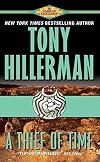
Visiting Joe Leaphorn and Jim Chee in the pages of a Hillerman mystery is the next best thing to sleeping under the stars in Navajo country, wondering if there is magic in the sky above.
A Thief of Time has atmosphere to spare, and a complex plot. Leaphorn and Chee are also fleshed out more than usual in this terrific entry. Both men are dealing with personal issues as this mystery begins. Chee hasn't quite figured out how he feels about Mary leaving him because he could not leave his Navajo show more way of life behind, and move to the city with her. He is smitten with a pretty Navajo attorney named Janet, but she's with someone else. Leaphorn, meanwhile, is on terminal leave and retiring after an unexpected death which has hit home.
Neither man can explain Leaphorn's obsession with finding a missing pot hunter named Eleanor Friedman-Bernal. Perhaps Leaphorn is simply distracting himself from the pain. All that is clear is that a Navajo would not be involved; because according to Navajo tradition, stealing pots would make one a Thief of Time.
Chee's allowing a rather large backhoe get stolen right under his nose will have ties to Leaphorn's investigation. Once more the young policeman with an appreciation for the old ways of the Navajo will be investigating with Leaphorn all across the Navajo territory. This one stretches all the way up into Utah, and then down the San Juan River. Leaphorn's recollection of another death will tie-in with Eleanor's disappearance, who was collecting pots made by the mysterious Anasazi. Was something she discovered worth killing for?
Leaphorn and Chee will be hundreds of miles apart when they reach the same conclusion in this quite complex and multi-layered mystery. One will have to race to the other as things turn ugly, and two very different men will find common ground when Leaphorn asks the unexpected of young Chee.
This one is a real gem in this fine series. Hillerman's description of the thousand foot cliffs along the San Juan River at night, and a starry sky filled with Navajo mystery create an unforgettable portrait of the America's Southwest. A terrific read! show less
A Thief of Time has atmosphere to spare, and a complex plot. Leaphorn and Chee are also fleshed out more than usual in this terrific entry. Both men are dealing with personal issues as this mystery begins. Chee hasn't quite figured out how he feels about Mary leaving him because he could not leave his Navajo show more way of life behind, and move to the city with her. He is smitten with a pretty Navajo attorney named Janet, but she's with someone else. Leaphorn, meanwhile, is on terminal leave and retiring after an unexpected death which has hit home.
Neither man can explain Leaphorn's obsession with finding a missing pot hunter named Eleanor Friedman-Bernal. Perhaps Leaphorn is simply distracting himself from the pain. All that is clear is that a Navajo would not be involved; because according to Navajo tradition, stealing pots would make one a Thief of Time.
Chee's allowing a rather large backhoe get stolen right under his nose will have ties to Leaphorn's investigation. Once more the young policeman with an appreciation for the old ways of the Navajo will be investigating with Leaphorn all across the Navajo territory. This one stretches all the way up into Utah, and then down the San Juan River. Leaphorn's recollection of another death will tie-in with Eleanor's disappearance, who was collecting pots made by the mysterious Anasazi. Was something she discovered worth killing for?
Leaphorn and Chee will be hundreds of miles apart when they reach the same conclusion in this quite complex and multi-layered mystery. One will have to race to the other as things turn ugly, and two very different men will find common ground when Leaphorn asks the unexpected of young Chee.
This one is a real gem in this fine series. Hillerman's description of the thousand foot cliffs along the San Juan River at night, and a starry sky filled with Navajo mystery create an unforgettable portrait of the America's Southwest. A terrific read! show less
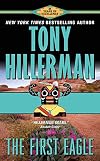
In The First Eagle, Tony Hillerman once again crafted a fresh and involving entry in his fine series about the Navajo Tribal Police. In this one, the retired Leaphorn is still at loose ends after a tragic death close to home. Chee, meanwhile, has become acting Lieutenant, but is having misgivings over the possibility that it will become permanent. There is a tad less of the Navajo mysticism in this entry, but the vast territory covered by the Navajo Tribal Police is given its due as show more always.
Hillerman dedicated The First Eagle to six officers who had given their lives in defense of their people from the time he wrote his first book until this one. It is only fitting that while keeping true to the Navajo atmosphere always present in the series, good police work and the very real dangers involved for the Tribal Police are brought to the forefront.
Leaphorn is asked to look for the missing Catherine Pollard. His unofficial inquiry will intersect with Chee's investigation into an officer's death. Chee's case is seemingly wrapped up, but may be more complex than it first appeared. Chee is chagrined to discover he is still a little intimidated by Leaphorn, but as the two cases cross paths, they will peel back the veneer and move closer to understanding one another.
This one has everything from poaching eagles to the possibility of the bubonic plague being spread all across the Navajo landscape. Why a pack of prairie dogs are unaffected, and an old Navajo woman who claims to have seen a skinwalker will figure greatly into the exciting conclusion to this one. The ending is also heartfelt for Chee, as his relationship with the pretty lawyer Janet begins to flame out, for she may be Navajo in name only after her time in Washington.
While this entry in the series is a bit different, I highly recommend it. Another fine read in one of the truly great mystery series which has often been copied, but never equaled. show less
Hillerman dedicated The First Eagle to six officers who had given their lives in defense of their people from the time he wrote his first book until this one. It is only fitting that while keeping true to the Navajo atmosphere always present in the series, good police work and the very real dangers involved for the Tribal Police are brought to the forefront.
Leaphorn is asked to look for the missing Catherine Pollard. His unofficial inquiry will intersect with Chee's investigation into an officer's death. Chee's case is seemingly wrapped up, but may be more complex than it first appeared. Chee is chagrined to discover he is still a little intimidated by Leaphorn, but as the two cases cross paths, they will peel back the veneer and move closer to understanding one another.
This one has everything from poaching eagles to the possibility of the bubonic plague being spread all across the Navajo landscape. Why a pack of prairie dogs are unaffected, and an old Navajo woman who claims to have seen a skinwalker will figure greatly into the exciting conclusion to this one. The ending is also heartfelt for Chee, as his relationship with the pretty lawyer Janet begins to flame out, for she may be Navajo in name only after her time in Washington.
While this entry in the series is a bit different, I highly recommend it. Another fine read in one of the truly great mystery series which has often been copied, but never equaled. show less

This was all Jim Chee, and he spent most of the book prowling the desert alone, defying his boss's orders, trying to solve a mystery that wasn't their jurisdiction, and getting crosswise of the DEA agents whose case it was. Naturally, he was frequently in peril of losing his job, or his life, and it was all terribly convoluted, but much of the action was in Chee's head as he attempted to apply concentration techniques taught to him since childhood by a respected elder. The best parts of this show more book for me were the details of Hopi and Navajo culture (differences abound, and members of the two tribes go about things differently...also, they do not look alike, a point made more than once!), and the fine points of tracking, at which Chee is better than the Feds by several orders of magnitude. For anyone who has watched the excellent Robert Redford/George R. R. Martin production by the same name, featuring Leaphorn, Chee and Manuelito, there is virtually no connection between this particular Hillerman entry and that mini-series. show less

He was so lonely. I think it must be bad to be a Navajo if being lonely bothers you. [168]
Two young teens are missing, one Zuñi and the other Navajo, with strong suspicions that the Zuñi boy was murdered and the Navajo knows how if not by whom. Yet Shalako ceremonies at Zuñi Village will be held in just a few days, when crowds will make investigation difficult and hiding clues easy. Lieutenant Leaphorn makes the rounds of the few places the Navajo boy is known to visit: his family hogan show more and its troubled past; a nearby archaeology dig site; a Franciscan Mission; a hippy commune. Everyone remembers the boy as a "little crazy" but claims not to know where he's gone.
The FBI lead their own investigation and typically, insist on supervising all other law enforcement on the scene. Their approach suggests the missing boys are not a particular motivation, however.
He was finding no order in his thoughts, none of that mild and abstract pleasure which the precise application of logic always brought to him. Instead there was only the discordant clash of improbable against unlikely, effect without cause, action without motive, patternless chaos. Leaphorn's orderly mind found this painful. [74-5]
In this story and the novel before it, Hillerman uses supernatural events as a blind for natural crime. In each case, the perpetrator intended for others to see a mythological interpretation for their behaviour. It will be curious to see if future stories mix it up a bit: criminals not intentionally mimicking supernatural activity, the mythology element overlapping with but not directly connected to the crime, and so forth. And: will there be any scenarios in which the supernatural element is left open to the reader, because irrelevant to the specific solution?
[A]nthropologists have paid scant attention to one of the most basic dimensions of human experience – that close companion of heart and mind, often subdued yet potentially overwhelming, that is known as sense of place. [106]
-- Keith Basso, Wisdom Sits In Places
Hillerman's careful inclusion of landscape references is a key means for acquainting the reader with the lived aspect of Dinetah. Scenes typically include prevailing weather: not merely for scene setting, though it's effective in that way. Immediate conditions are highly relevant to what is happening and what is possible, as evidenced in this story with imminent winter on the high desert and the threat even to seasoned Najavo (never mind a 14-year-old boy alone without food or shelter). In The Blessing Way, territory and climate were relevant both for Leaphorn's immediate need to locate someone hiding in the vast tracts of Dinetah, but also for understanding the ways different people (from different cultures) were likely to see and move through that landscape: other Najavo, military contractors, other indigenous people, city dwellers travelling interstates through reservation lands.
Perhaps even more insightful into the Navajo Way is the land's direct link to Diné stories and values. Places people pass in their daily rounds are the very same places that are featured in their myths and cultural stories. Hillerman regularly notes when events take place near or at these locations, allowing the attentive reader to wonder about the relevance of placenames like Halona or Corn Mountain or Mount Taylor. What is more, these places are shared by other cultures (Hopi, Zuñi, Apache), everyone living among them with slightly different emphases and understanding, and of course, different names. Perhaps similar to Muslim, Christian, and Jewish people living alongside one another in the Middle East, a parallel blend of historical and contemporary.
//
This second novel is the first to follow Leaphorn as primary force behind the investigation. While other law enforcement are involved in significant aspects of the larger story bearing on the initial case, Leaphorn is alone in focusing on finding George Bowlegs, the missing Navajo teen. The first novel, by contrast, gave an Anglo anthropologist as much of the drive behind the investigation as it gave Leaphorn. The next significant change won't be for another few novels: when Hillerman introduces the character of Jim Chee.
Again not all Navajo are portrayed as the good guys, here, nor was the primary criminal a Navajo or Zuñi but someone off-reservation. That could become a tiresome scenario if it were to become formulaic. show less
Two young teens are missing, one Zuñi and the other Navajo, with strong suspicions that the Zuñi boy was murdered and the Navajo knows how if not by whom. Yet Shalako ceremonies at Zuñi Village will be held in just a few days, when crowds will make investigation difficult and hiding clues easy. Lieutenant Leaphorn makes the rounds of the few places the Navajo boy is known to visit: his family hogan show more and its troubled past; a nearby archaeology dig site; a Franciscan Mission; a hippy commune. Everyone remembers the boy as a "little crazy" but claims not to know where he's gone.
The FBI lead their own investigation and typically, insist on supervising all other law enforcement on the scene. Their approach suggests the missing boys are not a particular motivation, however.
He was finding no order in his thoughts, none of that mild and abstract pleasure which the precise application of logic always brought to him. Instead there was only the discordant clash of improbable against unlikely, effect without cause, action without motive, patternless chaos. Leaphorn's orderly mind found this painful. [74-5]
[A]nthropologists have paid scant attention to one of the most basic dimensions of human experience – that close companion of heart and mind, often subdued yet potentially overwhelming, that is known as sense of place. [106]
-- Keith Basso, Wisdom Sits In Places
Hillerman's careful inclusion of landscape references is a key means for acquainting the reader with the lived aspect of Dinetah. Scenes typically include prevailing weather: not merely for scene setting, though it's effective in that way. Immediate conditions are highly relevant to what is happening and what is possible, as evidenced in this story with imminent winter on the high desert and the threat even to seasoned Najavo (never mind a 14-year-old boy alone without food or shelter). In The Blessing Way, territory and climate were relevant both for Leaphorn's immediate need to locate someone hiding in the vast tracts of Dinetah, but also for understanding the ways different people (from different cultures) were likely to see and move through that landscape: other Najavo, military contractors, other indigenous people, city dwellers travelling interstates through reservation lands.
Perhaps even more insightful into the Navajo Way is the land's direct link to Diné stories and values. Places people pass in their daily rounds are the very same places that are featured in their myths and cultural stories. Hillerman regularly notes when events take place near or at these locations, allowing the attentive reader to wonder about the relevance of placenames like Halona or Corn Mountain or Mount Taylor. What is more, these places are shared by other cultures (Hopi, Zuñi, Apache), everyone living among them with slightly different emphases and understanding, and of course, different names. Perhaps similar to Muslim, Christian, and Jewish people living alongside one another in the Middle East, a parallel blend of historical and contemporary.
//
This second novel is the first to follow Leaphorn as primary force behind the investigation. While other law enforcement are involved in significant aspects of the larger story bearing on the initial case, Leaphorn is alone in focusing on finding George Bowlegs, the missing Navajo teen. The first novel, by contrast, gave an Anglo anthropologist as much of the drive behind the investigation as it gave Leaphorn. The next significant change won't be for another few novels: when Hillerman introduces the character of Jim Chee.
Again not all Navajo are portrayed as the good guys, here, nor was the primary criminal a Navajo or Zuñi but someone off-reservation. That could become a tiresome scenario if it were to become formulaic. show less
Lists
Page Turners (1)
Awards


You May Also Like


Associated Authors
Statistics
- Works
- 122
- Also by
- 39
- Members
- 45,335
- Popularity
- #359
- Rating
- 3.8
- Reviews
- 792
- ISBNs
- 940
- Languages
- 20
- Favorited
- 129

