
Simon Goldhill (1) (1957–)
Author of Love, Sex & Tragedy: How the Ancient World Shapes Our Lives
For other authors named Simon Goldhill, see the disambiguation page.
Works by Simon Goldhill
A Very Queer Family Indeed: Sex, Religion, and the Bensons in Victorian Britain (2016) 65 copies, 1 review
Freud's Couch, Scott's Buttocks, Brontë's Grave (Culture Trails: Adventures in Travel) (2011) 59 copies, 5 reviews
Foucault's Virginity: Ancient Erotic Fiction and the History of Sexuality (The Stanford Memorial Lectures) (1995) 52 copies
The Christian Invention of Time: Temporality and the Literature of Late Antiquity (Greek Culture in the Roman World) (2022) 13 copies
Art and Text in Ancient Greek Culture (Cambridge Studies in New Art History and Criticism) (1994) — Editor — 6 copies
Tagged
Common Knowledge
- Canonical name
- Goldhill, Simon
- Legal name
- Goldhill, Simon David
- Birthdate
- 1957-03-17
- Gender
- male
- Education
- King's College, Cambridge University (MA | 1978 | PhD | 1982)
- Occupations
- classical scholar
university professor - Organizations
- King's College, Cambridge University
- Awards and honors
- Fellow, British Academy (2016)
Academia Europaea (2023)
International Honorary Member, American Academy of Arts and Sciences (2009)
Corresponding Fellow, Australian Academy of the Humanities (2020)
Independent Publisher's Gold Medal (2011)
Robert Lowry Patten Award (2012) (show all 7)
Runciman Prize (2013) - Nationality
- UK
- Birthplace
- London, England, UK
- Places of residence
- Cambridge, Cambridgeshire, England, UK
- Associated Place (for map)
- England, UK
Members
Reviews

Armchair travelers will enjoy this account of visits to the homes of five authors in Great Britain — Shakespeare, Scott, Wordsworth, Brontë, Freud — but this book offers more. Simon Goldhill, a Cambridge scholar who straddles the ancient classics and Victorian literature, has an overarching theme. In the 19th century, it was common to hail literature as a branch of religion, indeed, the only branch with a future. If one grants that, then it follows that poets are its prophets. Goldhill show more sees a connection between this and the rise of visits to writers’s homes at the time: A new form of pilgrimage. His book is an exploration of some top Victorian destinations (well, calling Freud a Victorian might seem a stretch, but the author makes a plausible case for finishing in Hampstead).
He starts out, though, as an anti-pilgrim. In preparing his itinerary and researching the writers whose haunts he was to visit, he felt no emotional pull. He is fully at home in the books: “Why would you want to shut the door on such a greater landscape,” he asks, “to fixate on some merely real place or object?”
Yet there are discoveries. In various ways, the visits reveal aspects of identity. His first stop, Abbotsford, revealed more about Sir Walter Scott the manipulator of his own image, than Scott the writer. Wordsworth’s two homes in the Lake District, meanwhile, evoke the poet’s “journey into the self through memory, self-exploration, and friendship.” “Shakespeare’s birthplace was invented to give voice to a national identity, a truly English selfhood,” writes Goldhill, whereas the parsonage in Haworth that housed the Brontë family seemed to him “a physical expression of the interiority of the self.”
In describing his visit to Stratford-on-Avon the author seems to savor his disgust. It was, he writes, “the hardest place on our pilgrimage . . . to feel any aura of genius, to sense the presence.” Yet the author brings to it a clever eye for the incongruous, telling detail, such as the small glimpse of wattle and daub under plate glass in the wall, or the assurance that the furniture on display are “authentically crafted, accurate replicas.”
In earlier times, one embarked on a pilgrimage not to learn about the places visited, but about one’s self. On this point, Goldhill is coy, in fact, his syntax when he touches on this point became garbled so that it was hard for this reader to follow exactly what he was saying. Despite his initial scepticism — surely the book matters, not the life of the author — as he transfers his reading skills to a different kind of text, namely, author’s houses, these yield insights as well. Still, what does he learn about himself? Whatever it was, it may also be true that he is under no obligation to share it with the reader. What he does share is sufficient encouragement to undertake one’s own quests and make one’s own discoveries.
This book is written in the learned and witty manner of the best of British academics. It is a good read. show less
He starts out, though, as an anti-pilgrim. In preparing his itinerary and researching the writers whose haunts he was to visit, he felt no emotional pull. He is fully at home in the books: “Why would you want to shut the door on such a greater landscape,” he asks, “to fixate on some merely real place or object?”
Yet there are discoveries. In various ways, the visits reveal aspects of identity. His first stop, Abbotsford, revealed more about Sir Walter Scott the manipulator of his own image, than Scott the writer. Wordsworth’s two homes in the Lake District, meanwhile, evoke the poet’s “journey into the self through memory, self-exploration, and friendship.” “Shakespeare’s birthplace was invented to give voice to a national identity, a truly English selfhood,” writes Goldhill, whereas the parsonage in Haworth that housed the Brontë family seemed to him “a physical expression of the interiority of the self.”
In describing his visit to Stratford-on-Avon the author seems to savor his disgust. It was, he writes, “the hardest place on our pilgrimage . . . to feel any aura of genius, to sense the presence.” Yet the author brings to it a clever eye for the incongruous, telling detail, such as the small glimpse of wattle and daub under plate glass in the wall, or the assurance that the furniture on display are “authentically crafted, accurate replicas.”
In earlier times, one embarked on a pilgrimage not to learn about the places visited, but about one’s self. On this point, Goldhill is coy, in fact, his syntax when he touches on this point became garbled so that it was hard for this reader to follow exactly what he was saying. Despite his initial scepticism — surely the book matters, not the life of the author — as he transfers his reading skills to a different kind of text, namely, author’s houses, these yield insights as well. Still, what does he learn about himself? Whatever it was, it may also be true that he is under no obligation to share it with the reader. What he does share is sufficient encouragement to undertake one’s own quests and make one’s own discoveries.
This book is written in the learned and witty manner of the best of British academics. It is a good read. show less
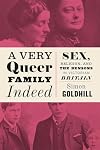
An unconventional biographical treatment of an extremely unconventional family. While I would have liked some more biographical and literary detail about the Bensons (and much more about their ghost stories!), Goldhill's treatment of the notable aspects of their lives is well done and interestingly told.
Freud's Couch, Scott's Buttocks, Brontë's Grave (Culture Trails: Adventures in Travel) by Simon Goldhill
A delightful read on authors and the places they lived in. It was enlightening and genuinely interesting to read about Wordsworth and Bronte's houses, especially in the way they so deeply contrasted each other. Shakespeare's house was an exercise in "packaged heritage" and how "tacky" and commercialized the whole institution can be. Meanwhile, Sir Walter Scott's place was a great way of showing how a house can be manufactured around an author's identity and presence in the world. Finally, show more the author meditates on Freud's fascination in maintaining the same office in both Vienna and London. I felt this chapter was more personal for the author, and the analysis was good.
It's a quick read that explores how author's shape their houses and how their houses also shape their identity and their works. show less
It's a quick read that explores how author's shape their houses and how their houses also shape their identity and their works. show less
A truly wonderful book written by one of today's foremost classicists. His argument is that contemporary society must, but continually fails to, understand our classical heritage in order to understand not just our institutions, but our very selves. Sweeps majestically through classical and contemporary depictions of the human body, the development of Christianity in a classical environment, the birth of democracy, penises, Freud, the importance of Greek tragedy in today's world and show more Victorian Britain. Doesn't miss much, really... show less
Lists
Reading list (2)
Awards


You May Also Like
Associated Authors
Statistics
- Works
- 17
- Members
- 738
- Popularity
- #34,414
- Rating
- 3.5
- Reviews
- 13
- ISBNs
- 121
- Languages
- 4