

Arjun Basu
Author of Waiting for the Man
Works by Arjun Basu
Associated Works
Tagged
Common Knowledge
There is no Common Knowledge data for this author yet. You can help.
Members
Reviews
This review originally appeared on Buried.In.Print.
“We crave narrative,” Joe tells us.
And the Reader who picks up Arjun Basu’s Waiting for the Man nods: a narrative craver.
“We believe we are uninteresting without a compelling story.”
But Joe himself no longer finds his story compelling.
The Reader meets Joe when he steps outside of his life, disenchanted by the tedium of day-in-day-out employment in an ad agency, where he has been fuelling consumer desire by writing product show more narratives.
With the luxury of a well-stuffed bank account behind him, he turns his back on what his father views as grown-up life, and he walks away.
Well, figuratively speaking, for he actually simply sits – at first, anyway –on the steps of the New York building in which he lives.
Perhaps he has been listening to too much Lou Reed. The Author credits him directly, the novel’s playlist begins with “I’m Waiting for The Man”, and Joe does just that: he waits for the Man.
Once a shaper of ad campaigns, Joe is now susceptible to the same “carnival magic”.
“I bought the promise. I saw in his message my own improvement. He had created a need I didn’t know I had. I was willing to see what he was selling. I was willing to make a purchase from the Man. I was willing.”
While looking waiting for the Man, Joe’s tone falls somewhere between realism and cynicism, depending on the Reader’s perspective. Sharply intelligent, critical and unhappy, he is experiencing a crisis of self in his mid-30s.
Once, this experience might have been marketed as a midlife crisis. Even now, the Reader could well spend too much time with people like Joe off-the-page. The Reader could be Joe. The Reader might rather find other kinds of characters in fiction.
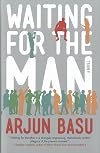
The Author seems to understand the risk; he has created a suitably savvy trailer which gathers images designed to showcase the “specialness of being human”, although an effort the Old Joe might not have appreciated. (The cover design by Michel Vrana is striking as well.)
“Advertising is the engine of our economy, of our way of life. It keeps everyone working. Because it’s there to get us to consume. And without consumption, we have nothing. It is so central to our way of life that it is almost impossible to imagine a life devoid of it, of the message.”
Ironically, as Joe sits, waiting, ostensibly refusing a world devoted to consumption, he transforms into the media’s next meal, for neighbours and New Yorkers and, later, for international-news consumers.
This invites commentary on print and web culture and particularly the ways in which narratives are created (and dismissed) in media.
“’The web is just another part of our cult of entitlement,’ I said. ‘The web tells everyone that everything you say, every opinion you have, every action you take, has value. It’s the logical conclusion to the entitlement that everyone feels. It’s brought fifteen minutes down to one.’”
Such statements might seem most interesting to the Reader working in media (or *whispers* advertising) but if you are reading the words I have posted to this screen, you inhabit a media- and an ad-soaked world.
You, the Reader, are an integral part of this narrative, as a Consumer of stories.
And so you have an interest in Joe’s one-minute of fame, but perhaps, like Joe, you will not find satisfaction.
“I wanted closure. I did not want to go anywhere.”
It’s paradoxical, to want something but not want to move, even in pursuit.
And perhaps Joe realizes this (or perhaps he is simply seeking a more marketable narrative arc) for he does eventually move.
What passes for closure in Joe’s tale is necessarily dissatisfying. As this passage from relatively early in the narrative suggests, at best, Joe’s arc is still unfolding.
“And being here, however I managed to find this place. I’m reclaiming my life, making things normal again, not feeling the world revolving around me. Making me dizzy.
Taking back control. Becoming me.”
In trying to rediscover his instinct, his pursuit of meaning strains against custom and although others try to define the identity of the Man for him, he struggles to hear a voice speaking to him alone.
“If not the Man, then what? How could I explain that? Did I want to see the Man so badly that I had forsaken everything? Was my life so bad that I invented the Man?”
Rooted in incisive and provocative commentary, Joe’s story is credible and accessible, and for all his dis-ease, the prose reads easily, with the kind of fragmented thoughts that likely clutter the Reader’s media-soaked mind.
So while Waiting for the Man considers overarching questions -- free will and design, advertising and religion, connection and alienation, belonging and dislocation, wilderness and urban life, love and desolation – it simultaneously explores the idea that concepts which are traditionally opposed can be united in narrative.
Arjun Basu’s Reader might well be craving a different kind of narrative and be every bit as disillusioned as Joe.
And wouldn’t you rather have a book in hand while you are Waiting for the Man?
show less
“We crave narrative,” Joe tells us.
And the Reader who picks up Arjun Basu’s Waiting for the Man nods: a narrative craver.
“We believe we are uninteresting without a compelling story.”
But Joe himself no longer finds his story compelling.
The Reader meets Joe when he steps outside of his life, disenchanted by the tedium of day-in-day-out employment in an ad agency, where he has been fuelling consumer desire by writing product show more narratives.
With the luxury of a well-stuffed bank account behind him, he turns his back on what his father views as grown-up life, and he walks away.
Well, figuratively speaking, for he actually simply sits – at first, anyway –on the steps of the New York building in which he lives.
Perhaps he has been listening to too much Lou Reed. The Author credits him directly, the novel’s playlist begins with “I’m Waiting for The Man”, and Joe does just that: he waits for the Man.
Once a shaper of ad campaigns, Joe is now susceptible to the same “carnival magic”.
“I bought the promise. I saw in his message my own improvement. He had created a need I didn’t know I had. I was willing to see what he was selling. I was willing to make a purchase from the Man. I was willing.”
While looking waiting for the Man, Joe’s tone falls somewhere between realism and cynicism, depending on the Reader’s perspective. Sharply intelligent, critical and unhappy, he is experiencing a crisis of self in his mid-30s.
Once, this experience might have been marketed as a midlife crisis. Even now, the Reader could well spend too much time with people like Joe off-the-page. The Reader could be Joe. The Reader might rather find other kinds of characters in fiction.
The Author seems to understand the risk; he has created a suitably savvy trailer which gathers images designed to showcase the “specialness of being human”, although an effort the Old Joe might not have appreciated. (The cover design by Michel Vrana is striking as well.)
“Advertising is the engine of our economy, of our way of life. It keeps everyone working. Because it’s there to get us to consume. And without consumption, we have nothing. It is so central to our way of life that it is almost impossible to imagine a life devoid of it, of the message.”
Ironically, as Joe sits, waiting, ostensibly refusing a world devoted to consumption, he transforms into the media’s next meal, for neighbours and New Yorkers and, later, for international-news consumers.
This invites commentary on print and web culture and particularly the ways in which narratives are created (and dismissed) in media.
“’The web is just another part of our cult of entitlement,’ I said. ‘The web tells everyone that everything you say, every opinion you have, every action you take, has value. It’s the logical conclusion to the entitlement that everyone feels. It’s brought fifteen minutes down to one.’”
Such statements might seem most interesting to the Reader working in media (or *whispers* advertising) but if you are reading the words I have posted to this screen, you inhabit a media- and an ad-soaked world.
You, the Reader, are an integral part of this narrative, as a Consumer of stories.
And so you have an interest in Joe’s one-minute of fame, but perhaps, like Joe, you will not find satisfaction.
“I wanted closure. I did not want to go anywhere.”
It’s paradoxical, to want something but not want to move, even in pursuit.
And perhaps Joe realizes this (or perhaps he is simply seeking a more marketable narrative arc) for he does eventually move.
What passes for closure in Joe’s tale is necessarily dissatisfying. As this passage from relatively early in the narrative suggests, at best, Joe’s arc is still unfolding.
“And being here, however I managed to find this place. I’m reclaiming my life, making things normal again, not feeling the world revolving around me. Making me dizzy.
Taking back control. Becoming me.”
In trying to rediscover his instinct, his pursuit of meaning strains against custom and although others try to define the identity of the Man for him, he struggles to hear a voice speaking to him alone.
“If not the Man, then what? How could I explain that? Did I want to see the Man so badly that I had forsaken everything? Was my life so bad that I invented the Man?”
Rooted in incisive and provocative commentary, Joe’s story is credible and accessible, and for all his dis-ease, the prose reads easily, with the kind of fragmented thoughts that likely clutter the Reader’s media-soaked mind.
So while Waiting for the Man considers overarching questions -- free will and design, advertising and religion, connection and alienation, belonging and dislocation, wilderness and urban life, love and desolation – it simultaneously explores the idea that concepts which are traditionally opposed can be united in narrative.
Arjun Basu’s Reader might well be craving a different kind of narrative and be every bit as disillusioned as Joe.
And wouldn’t you rather have a book in hand while you are Waiting for the Man?
show less
Waiting for the Man is Arjun Basu's debut novel.
Joe is a New York copywriter. He's good at his job, fairly happy and his success has brought him material wealth. Until he starts daydreaming in meetings, floating away from the boardroom and watching himself from above. And then he starts dreaming at night as well. Dreaming of the Man. The Man who tells him to wait. To wait for him. "He had created a need I didn't know I had."
And Joe does just that. He sits on the stoop of his building day show more and night - waiting for further instructions. Others of course worry and wonder about him. Who is the Man? What has he said to Joe? And without trying or wanting, Joe becomes news. Small at first, then growing exponentially.
Basu easily conveys Joe's sense of dissatisfaction and disillusionment. When I started Waiting For The Man, I could only read a few chapters at a time. Basu provides much food for thought through Joe's ruminations on society, life, familial relationships, the media, religion and much more. It's impossible to read some passages without stopping and looking at them in relation to your own life and circumstances.
But as I continued to read, I became caught up in Joe's waiting. I felt like one of the public, hooked on Joe's story, just waiting for the latest reports form the media crew following his every move.
I was initially confused when the book's narrative abruptly switched time and place in the first few chapters. And then I realized that we learn Joe's story from the beginning and the end in alternating chapters until all is revealed. Or is it? Do we ever find the answers or do we create them ourselves?
Interestingly, I found myself more caught up in the ideas that Joe presented, rather than Joe himself. I ended up feeling quite middle of the road about Joe, neither here nor there. For me, he was simply a vehicle for Basu's exploration of the search for meaning in our lives.
Basu has crafted an unsettling, thought provoking first novel, one sure to leave you taking a second look at many aspects of our society and our own lives show less
Joe is a New York copywriter. He's good at his job, fairly happy and his success has brought him material wealth. Until he starts daydreaming in meetings, floating away from the boardroom and watching himself from above. And then he starts dreaming at night as well. Dreaming of the Man. The Man who tells him to wait. To wait for him. "He had created a need I didn't know I had."
And Joe does just that. He sits on the stoop of his building day show more and night - waiting for further instructions. Others of course worry and wonder about him. Who is the Man? What has he said to Joe? And without trying or wanting, Joe becomes news. Small at first, then growing exponentially.
Basu easily conveys Joe's sense of dissatisfaction and disillusionment. When I started Waiting For The Man, I could only read a few chapters at a time. Basu provides much food for thought through Joe's ruminations on society, life, familial relationships, the media, religion and much more. It's impossible to read some passages without stopping and looking at them in relation to your own life and circumstances.
But as I continued to read, I became caught up in Joe's waiting. I felt like one of the public, hooked on Joe's story, just waiting for the latest reports form the media crew following his every move.
I was initially confused when the book's narrative abruptly switched time and place in the first few chapters. And then I realized that we learn Joe's story from the beginning and the end in alternating chapters until all is revealed. Or is it? Do we ever find the answers or do we create them ourselves?
Interestingly, I found myself more caught up in the ideas that Joe presented, rather than Joe himself. I ended up feeling quite middle of the road about Joe, neither here nor there. For me, he was simply a vehicle for Basu's exploration of the search for meaning in our lives.
Basu has crafted an unsettling, thought provoking first novel, one sure to leave you taking a second look at many aspects of our society and our own lives show less

satirical fiction - a dissatisfied ad copywriter looks to a mysterious (imaginary?) man for advice.
Read to page 48 of 306 (about 15%). It's OK, sorta funny, but not feeling compelled to continue reading or even to pick it up again.
hoopla bonus borrow March 2025
Read to page 48 of 306 (about 15%). It's OK, sorta funny, but not feeling compelled to continue reading or even to pick it up again.
hoopla bonus borrow March 2025
Awards


You May Also Like
Associated Authors
Statistics
- Works
- 3
- Also by
- 1
- Members
- 25
- Popularity
- #508,560
- Rating
- 3.9
- Reviews
- 3
- ISBNs
- 17