
Max Fisher (1)
Author of The Chaos Machine: The Inside Story of How Social Media Rewired Our Minds and Our World
For other authors named Max Fisher, see the disambiguation page.
Works by Max Fisher
The Chaos Machine: The Inside Story of How Social Media Rewired Our Minds and Our World (1900) 460 copies, 18 reviews
Tagged
Common Knowledge
There is no Common Knowledge data for this author yet. You can help.
Members
Reviews
The Chaos Machine: The Inside Story of How Social Media Rewired Our Minds and Our World by Max Fisher
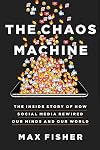
This book is brilliant! Not only does the author expose an important and disturbing topic--artificial "intelligence", in the form of social media web site algorithms, foments hate and discord in the service of "engagement" (that is, capitalism)--he situates these current developments in the history of Silicon Valley and enduring sociological concepts. His analysis of the research studies that demonstrate the link between social media and violence in Myanmar, Sri Lanka, and the United States show more is thorough and balanced. The writing is very engaging and, miraculously, did not leave me with a feeling of despair but instead with gratitude for learning how an ubiquitous part of modern life functions. Highly recommended for all libraries and any readers who use (or are used by) social media. show less
The Chaos Machine: The Inside Story of How Social Media Rewired Our Minds and Our World by Max Fisher
If you're looking at reading this, you're probably already aware that social media is problematic. But laid out in story after story that we have lived through, bringing the receipts... it's a whole other level. Incredibly disturbing. You don't (or at least I don't!) start a book on social media prepared for the sentence, "By the time I landed in Myanmar, the soldiers were already throwing babies in fires." It's a heavy book, partly because we're not finished living this story.
The Chaos Machine: The Inside Story of How Social Media Rewired Our Minds and Our World by Max Fisher
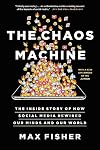
The Chaos Machine by Max Fisher gives readers an eye-opening, sobering look at some of the major social media platforms (Facebook, YouTube, and the site formerly known as Twitter) and their impact on individual users and the world.
Fisher explores the libertarian Silicon Valley mindset that led to the creation of these software giants and their hubristic pursuit of unlimited profits and growth. In Fisher’s telling, the callousness, irresponsibility, and greed of Facebook’s Mark show more Zuckerberg and other corporate leaders are mind-boggling to behold. In impoverished countries such as Myanmar and Sri Lanka, social media sites have fanned the flames of hatred, leading directly to rape, murder, and even genocide. Closer to home, heavy social media use makes people isolated, lonely, and prone to buying into conspiracy theories such as Pizzagate and QAnon. Like cigarette company executives, Silicon Valley’s corporate titans and the venture capitalists who finance them consistently dodge responsibility for the long-term harm their products cause.
This well-researched book has me rethinking my social media use. show less
Fisher explores the libertarian Silicon Valley mindset that led to the creation of these software giants and their hubristic pursuit of unlimited profits and growth. In Fisher’s telling, the callousness, irresponsibility, and greed of Facebook’s Mark show more Zuckerberg and other corporate leaders are mind-boggling to behold. In impoverished countries such as Myanmar and Sri Lanka, social media sites have fanned the flames of hatred, leading directly to rape, murder, and even genocide. Closer to home, heavy social media use makes people isolated, lonely, and prone to buying into conspiracy theories such as Pizzagate and QAnon. Like cigarette company executives, Silicon Valley’s corporate titans and the venture capitalists who finance them consistently dodge responsibility for the long-term harm their products cause.
This well-researched book has me rethinking my social media use. show less
The Chaos Machine: The Inside Story of How Social Media Rewired Our Minds and Our World by Max Fisher
Summary: A deep dive into how social media has rewired our minds and fueled social divisions.
If the events of the past years have not already done so, this book should give you pause about any of the social media platforms you use regularly. It did so for me.
Max Fisher looks at phenomena as diverse as the genocide of the Rohingya in Myanmar, the growth of anti-vaccine movements, and the political discord of our recent elections. He shows how these are not simply the result of zealots posting show more what is often false information or incendiary statements. Rather, he argues that there is something baked into our social media that turns these into potent movements that in some instances have led to the loss of life and the deception of many.
The issue is engagement. If all the things posted on any platform, Facebook, Twitter, YouTube, or Reddit, were given equal weight, the postings of zealots, social media influencers, and bad actors from other countries would still have minimal effect–getting lost in the mass of material posted every day. What makes it different is that each of these platforms and others, in the pursuit of advertising dollars, where they make their money, promote the material that gets the most engagement through the algorithms that determine what we see when we visit one of these sites. Those algorithms are tailored to our interests and show us more of what we’ve viewed, liked, and clicked on.
But there is more. These platforms use recommendation engines that show you other content that is related to your interests, content that is getting a lot of engagement. And often this is inflammatory, engendering fear or anger. And this can lead people into groups that share that anger, that disengagement with society, and down a rabbit hole, away from family and friends in the real world.
What is chilling is Fisher’s account of the indifference of these platforms, even when their internal research calls attention to the effect of their algorithms. Often, government authorities, seeking to stop the spread of misinformation, find it impossible to even get a response from these platforms–unless they pull the plug on these platforms’ access to their countries. But in many countries, these platforms serve as the primary source of information for their people. Hence, the reluctance to take this step.
I found this a deeply disturbing trend. And in the light of the recent takeover of Twitter and the financial struggles of Meta, the parent company of Facebook, I think the chaos Fisher chronicles could easily increase–unless. Unless we educate ourselves about how these platforms work, how they show us content (or not), and make decisions of how we will engage them without being manipulated by them. But this is a big ask. All I know is that I am asking myself hard questions about how I will engage these platforms going forward–or whether I will continue to do so.
____________________
Disclosure of Material Connection: I received a complimentary review copy of this book from the publisher. show less
If the events of the past years have not already done so, this book should give you pause about any of the social media platforms you use regularly. It did so for me.
Max Fisher looks at phenomena as diverse as the genocide of the Rohingya in Myanmar, the growth of anti-vaccine movements, and the political discord of our recent elections. He shows how these are not simply the result of zealots posting show more what is often false information or incendiary statements. Rather, he argues that there is something baked into our social media that turns these into potent movements that in some instances have led to the loss of life and the deception of many.
The issue is engagement. If all the things posted on any platform, Facebook, Twitter, YouTube, or Reddit, were given equal weight, the postings of zealots, social media influencers, and bad actors from other countries would still have minimal effect–getting lost in the mass of material posted every day. What makes it different is that each of these platforms and others, in the pursuit of advertising dollars, where they make their money, promote the material that gets the most engagement through the algorithms that determine what we see when we visit one of these sites. Those algorithms are tailored to our interests and show us more of what we’ve viewed, liked, and clicked on.
But there is more. These platforms use recommendation engines that show you other content that is related to your interests, content that is getting a lot of engagement. And often this is inflammatory, engendering fear or anger. And this can lead people into groups that share that anger, that disengagement with society, and down a rabbit hole, away from family and friends in the real world.
What is chilling is Fisher’s account of the indifference of these platforms, even when their internal research calls attention to the effect of their algorithms. Often, government authorities, seeking to stop the spread of misinformation, find it impossible to even get a response from these platforms–unless they pull the plug on these platforms’ access to their countries. But in many countries, these platforms serve as the primary source of information for their people. Hence, the reluctance to take this step.
I found this a deeply disturbing trend. And in the light of the recent takeover of Twitter and the financial struggles of Meta, the parent company of Facebook, I think the chaos Fisher chronicles could easily increase–unless. Unless we educate ourselves about how these platforms work, how they show us content (or not), and make decisions of how we will engage them without being manipulated by them. But this is a big ask. All I know is that I am asking myself hard questions about how I will engage these platforms going forward–or whether I will continue to do so.
____________________
Disclosure of Material Connection: I received a complimentary review copy of this book from the publisher. show less
Lists
Awards


Statistics
- Works
- 1
- Members
- 460
- Popularity
- #53,418
- Rating
- 4.4
- Reviews
- 18
- ISBNs
- 16
- Languages
- 4
