
Lance M. Dodes
Author of The Sober Truth: Debunking the Bad Science Behind 12-Step Programs and the Rehab Industry
About the Author
Lance Dodes, MD, is assistant clinical professor of psychiatry at Harvard Medical School in the Division on Addictions. He has been director of the substance abuse treatment unit of Harvard's McLean Hospital and director of the Boston Center for Problem Gambling. He has been elected a distinguished show more fellow of the American Academy of Addiction Psychiatry. show less
Works by Lance M. Dodes
The Sober Truth: Debunking the Bad Science Behind 12-Step Programs and the Rehab Industry (2014) 91 copies, 13 reviews
The Heart of Addiction: A New Approach to Understanding and Managing Alcoholism and Other Addictive Behaviors (2002) 67 copies, 1 review
Breaking Addiction 2 copies
Associated Works
Tagged
Common Knowledge
- Birthdate
- 1946
- Gender
- male
- Occupations
- training and supervising analyst
assistant clinical professor of psychiatry - Organizations
- Boston Psychoanalytic Society
Harvard Medical School - Awards and honors
- Harvard Medical School. Division on Addictions "Distinguished Contribution"
American Academy of Addiction Psychiatry Distinguished Fellow - Short biography
- Lance Dodes, MD, is a Training and Supervising Analyst Emeritus at the Boston Psychoanalytic Society and retired Assistant Clinical Professor of Psychiatry at Harvard Medical School. He is the author of many articles, book chapters, and books describing a new understanding of the nature and treatment of addiction. He has been honored by the Division on Addictions at the Harvard Medical School for “Distinguished Contribution” to the study and treatment of addictive behavior, and elected a Distinguished Fellow of the American Academy of Addiction Psychiatry.[adapted from The Dangerous Case of Donald Trump (2017)]
- Nationality
- USA
- Associated Place (for map)
- USA
Members
Reviews
The Sober Truth: Debunking the Bad Science Behind 12-Step Programs and the Rehab Industry by Lance Dodes
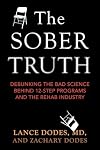
The Sober Truth: Debunking the Bad Science Behind 12-Step Programs and the Rehab Industry, co-authored by brothers Lance and Zachary Dodes, is a far less dry and more radically change-oriented book than its title might suggest. What makes this read so compelling and its ideas so unusual, IMHO, is the primacy of individual human beings who struggle with addiction issues -- their personal thoughts, feelings, experiences -- in its assessment of the value of treatment options for those . Because show more of this fresh, humanistic perspective I believe the book is likely to be of great value to both readers drawn to this topic for reasons of personal experience (broadly speaking -- I’m not just talking about the addicts themselves) and/or those interested in the problem more generally because of its impact on society as a whole and the grievous damage it does to so many human lives and human relationships.
In my view, The Sober Truth successfully discredits the popular assumption that 12-step programs such as Alcoholics Anonymous (AA), its various affiliates focused on other types of addiction, and the great many other rehabilitation programs that incorporate significant components of the 12-step method into their own methodology not only are unnecessary for successful recovery, but that these programs can set individuals back in their attempts to curtail their substance abuse (or other targeted behavior) and sustainably change their lives.
You may imagine, as I did, that the book’s attack on the legitimacy of the 12-step treatment modality created by AA would rely on the deployment of in-depth analysis of a variety of scientific research studies on these programs’ (as well as other forms of treatments’) ability to provide their respective participants with successful coping methods and effect sustainable life change. While some observational studies (necessarily of less value than randomized treatment trial studies) are reviewed in the book, science is not the weapon the book uses in its argument. First of all, there is a dearth of reliable research available on the efficacy of 12-step and other addiction treatments, either individually or comparatively. Summing up the reasons for the lack of “good science” available on this topic, the authors state:
“A poor understanding of these issues--the need for randomization, the difference between correlation and causation, and the power of the compliance effect--has colored much of the research that has been conducted to date about the effectiveness of 12-step membership and attendance” (p. 33).
Existing research is surveyed in greater detail with applicable limitations set forth straightforwardly and specifically in the book’s chapter: “Does AA work?”
However, the authors make clear their belief that numerical data would not be the most effective fodder for an attack on ineffective treatment modalities. In Chapter Nine, “The Failure of Addiction Research and Designing the Perfect Study,” they explain the foundation of their approach:
“These days, virtually every addiction journal assigns far more value to statistical studies than to clinical findings. The primary claim is that words are not rigorous; number are. Yet this perspective fails to account for the complexity of human beings, who are, let’s face it...more complex than any number could possibly assimilate” (p. 157).
Accordingly, most of the argument involves straightforward discussion of the particular history and practice of the 12-step programs, which highlights their origins in ideology rather than science and experience , and more critically, their rigidity and dogmatism. The 12-step programs hold themselves out as the only likely effective -- approach to addiction problems of manifold particularities experiences by a diverse cross-section of people in our society.
This book is at its best when it points out the poor reasoning behind some of AA’s cherished dogma and the very real threat some of its bad ideas pose to participants’ chances of recovery. If you only read one chapter of this book, make it “The Myths of AA” in which the authors quickly and powerfully expose the contradictions between people’s experiences of addiction and the one-size-fits-all narrative of addiction and recovery that underlies the 12-step system.
All this said, The Sober Truth as Dr. and Mr. Dodes tell it is not hopeless. While AA’s 12-step model is knocked down, psychotherapy is held up as an alternative that can meet people’s individual needs with a depth of empathy and flexibility of response unavailable in the former modality. What is powerfully persuasive about this and all the ideas propounded in the book is the openness to change and an implicit expectation of dialogue among treatment participants (before, during, after), clinicians, loved ones and other people with relevant experience in a continuing public discourse about how best to fight the problem of addiction and ameliorate affected lives. This openness is communicated in various ways throughout the book.
Most explicitly, a long chapter includes extended narrative accounts by people with 12-step program experience. Some positive views are expressed; most assessments are mixed or largely negative. The relative range of viewpoints presented, and especially the lack of heavy editing of these narratives, demonstrated to me the value of the personal particulars of these stories to the authors. They didn’t cherry pick for useful quotations, or ones that clearly and succinctly set forth particular views, or ones particularly expressive of the full spectrum of positive and negative experiences with 12-step treatment. I got the sense that the authors took these contributors’ ideas as they found them, more or less, and that spoke volumes to me. I think this book is really worthwhile reading.
Please be advised I received a free copy of this book from the LibraryThing Early Reviewer program in return for a promise to publish an honest review. Thank you for reading my ideas; I hope they prove helpful to some of you. show less
In my view, The Sober Truth successfully discredits the popular assumption that 12-step programs such as Alcoholics Anonymous (AA), its various affiliates focused on other types of addiction, and the great many other rehabilitation programs that incorporate significant components of the 12-step method into their own methodology not only are unnecessary for successful recovery, but that these programs can set individuals back in their attempts to curtail their substance abuse (or other targeted behavior) and sustainably change their lives.
You may imagine, as I did, that the book’s attack on the legitimacy of the 12-step treatment modality created by AA would rely on the deployment of in-depth analysis of a variety of scientific research studies on these programs’ (as well as other forms of treatments’) ability to provide their respective participants with successful coping methods and effect sustainable life change. While some observational studies (necessarily of less value than randomized treatment trial studies) are reviewed in the book, science is not the weapon the book uses in its argument. First of all, there is a dearth of reliable research available on the efficacy of 12-step and other addiction treatments, either individually or comparatively. Summing up the reasons for the lack of “good science” available on this topic, the authors state:
“A poor understanding of these issues--the need for randomization, the difference between correlation and causation, and the power of the compliance effect--has colored much of the research that has been conducted to date about the effectiveness of 12-step membership and attendance” (p. 33).
Existing research is surveyed in greater detail with applicable limitations set forth straightforwardly and specifically in the book’s chapter: “Does AA work?”
However, the authors make clear their belief that numerical data would not be the most effective fodder for an attack on ineffective treatment modalities. In Chapter Nine, “The Failure of Addiction Research and Designing the Perfect Study,” they explain the foundation of their approach:
“These days, virtually every addiction journal assigns far more value to statistical studies than to clinical findings. The primary claim is that words are not rigorous; number are. Yet this perspective fails to account for the complexity of human beings, who are, let’s face it...more complex than any number could possibly assimilate” (p. 157).
Accordingly, most of the argument involves straightforward discussion of the particular history and practice of the 12-step programs, which highlights their origins in ideology rather than science and experience , and more critically, their rigidity and dogmatism. The 12-step programs hold themselves out as the only likely effective -- approach to addiction problems of manifold particularities experiences by a diverse cross-section of people in our society.
This book is at its best when it points out the poor reasoning behind some of AA’s cherished dogma and the very real threat some of its bad ideas pose to participants’ chances of recovery. If you only read one chapter of this book, make it “The Myths of AA” in which the authors quickly and powerfully expose the contradictions between people’s experiences of addiction and the one-size-fits-all narrative of addiction and recovery that underlies the 12-step system.
All this said, The Sober Truth as Dr. and Mr. Dodes tell it is not hopeless. While AA’s 12-step model is knocked down, psychotherapy is held up as an alternative that can meet people’s individual needs with a depth of empathy and flexibility of response unavailable in the former modality. What is powerfully persuasive about this and all the ideas propounded in the book is the openness to change and an implicit expectation of dialogue among treatment participants (before, during, after), clinicians, loved ones and other people with relevant experience in a continuing public discourse about how best to fight the problem of addiction and ameliorate affected lives. This openness is communicated in various ways throughout the book.
Most explicitly, a long chapter includes extended narrative accounts by people with 12-step program experience. Some positive views are expressed; most assessments are mixed or largely negative. The relative range of viewpoints presented, and especially the lack of heavy editing of these narratives, demonstrated to me the value of the personal particulars of these stories to the authors. They didn’t cherry pick for useful quotations, or ones that clearly and succinctly set forth particular views, or ones particularly expressive of the full spectrum of positive and negative experiences with 12-step treatment. I got the sense that the authors took these contributors’ ideas as they found them, more or less, and that spoke volumes to me. I think this book is really worthwhile reading.
Please be advised I received a free copy of this book from the LibraryThing Early Reviewer program in return for a promise to publish an honest review. Thank you for reading my ideas; I hope they prove helpful to some of you. show less
 This review was written for LibraryThing Early Reviewers.
The sober truth : debunking the bad science behind 12-step programs and the rehab industry by Lance Dodes
A well-written and researched book focusing on the problems of Alcoholics Anonymous and its 12-step program which has been accepted whole hog by much of the medical and popular establishments and adopted by many rehabilitation facilities. The thrust of the argument against AA and 12-step methods is their lack of grounding in scientific research proving any of the approach's effectiveness; in fact the authors claim that as few as 5% of people who attempt to treat their own alcohol addiction show more via AA are "cured" of their dependency, however, the 12-step and even medical communities refuse to do the kinds of studies that would gather needed data in order to properly evaluate their approach. The authors carefully pick apart the 12-step method, showing its lack of scientific and psychological merit, and they even look at many of the very expensive rehab facilities out there which base their treatments on 12-steps, such as the Betty Ford Clinic, showing that they avoid any attempt to measure the effectiveness of their programs; and as examples of their weaknesses, the programs often lack any individual psychotherapy, generally charge over $1000 a day, and require patients to stay 30 days, which is coincidentally what most insurance programs will pay for. The authors' arguments are strong and well-laid out. I did have some questions about the authors' own statements that psychodynamic therapy was the best and nearly the only approach that works, rejecting theories that genetics or neurochemistry could also play a role as ideas pushed by drug companies. I appreciated reading this book and highly recommend it. My guess is that many people for whom AA has worked or who know a friend or family member who claim that AA has saved their lives may feel very threatened by this book and pan it without much critical thought. show less
This review was written for LibraryThing Early Reviewers.The Sober Truth: Debunking the Bad Science Behind 12-Step Programs and the Rehab Industry by Lance Dodes
(an Early Reviewer review)
Six-word review: Angry indictment based on mistaken assumptions.
Extended review:
Debunking the bad science behind anything that claims false credentials sounds like a good idea. But is that the case with Alcoholics Anonymous?
Let's imagine for a moment that someone tells a friend, "I've started taking yoga classes, and already I'm losing weight."
The friend decides to try a yoga class too, attends two or three sessions, and then complains: "I've been doing yoga, and I show more haven't lost any weight. Yoga doesn't work." This person then goes on to blame yoga for not being an effective weight loss program and, moreover, for preventing her from losing weight by not teaching her about diet and exercise, much less giving her diet pills. It's yoga's fault that the complainer hasn't lost ten pounds. Never mind that yoga was developed for another purpose entirely and that there is no such coherent entity as "yoga" to be making any claims about its own efficacy; somehow she considers it a system that's to blame for the fact that it doesn't provide weight-loss success for everybody who tries it.
Absurd, right?
How many times more absurd would it be, then, if a disappointed weight-loss seeker--or perhaps a disappointed weight-loss seeker's parent--published a book "debunking the bad science" behind yoga as a weight-loss treatment, and tackled the weight-loss industry as a predatory taker of advantage of people's weakness because profit-making weight-loss clinics incorporated yoga into their programs?
That is a fair parallel of what we have here in this book.
Disclosure: I couldn't read this book without bias, and I can't review it without bias. It's also hard for me to think of someone's choosing to read it who doesn't already have some history with the topic and therefore also a probable bias. So it seems best to me to go ahead and expose my bias and let my comments be viewed in that light.
On the one hand, I have a fair amount of direct and indirect experience with twelve-step programs, from long association with a sober 30-year member of AA, from attending AA meetings as a visitor, and from attending Al-Anon meetings (for family and friends of alcoholics) for several years myself. I've gained some knowledge and understanding that have been helpful to me.
On the other, I have no appetite for God-talk and no place in my life for magical thinking. I'm always going to favor a rational approach. But other people don't have to believe what I believe, any more than I have to surrender my brains to their credulity. Something might work for another person even if it's not the same for me; yoga for weight loss, for instance, or religion as an antidote to life's stresses.
So. This book takes up what I regard as an extremely important topic, namely, how we as a society (American, implicitly) respond to alcoholism, what addiction is, and what methods of recovery are effective. Included is the question of whether the prototypical twelve-step program is religious in nature and consequently whether it is or is not right for judges to prescribe attendance at AA (or NA) meetings for people convicted of alcohol-related (or drug-related) charges.
However: the first-person author (Lance, according to the preface) not only exhibits a considerable bias of his own but frequently uses loaded language, making it apparent that his findings are tinged by, if not guided by, his emotions--principally indignation. To me his tone sounds more like the bitter, scornful voice of a disaffected ex than that of a balanced, objective man of science, never mind a Harvard professor of psychiatry. Does sarcasm belong in a book that claims to be a sober application of scientific principles?
Given the way addiction works psychologically, it could be possible that some decreased biological tolerance of certain emotions could lead to a variety of symptoms, including addiction. But nobody in human history has ever walked into a bar because a gene told them to. (page 89)
Consider: Chapter 4 is titled "The Business of Rehab and the Broken Promise of 'AA-Plus'." Think "broken promise" sounds like weighted language? How about the fact that this chapter title is the only mention of "AA-plus"? The only mention in the entire book. The expression simply isn't used or explained (and it certainly isn't AA terminology). So--broken promise of what, then? Broken or unbroken, what promise? The authors don't substantiate this accusatory language; it just sits there, coloring the reader's perception.
And there's plenty more accusing going on, much of it sounding kneejerk and irrational to me. The book
• accuses AA of being based on bad science when it doesn't claim to be based on science at all
• blames AA for copycat twelve-step programs and for the fact that rehab programs too are typically based on a twelve-step model
• accuses it of not working for everybody (because we are all alike?) while in the same breath complaining that it doesn't individualize treatment (because we are not all alike?)--even though it never says it will work for everybody and in fact doesn't represent itself as "treatment" at all
• acknowledges that AA works for those it works for--which, yup, is all it does--so? The same goes for, let's say, yoga as a way to fitness and weight loss; is it the fault of yoga that not everybody who comes to a few yoga classes will get fit or lose weight? It's like writing about the "bad science" behind Zen meditation: Zen claims nothing, but that wouldn't prevent someone from attributing claims to it and then "debunking" them.
• blames AA for its popularity and thus for crowding out other solutions, as if it were somehow a matter of competing for market share
• confuses AA's practice and self-description with studies of AA done by others, as if AA were responsible for researchers' findings about it
• scorns the efficacy of free volunteer-run programs that meet in church basements and then asks: "[W]hy do people spend a fortune for programs that aren't fundamentally different from what they could find for free in a church basement?" (page 61)
It's almost as if the authors were so mad that at any given point they just want to say something derogatory or sarcastic right then, whether or not it's consistent with remarks made elsewhere.
Note that the authors repeatedly fault the AA program for being based on irrational premises. That may be so, but AA doesn't claim to be rational, whereas they do. You can't debunk something that doesn't make any claims. There's a reason why the twelve steps say "we" and use the past tense ("We admitted we were powerless," etc.)--it's not prescriptive. It's about what the founders did, their own story, which they then went on to share with others, together with testimonials of many who had followed their path. They're describing the path and posting markers, not taking hostages and dragging them down it.
It's not that there aren't fair questions that can be asked about AA and its view of recovery. For some people it's the only way, and for others it's simply not. Significantly, for some, it is the way that worked for them (or, rather, that they worked successfully--and that's an important difference), and it seems to me both pointless and destructive to try to invalidate that somehow. Reasonable questions--is alcoholism really a disease in the same sense that diabetes or pneumonia is a disease? should the court require offenders to attend a spiritual program?--are swallowed up in bile.
This book won't hurt AA at all or take anything away from people who have found help in the program. Perhaps it will encourage some who have not found recovery in one way to seek other solutions, and that's fine. But why spend all that effort trying to tear something down--especially through misdirection, such as trying to hold AA accountable for its imitators and those who make a profit from treatment facilities--when there is so much necessary and positive work to be done in the field of addiction and chemical dependency? If treating addiction as a compulsive behavior that's amenable to therapy is a more effective solution--and I'm not arguing against that; maybe it is--won't it prove itself? I can't escape the feeling that there is some personal disappointment, such as perhaps a failed recovery attempt in a friend or loved one, lurking behind all the highly colored rhetoric and that its taint impairs the very credibility that the authors are trying to establish.
It makes no sense at all to criticize AA for not doing this or that--for not having a medically based treatment program, for not systematically integrating newcomers, for not doing follow-up studies. You might as well criticize a spoon for not being a fork. There's no structural hierarchy, no formal management of groups, no set of rules governing conduct toward members or newcomers. There's just a bunch of folks with their steps and traditions and slogans, trying to get their lives straight, putting in volunteer time and effort to sustain the group, setting up chairs and making coffee, working on their own recovery and extending a hand to others. They strive for progress, not perfection. If it works for them, who are Lance Dodes and Zachary Dodes to say they're doing it wrong? show less
Six-word review: Angry indictment based on mistaken assumptions.
Extended review:
Debunking the bad science behind anything that claims false credentials sounds like a good idea. But is that the case with Alcoholics Anonymous?
Let's imagine for a moment that someone tells a friend, "I've started taking yoga classes, and already I'm losing weight."
The friend decides to try a yoga class too, attends two or three sessions, and then complains: "I've been doing yoga, and I show more haven't lost any weight. Yoga doesn't work." This person then goes on to blame yoga for not being an effective weight loss program and, moreover, for preventing her from losing weight by not teaching her about diet and exercise, much less giving her diet pills. It's yoga's fault that the complainer hasn't lost ten pounds. Never mind that yoga was developed for another purpose entirely and that there is no such coherent entity as "yoga" to be making any claims about its own efficacy; somehow she considers it a system that's to blame for the fact that it doesn't provide weight-loss success for everybody who tries it.
Absurd, right?
How many times more absurd would it be, then, if a disappointed weight-loss seeker--or perhaps a disappointed weight-loss seeker's parent--published a book "debunking the bad science" behind yoga as a weight-loss treatment, and tackled the weight-loss industry as a predatory taker of advantage of people's weakness because profit-making weight-loss clinics incorporated yoga into their programs?
That is a fair parallel of what we have here in this book.
Disclosure: I couldn't read this book without bias, and I can't review it without bias. It's also hard for me to think of someone's choosing to read it who doesn't already have some history with the topic and therefore also a probable bias. So it seems best to me to go ahead and expose my bias and let my comments be viewed in that light.
On the one hand, I have a fair amount of direct and indirect experience with twelve-step programs, from long association with a sober 30-year member of AA, from attending AA meetings as a visitor, and from attending Al-Anon meetings (for family and friends of alcoholics) for several years myself. I've gained some knowledge and understanding that have been helpful to me.
On the other, I have no appetite for God-talk and no place in my life for magical thinking. I'm always going to favor a rational approach. But other people don't have to believe what I believe, any more than I have to surrender my brains to their credulity. Something might work for another person even if it's not the same for me; yoga for weight loss, for instance, or religion as an antidote to life's stresses.
So. This book takes up what I regard as an extremely important topic, namely, how we as a society (American, implicitly) respond to alcoholism, what addiction is, and what methods of recovery are effective. Included is the question of whether the prototypical twelve-step program is religious in nature and consequently whether it is or is not right for judges to prescribe attendance at AA (or NA) meetings for people convicted of alcohol-related (or drug-related) charges.
However: the first-person author (Lance, according to the preface) not only exhibits a considerable bias of his own but frequently uses loaded language, making it apparent that his findings are tinged by, if not guided by, his emotions--principally indignation. To me his tone sounds more like the bitter, scornful voice of a disaffected ex than that of a balanced, objective man of science, never mind a Harvard professor of psychiatry. Does sarcasm belong in a book that claims to be a sober application of scientific principles?
Given the way addiction works psychologically, it could be possible that some decreased biological tolerance of certain emotions could lead to a variety of symptoms, including addiction. But nobody in human history has ever walked into a bar because a gene told them to. (page 89)
Consider: Chapter 4 is titled "The Business of Rehab and the Broken Promise of 'AA-Plus'." Think "broken promise" sounds like weighted language? How about the fact that this chapter title is the only mention of "AA-plus"? The only mention in the entire book. The expression simply isn't used or explained (and it certainly isn't AA terminology). So--broken promise of what, then? Broken or unbroken, what promise? The authors don't substantiate this accusatory language; it just sits there, coloring the reader's perception.
And there's plenty more accusing going on, much of it sounding kneejerk and irrational to me. The book
• accuses AA of being based on bad science when it doesn't claim to be based on science at all
• blames AA for copycat twelve-step programs and for the fact that rehab programs too are typically based on a twelve-step model
• accuses it of not working for everybody (because we are all alike?) while in the same breath complaining that it doesn't individualize treatment (because we are not all alike?)--even though it never says it will work for everybody and in fact doesn't represent itself as "treatment" at all
• acknowledges that AA works for those it works for--which, yup, is all it does--so? The same goes for, let's say, yoga as a way to fitness and weight loss; is it the fault of yoga that not everybody who comes to a few yoga classes will get fit or lose weight? It's like writing about the "bad science" behind Zen meditation: Zen claims nothing, but that wouldn't prevent someone from attributing claims to it and then "debunking" them.
• blames AA for its popularity and thus for crowding out other solutions, as if it were somehow a matter of competing for market share
• confuses AA's practice and self-description with studies of AA done by others, as if AA were responsible for researchers' findings about it
• scorns the efficacy of free volunteer-run programs that meet in church basements and then asks: "[W]hy do people spend a fortune for programs that aren't fundamentally different from what they could find for free in a church basement?" (page 61)
It's almost as if the authors were so mad that at any given point they just want to say something derogatory or sarcastic right then, whether or not it's consistent with remarks made elsewhere.
Note that the authors repeatedly fault the AA program for being based on irrational premises. That may be so, but AA doesn't claim to be rational, whereas they do. You can't debunk something that doesn't make any claims. There's a reason why the twelve steps say "we" and use the past tense ("We admitted we were powerless," etc.)--it's not prescriptive. It's about what the founders did, their own story, which they then went on to share with others, together with testimonials of many who had followed their path. They're describing the path and posting markers, not taking hostages and dragging them down it.
It's not that there aren't fair questions that can be asked about AA and its view of recovery. For some people it's the only way, and for others it's simply not. Significantly, for some, it is the way that worked for them (or, rather, that they worked successfully--and that's an important difference), and it seems to me both pointless and destructive to try to invalidate that somehow. Reasonable questions--is alcoholism really a disease in the same sense that diabetes or pneumonia is a disease? should the court require offenders to attend a spiritual program?--are swallowed up in bile.
This book won't hurt AA at all or take anything away from people who have found help in the program. Perhaps it will encourage some who have not found recovery in one way to seek other solutions, and that's fine. But why spend all that effort trying to tear something down--especially through misdirection, such as trying to hold AA accountable for its imitators and those who make a profit from treatment facilities--when there is so much necessary and positive work to be done in the field of addiction and chemical dependency? If treating addiction as a compulsive behavior that's amenable to therapy is a more effective solution--and I'm not arguing against that; maybe it is--won't it prove itself? I can't escape the feeling that there is some personal disappointment, such as perhaps a failed recovery attempt in a friend or loved one, lurking behind all the highly colored rhetoric and that its taint impairs the very credibility that the authors are trying to establish.
It makes no sense at all to criticize AA for not doing this or that--for not having a medically based treatment program, for not systematically integrating newcomers, for not doing follow-up studies. You might as well criticize a spoon for not being a fork. There's no structural hierarchy, no formal management of groups, no set of rules governing conduct toward members or newcomers. There's just a bunch of folks with their steps and traditions and slogans, trying to get their lives straight, putting in volunteer time and effort to sustain the group, setting up chairs and making coffee, working on their own recovery and extending a hand to others. They strive for progress, not perfection. If it works for them, who are Lance Dodes and Zachary Dodes to say they're doing it wrong? show less
This review was written for LibraryThing Early Reviewers.The Sober Truth: Debunking the Bad Science Behind 12-Step Programs and the Rehab Industry by Lance Dodes
The Sober Truth is a clear and concise look at alcohol addiction and it's treatment. Both are greatly misunderstood thanks to false wisdom purpetuated by the largely unchallenged 12-Step orthodoxy. Dodes looks into how a religious program that has consistently misrepresently it's efficacy through dubious reporting became sacrosanct in the field of addiction treatment. And in doing so he overturns some misconceptions that ought to be obvious if they hadn't become gospel. Here are a few.
1. 12 show more step programs are neither scientific nor medically sound. There success rate falls somewhere between 5-8% successful, a number comparable to the success rate of people who get sober without any treatment. The big red flag is that a legitimate medical treatment would never be excused from it's failure to act as designed by tranferring blame to the patient. In this way 12 step programs take credit for successsful treatment while blaming the vast number of addicts the program does not help.
2. Addiction is not a disease and addicts are not broken or fundamentally different than other people. It seams obvious when you think about it, but this oft cited truism is completely absurd. Alcoholism can't be traced to any particular biological cause, despite endless hunts for an "addiction" gene. More telling is the fact that normal diseases don't reappear experessed in completely different ways as recovered addicts often develop new addictions to replace old ones.
3. Alcoholics Anonymous is a religious program. Despite their ceaseless claims to the contrary their 12 steps, on multiple occasions, require the participant to believe in and depend on a "higher power". The frequent defence that it could be anything, even a "doorknob" ought to be met with the credulous disdain it deserves if they want us to believe that having faith in a doorknob could facilitate recovery. Thankfully some states have recognized the religious character of the program and have made it illegal for courts to mandate attendance as to do so violates the separation of church and state.
There are more, but I'll leave that to the book. But Dodes isn't here to drag AA and it's emulators through the mud (that's what the Orange Papers are for). At it's core The Sober Truth is designed to despell the widespread misinformation and provide better information and treatment alternatives. This book couldn't be more right for people facing addiction either in themselves or loved ones. And I hope that the information here gets to more would be ex-addicts before they are herded into the dubious and often detrimental programs based on AA's 12 steps. show less
1. 12 show more step programs are neither scientific nor medically sound. There success rate falls somewhere between 5-8% successful, a number comparable to the success rate of people who get sober without any treatment. The big red flag is that a legitimate medical treatment would never be excused from it's failure to act as designed by tranferring blame to the patient. In this way 12 step programs take credit for successsful treatment while blaming the vast number of addicts the program does not help.
2. Addiction is not a disease and addicts are not broken or fundamentally different than other people. It seams obvious when you think about it, but this oft cited truism is completely absurd. Alcoholism can't be traced to any particular biological cause, despite endless hunts for an "addiction" gene. More telling is the fact that normal diseases don't reappear experessed in completely different ways as recovered addicts often develop new addictions to replace old ones.
3. Alcoholics Anonymous is a religious program. Despite their ceaseless claims to the contrary their 12 steps, on multiple occasions, require the participant to believe in and depend on a "higher power". The frequent defence that it could be anything, even a "doorknob" ought to be met with the credulous disdain it deserves if they want us to believe that having faith in a doorknob could facilitate recovery. Thankfully some states have recognized the religious character of the program and have made it illegal for courts to mandate attendance as to do so violates the separation of church and state.
There are more, but I'll leave that to the book. But Dodes isn't here to drag AA and it's emulators through the mud (that's what the Orange Papers are for). At it's core The Sober Truth is designed to despell the widespread misinformation and provide better information and treatment alternatives. This book couldn't be more right for people facing addiction either in themselves or loved ones. And I hope that the information here gets to more would be ex-addicts before they are herded into the dubious and often detrimental programs based on AA's 12 steps. show less
This review was written for LibraryThing Early Reviewers.Lists
Beacon Press (1)
You May Also Like


Statistics
- Works
- 4
- Also by
- 1
- Members
- 205
- Popularity
- #107,801
- Rating
- 4.0
- Reviews
- 15
- ISBNs
- 10
