

Carolyn Earle Billingsley
Author of Communities of Kinship: Antebellum Families and the Settlement of the Cotton Frontier
About the Author
Works by Carolyn Earle Billingsley
Communities of Kinship: Antebellum Families and the Settlement of the Cotton Frontier (2004) 116 copies, 1 review
1850 Saline County, Arkansas census: Photocopied from the original microfilmed census, schedules 1, 2, 3, 4, 5, and 6, w (1988) 4 copies
Pleasant Grove families (Saline County, Arkansas): Recollections of a church, a cemetery, a community of the past (1988) 2 copies, 1 review
1890 Saline County, Arkansas, taxpayers: A substitute for the missing 1890 census, with full-name index (1986) 2 copies
Early Saline County, Arkansas, records: Transcriptions of the 1840 federal census and 1846 tax book (2000) 2 copies
Tagged
Common Knowledge
- Gender
- female
- Occupations
- professor
- Nationality
- USA
- Places of residence
- Arkansas, USA
Texas, USA - Associated Place (for map)
- USA
Members
Reviews
Communities of Kinship: Antebellum Families and the Settlement of the Cotton Frontier by Carolyn Earle Billingsley
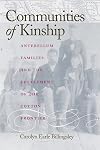
Trained as both a genealogist and a historian, Carolyn Earle Billingsley shows how the analytic category of kinship can add new dimensions to our understanding of the American South. In "Communities of Kinship, she studies a southern family--that of Thomas Keesee Sr.--to show how the biological, legal, and fictive kinship ties between him and some seven thousand of his descendants and relatives helped to shape the growth of the interior South. Keesee, who was born in Pittsylvania County, show more Virginia, left there with his family when he was still a boy and subsequently lived in South Carolina, Tennessee, Alabama, and Arkansas. Drawing on Keesee family history, Billingsley reminds us that, contrary to the accepted notion of rugged individuals heeding the proverbial call of the open spaces, kindred groups accounted for most of the migration to the South's interior and boundary lands. In addition, she discusses how, for antebellum southerners, the religious affiliation of one's parents was the most powerful predictor of one's own spiritual leanings, with marriage being the strongest motivation to change them. Billingsley also looks at the connections between kinship and economic and political power, offering examples of how Keesee family members facilitated and consolidated their influence and wealth through kin ties. Piecing together a wide assortment of public and private records that pertain to the Keesee family and shed light on naming practices, residential propinquity, migration patterns, economic and political dealings, and religious interactions, Billingsley offers a model of innovation and subtle analysis for historians. This important new study makes a persuasive case that kinship,particularly in the study of the antebellum South, should be considered a discrete category of analysis complementary to, and potentially as powerful as, race, class, and gender. show less

This short book hits on the highlights on how to become a professional genealogist, giving good advice and suggestions for resources. While it's probably dated a bit, it gave me some good ideas.
Pleasant Grove families (Saline County, Arkansas): Recollections of a church, a cemetery, a community of the past by Carolyn Earle Billingsley

I like this type of books but this book was boring just like all the other books written by this author. I did try to find one in the group that was a bit better but it didn't work.
Oh my Gosh, you've got to be kidding. This book is horrible.
Awards
You May Also Like


Associated Authors
Statistics
- Works
- 18
- Members
- 199
- Popularity
- #110,456
- Rating
- 2.3
- Reviews
- 5
- ISBNs
- 14