
Richard Todd (3)
Author of Good Prose: The Art of Nonfiction
For other authors named Richard Todd, see the disambiguation page.
Works by Richard Todd
Tagged
Common Knowledge
There is no Common Knowledge data for this author yet. You can help.
Members
Reviews

Tracy Kidder is a prize-winning and (justly) acclaimed writer of long-form non-fiction like Soul of a New Machine, Among Schoolchildren, and Mountains Beyond Mountains; Richard Todd is his longtime editor and friend. This book, a collaboration between them where their voices are sometimes made distinct and sometimes merged, is part joint memoir, part reflection on the nature of (some forms of) nonfiction, and part style guide.
There are interesting elements in this book: The glimpse inside show more the workings of The Atlantic Monthly back in the day were fascinating, the chapter titled "Beyond Accuracy" was thought-provoking, and the discussion of the relationship between "Art and Commerce" contained some gems . . . including A. J. Liebling's quote: "I can write better than everyone who can write faster, and I can write faster than everyone who can write better."
There are also elements that made me roll my eyes: The Atlantic Monthly reminiscences are fascinating as history but belong to an age so far removed from ours that they feel like a dead-end as insight into writing today, and "Rewrite!" is important, but hardly revelatory, advice to give any remotely experienced writer. The sections on style are particularly frustrating, since Kidder and Todd are more interested in deploring things than they are at suggesting alternatives.
The book's biggest problem, though, was that it ultimately felt like less than the sum of its parts. There is no clear through line, and the title and subtitle on the cover (Good Prose: The Art of Nonfiction) is, in the end, a far less accurate description of what's inside than the sub-subtitle just below: "Stories and advice from a lifetime of writing and editing." Go in with lower expectations than I did, and you'll probably enjoy it more. show less
There are interesting elements in this book: The glimpse inside show more the workings of The Atlantic Monthly back in the day were fascinating, the chapter titled "Beyond Accuracy" was thought-provoking, and the discussion of the relationship between "Art and Commerce" contained some gems . . . including A. J. Liebling's quote: "I can write better than everyone who can write faster, and I can write faster than everyone who can write better."
There are also elements that made me roll my eyes: The Atlantic Monthly reminiscences are fascinating as history but belong to an age so far removed from ours that they feel like a dead-end as insight into writing today, and "Rewrite!" is important, but hardly revelatory, advice to give any remotely experienced writer. The sections on style are particularly frustrating, since Kidder and Todd are more interested in deploring things than they are at suggesting alternatives.
The book's biggest problem, though, was that it ultimately felt like less than the sum of its parts. There is no clear through line, and the title and subtitle on the cover (Good Prose: The Art of Nonfiction) is, in the end, a far less accurate description of what's inside than the sub-subtitle just below: "Stories and advice from a lifetime of writing and editing." Go in with lower expectations than I did, and you'll probably enjoy it more. show less
During the past three decades American culture has become louder, faster, more disjointed. For immediacy of effect, writers can’t compete with popular music or action movies, cable network news or the multiplying forms of instant messaging. We think that writers shouldn’t try, and that there is no need to try. Writing remains the best route we know toward clarity of thought and feeling.
Amen! However: that’s like newspaper’s argument against radio and television -- that depth beats show more immediacy -- and as generations are abandoning newspaper’s depth, so I fear they will abandon writing’s clarity.
Anyway, Good Prose is a combination memoir + lessons-learned about writing and editing nonfiction (narratives, essays and memoirs), written by a writer and his long-time editor. It covers narrative elements (story, characters, point of view, setting, structure); style (from dense journalese to wandering vernacular); truth vs. fact (and fact vs. manipulation); art vs. commercial success; and re-writing/being edited. It’s like a broader, deeper version of the “A Conversation with Author X” programs held at auditoriums and book fests, and is one of the better books “on writing” for readers and beginning writers. Plus, its discussions of Kidder’s (and others’) books increased my wishlist by about ten.
I marked dozens of passages, here are several:
To write is to talk to strangers. You want them to trust you. You might well begin by trusting them -- by imagining for the reader an intelligence at least equal to the intelligence you imagine for yourself.
Point of view is the place from which a storyteller listens in and watches. {...It’s} a place to stand, but more than that, a way to think and feel. {...} Against a large background, “I” can provide human scale. {...} the smaller the canvas, the more intrusive the first person is likely to be.
Most memoirists, struggling for accuracy, would endorse this rough code of conduct: faithfulness to fact defined as faithfulness to one’s own memories. {But} like the act of remembering, the act of writing your own story inevitably distorts, if only by creating form where disorder reigns. {...} That’s one point of a story: to replace confusion with sense. The impulse of memoir is itself a fictive impulse.
With good writing the reader enjoys a doubleness of experience, succumbing to the story or the ideas while also enjoying the writer’s artfulness.
I always wince when a reviewer says, “This book needed an editor.” Often it had an editor, but the writer prevailed. Sometimes a book arrives at an editor’s desk too late for the editor to make a substantial difference.
The kind of rewriting one learns, or used to learn, in high school or in a college freshman composition class, is a chore that mainly involves tinkering -- moving sentences and paragraphs around, prettying up a phrase, crossing out words and substituting better ones. {...But there’s a} second kind, from figuring out the essential thing you’re trying to do and looking for better ways to tell your story. show less
Amen! However: that’s like newspaper’s argument against radio and television -- that depth beats show more immediacy -- and as generations are abandoning newspaper’s depth, so I fear they will abandon writing’s clarity.
Anyway, Good Prose is a combination memoir + lessons-learned about writing and editing nonfiction (narratives, essays and memoirs), written by a writer and his long-time editor. It covers narrative elements (story, characters, point of view, setting, structure); style (from dense journalese to wandering vernacular); truth vs. fact (and fact vs. manipulation); art vs. commercial success; and re-writing/being edited. It’s like a broader, deeper version of the “A Conversation with Author X” programs held at auditoriums and book fests, and is one of the better books “on writing” for readers and beginning writers. Plus, its discussions of Kidder’s (and others’) books increased my wishlist by about ten.
I marked dozens of passages, here are several:
To write is to talk to strangers. You want them to trust you. You might well begin by trusting them -- by imagining for the reader an intelligence at least equal to the intelligence you imagine for yourself.
Point of view is the place from which a storyteller listens in and watches. {...It’s} a place to stand, but more than that, a way to think and feel. {...} Against a large background, “I” can provide human scale. {...} the smaller the canvas, the more intrusive the first person is likely to be.
Most memoirists, struggling for accuracy, would endorse this rough code of conduct: faithfulness to fact defined as faithfulness to one’s own memories. {But} like the act of remembering, the act of writing your own story inevitably distorts, if only by creating form where disorder reigns. {...} That’s one point of a story: to replace confusion with sense. The impulse of memoir is itself a fictive impulse.
With good writing the reader enjoys a doubleness of experience, succumbing to the story or the ideas while also enjoying the writer’s artfulness.
I always wince when a reviewer says, “This book needed an editor.” Often it had an editor, but the writer prevailed. Sometimes a book arrives at an editor’s desk too late for the editor to make a substantial difference.
The kind of rewriting one learns, or used to learn, in high school or in a college freshman composition class, is a chore that mainly involves tinkering -- moving sentences and paragraphs around, prettying up a phrase, crossing out words and substituting better ones. {...But there’s a} second kind, from figuring out the essential thing you’re trying to do and looking for better ways to tell your story. show less
 This review was written for LibraryThing Early Reviewers.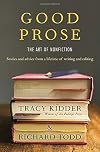
After a somewhat self-indulgent but not, for that, unnecessary introduction sketching the authors' history together, Good Prose is an excellent, well-written, and engaging bit of writing and editing advice. Todd and Kidder choose to discuss various aspects of non-fiction writing from the perspective of both writer and editor, mining their extraordinarily productive and mutually supportive relationship for examples and approaches to problems. It's good, uncomplicated writing advice, and it's show more a good read.
Like a lot of books about writing, it's a combination of memoir and advice, and the authors generally manage to stay out of their own ways while reminiscing. There's a very odd bit towards the end, though, where Todd, who otherwise seems like a normal guy, talks about the "gendered" roles of writer and editor that, while not reading as if Todd himself buys into gender stereotypes, is still jarring and presents a rather thoroughly outdated way of looking at the world. It tends to undercut the point he's trying to make, I think, about the nature of the relationship and whatever Todd might really think, it's surprisingly ill-advised in an otherwise really excellent book. show less
Like a lot of books about writing, it's a combination of memoir and advice, and the authors generally manage to stay out of their own ways while reminiscing. There's a very odd bit towards the end, though, where Todd, who otherwise seems like a normal guy, talks about the "gendered" roles of writer and editor that, while not reading as if Todd himself buys into gender stereotypes, is still jarring and presents a rather thoroughly outdated way of looking at the world. It tends to undercut the point he's trying to make, I think, about the nature of the relationship and whatever Todd might really think, it's surprisingly ill-advised in an otherwise really excellent book. show less
This review was written for LibraryThing Early Reviewers.I have been a BIG fan of Kidder's non-fiction. 'House', 'Among Schoolchildren', and 'Mountains Beyond Mountains', are among my favorite books. With 'Good Prose', Kidder and his longtime friend and editor, Todd, exchange stories and share their views as to what constitutes good prose writing. They offer many examples, good and bad, from both their own writing and that of others. Loved when I recognized takes from writing I know and appreciate. I was intrigued enough to investigate further show more when introduced to writing I didn't know. The breathtakingly beautiful 'The Color of a Sound' haunts me still. This is less a nuts-and-bolts primer, and more like a very good masters class. It is daunting to write a review about book on good prose - laying bare all my own weaknesses. For Kidder and Todd, I'm happy to join in the plaudits with a hearty 'huzzah'. I loved this book for making me a better writer and reader. show less
This review was written for LibraryThing Early Reviewers.Lists
To Read (1)
Awards

Statistics
- Works
- 1
- Members
- 489
- Popularity
- #50,497
- Rating
- 3.8
- Reviews
- 34
- ISBNs
- 37
