

Charles Sheffield (1) (1935–2002)
Author of Cold as Ice
For other authors named Charles Sheffield, see the disambiguation page.
Series
Works by Charles Sheffield
Borderlands of Science: How to Think Like a Scientist and Write Science Fiction (1999) 154 copies, 5 reviews
One Man's Universe: The Continuing Chronicles of Arthur Morton McAndrew (Tor Science Fiction) (1993) 23 copies
The Magazine of Fantasy and Science Fiction 67. Dinosaurier auf dem Broadway. (1983) — Contributor — 10 copies
A Braver Thing [short fiction] 9 copies
Georgia on My Mind [short fiction] 8 copies
Phallicide 6 copies
The Lady Vanishes {short story} 6 copies
The Deimos Plague 4 copies
Universi in fuga - Prima parte 4 copies
The Feynman Saltation 4 copies
The Diamond Drill 3 copies
Trapalanda 3 copies
Universi in fuga - Seconda parte 3 copies
Unterwegs in die Welt von morgen (141): Hüter meines Bruders - Die Kolonisten Terras (1994) 2 copies
That Strain Again… 2 copies
Destroyer Of Worlds 2 copies
Nightmares Of The Classical Mind 2 copies
The Waste Land 2 copies
Skystalk 2 copies
Summertide [short story] 2 copies
With the Knight Male 2 copies
The Bee's Kiss 2 copies
Forefather Figure 2 copies
At the Eschaton {novella} 2 copies
Transition Team 2 copies
The Heritage Universe - OMNI 1 copy
McAndrew and THE LAW 1 copy
The Art Of Fugue 1 copy
Fat Man's Gold {novelette} 1 copy
Counting Up {essay} 1 copy
Short Fiction Collected 1 copy
Izmedu otkucaja noci 1 copy
Short Fiction Collection 1 copy
HLe Isfere del cielo 1 copy
HLe Ilune fredde 1 copy
Proteus 1: Sight Of Proteus 1 copy
Proteus 2: Proteus Unbound 1 copy
The Peacock Throne 1 copy
The Softest Hammer 1 copy
Power Failure 1 copy
The Courts of Xanadu 1 copy
Godspeed [short story] 1 copy
Millennium 1 copy
Beyond The Golden Road 1 copy
Health Care System 1 copy
Obsolete Skill 1 copy
What Song The Sirens Sang 1 copy
Marconi Mattin Maxwell 1 copy
Dinsdale Dissents 1 copy
Analog Fantascienza n. 2 1 copy
How To Build A Beanstalk 1 copy
The Dalmatian Of Faust 1 copy
The Man Who Stole The Moon 1 copy
From Natural Causes 1 copy
Legacy 1 copy
A Certain Place In History 1 copy
The Marriage Of True Minds 1 copy
Humanity Test 1 copy
Associated Works
The Year's Best Science Fiction: Seventeenth Annual Collection (2000) — Contributor — 557 copies, 2 reviews
The Year's Best Science Fiction: Eleventh Annual Collection (1994) — Contributor — 467 copies, 2 reviews
The Year's Best Science Fiction: Fourteenth Annual Collection (1997) — Contributor — 444 copies, 2 reviews
The Year's Best Science Fiction: Eighth Annual Collection (1991) — Contributor — 415 copies, 6 reviews
The Year's Best Science Fiction: Seventh Annual Collection (1990) — Contributor — 310 copies, 2 reviews
Isaac Asimov's Wonderful Worlds of Science Fiction, Volume 6: Neanderthals (1987) — Contributor — 72 copies, 1 review
Nebula Awards 29: SFWA's Choices For The Best Science Fiction And Fantasy Of The Year (Nebula Awards Showcase) (1995) — Contributor — 57 copies
Great Science Fiction Stories By the World's Greatest Scientists (1985) — Author — 56 copies, 2 reviews
Visions of Tomorrow: Science Fiction Predictions that Came True (2010) — Contributor — 40 copies, 1 review
Analog Science Fiction/Science Fact: Vol. XCVIII, No. 7 (July 1978) (1978) — Contributor — 27 copies, 1 review
Isaac Asimov's Science Fiction Magazine: Vol. 13, No. 2 [February 1989] (1989) — Contributor — 16 copies
Pieces of Six (An Anthology of works by the Guests of Honor at Bucconeer, the 56th Annual World Science Fiction Convention) (1998) — Contributor — 15 copies, 1 review
The Magazine of Fantasy and Science Fiction May 1989, Vol. 76, No. 5 (1989) — Contributor — 13 copies
Hollywood Ghosts: Haunting, Spine-Chilling Stories from America's Film Capital (American Ghost Series) (1991) — Contributor — 12 copies
The Magazine of Fantasy and Science Fiction May 1983, Vol. 64, No. 5 (1983) — Contributor — 12 copies
Science Fiction Eye #08, Winter 1991 — Contributor — 1 copy
Science Fiction Eye #10, June 1992 — Contributor — 1 copy
Tagged
Common Knowledge
- Legal name
- Sheffield, Charles A.
- Birthdate
- 1935-06-25
- Date of death
- 2002-11-02
- Gender
- male
- Education
- St John's College, Cambridge
American University (PhD | Physics) - Occupations
- mathematician
physicist
science fiction writer
author
novelist - Organizations
- Science Fiction and Fantasy Writers of America
Earth Satellite Corporation
American Astronautical Society - Agent
- Spectrum Literary
- Relationships
- Kress, Nancy (wife)
- Cause of death
- cancer (brain)
- Nationality
- UK (birth)
- Birthplace
- Kingston Upon Hull, Yorkshire, England, UK
- Places of residence
- Silver Spring, Maryland, USA
- Place of death
- Silver Spring, Maryland, USA
- Map Location
- England, UK
Members
Reviews

Sheffield dedicated this book to Robert Louis Stevenson and Robert Heinlein; there's your first clue. Yes, this is "Treasure Island" channeled through a Heinleinesque SF adventure, but it works well nonetheless. The villain is far more thoughtful and focused than simply malevolent, though the spacer crewmen are pretty low-brow lumoxes: a chance to explore a complex crew dynamic was lost there. Since the main character is a teen, and a sheltered one at that, it does allow the author to skim show more the ramifications of a planetary culture facing population crisis and extinction. That culture's accommodations to the problems (such as decreasing fertility, environmental selection against live XX births, delayed onset of puberty for offspring) are credible if uncomfortable to our mores, but the future remains a dark one even after the book's fairly upbeat ending. This is better than average SF, even with its more-or-less YA bent, and I bump it up from a 3.5 to a 4 simply because of my love for TI. show less
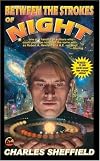
Between the Strokes of Night is a hard science-fiction novel caught between the grandiosity of deep time and associated big ideas, some standard medium-clunky characterization typical of the genre, and a plot that feels entirely tertiary to the ideas.
The first part of the book is set in the near-future of the 2010s. Earth is suffering under climate change and political instability. An enigmatic super-billionaire and space industrialist recruits the sleep-research time lead by Judith Niles, show more with the goal of cracking suspended animation. The scientific team just manages to make the transfer to the orbital habs when someone decides to try a nuclear first strike and the waves of counterstrikes obliterate civilization, leaving just a few tens of thousands of people in what are fortunately more-or-less self-sustaining habitats to figure out what to do next.
Smash cut nearly 30000 years in the future, and we're with Peron, a 20 year old who's participating in the Planetfest contest, a series of grueling endurance contests that'll whittle down thousands of finalists to a top 25 who get an elite status. He and some of the other competitors figure out that there's something weird going on with the space-faring Immortals who influence their society from behind the scenes, and when Peron is injured in one of the contests, he's whisked away on an Immortal starship to find out.
All of this is windup to the core tech of the book. S-space, which the immortals use, isn't some kind of hyperspace FTL physics tech. Rather, it's a form of suspended animation that has people living at a roughly 2000 : 1 time dilation, such that a single normal year passes in a little over 4 days. The Immortals are the sleep researchers from Part I, working through the social and astronomical problems of deep time, which involve communicating with extra-galactic intelligences that seem to operate at even slower timescales. S-space has some advantages, you don't need to sleep and age ever more slowly than subjective time would expect. Normal space robotics provide the illusion of instantaneous meals and local teleportation. The explored downsides are hair loss and infertility. Unexplored is the problem that you're still physically in N-space, and if something goes wrong, like explosive decompression, it'll be over far before you can meaningfully react to it.
The pressing problem facing S-space society is that some other uncontacted alien species is doing stellar engineering, and in a few hundred thousand years every star in Sol's neighborhood is going to be a red dwarf. Peron and his friends make a radical suggestion, that they lead a cohort to abandon S-space and do research in real time, providing a roughly 2000x effective research speedup. This is something the S-space geniuses missed entirely, the obvious flipside of their slowed down lifespans.
We don't hear if there's a solution, though the end has another deep-time being witness The Big Crunch as the universe ends.
What's good is the depiction of scientists as both brilliant and human (Sheffield had a scientific background himself), and people are horny in a way that's refreshing, between the "obviously author's fetishes" of the era and the chastity of the present. S-space is an interesting idea, and the game of figuring it out is well-done, though Sheffield misses some obvious extensions to his theory. The plot, three totally disconnected chunks, could use some work. But hey, if you like classic scifi, this is a overlooked gem. show less
The first part of the book is set in the near-future of the 2010s. Earth is suffering under climate change and political instability. An enigmatic super-billionaire and space industrialist recruits the sleep-research time lead by Judith Niles, show more with the goal of cracking suspended animation. The scientific team just manages to make the transfer to the orbital habs when someone decides to try a nuclear first strike and the waves of counterstrikes obliterate civilization, leaving just a few tens of thousands of people in what are fortunately more-or-less self-sustaining habitats to figure out what to do next.
Smash cut nearly 30000 years in the future, and we're with Peron, a 20 year old who's participating in the Planetfest contest, a series of grueling endurance contests that'll whittle down thousands of finalists to a top 25 who get an elite status. He and some of the other competitors figure out that there's something weird going on with the space-faring Immortals who influence their society from behind the scenes, and when Peron is injured in one of the contests, he's whisked away on an Immortal starship to find out.
All of this is windup to the core tech of the book. S-space, which the immortals use, isn't some kind of hyperspace FTL physics tech. Rather, it's a form of suspended animation that has people living at a roughly 2000 : 1 time dilation, such that a single normal year passes in a little over 4 days. The Immortals are the sleep researchers from Part I, working through the social and astronomical problems of deep time, which involve communicating with extra-galactic intelligences that seem to operate at even slower timescales. S-space has some advantages, you don't need to sleep and age ever more slowly than subjective time would expect. Normal space robotics provide the illusion of instantaneous meals and local teleportation. The explored downsides are hair loss and infertility. Unexplored is the problem that you're still physically in N-space, and if something goes wrong, like explosive decompression, it'll be over far before you can meaningfully react to it.
The pressing problem facing S-space society is that some other uncontacted alien species is doing stellar engineering, and in a few hundred thousand years every star in Sol's neighborhood is going to be a red dwarf. Peron and his friends make a radical suggestion, that they lead a cohort to abandon S-space and do research in real time, providing a roughly 2000x effective research speedup. This is something the S-space geniuses missed entirely, the obvious flipside of their slowed down lifespans.
We don't hear if there's a solution, though the end has another deep-time being witness The Big Crunch as the universe ends.
What's good is the depiction of scientists as both brilliant and human (Sheffield had a scientific background himself), and people are horny in a way that's refreshing, between the "obviously author's fetishes" of the era and the chastity of the present. S-space is an interesting idea, and the game of figuring it out is well-done, though Sheffield misses some obvious extensions to his theory. The plot, three totally disconnected chunks, could use some work. But hey, if you like classic scifi, this is a overlooked gem. show less

As Charles Fort might have said, “It’s space elevator time when it’s space elevator time.” And 1979 was space elevator time in science fiction. Besides this novel, Arthur C. Clarke’s The Fountains of Paradise was published that year. Clarke’s introduction to this novel makes it clear Sheffield came up with the idea independently.
There’s plenty of what science fiction critic John J. Pierce called “industrial science fiction” here. It includes not only our hero Rob Merlyn, an show more engineer who specializes in building massive bridges on Earth, discusseing the project with his client Darius Regula, the Rocket King of the solar system, but a whole chapter describing the tethering of the space elevator.
But, since this is Sheffield, there’s a whole other story going on besides building that elevator. The novel starts out with the murder of Rob’s parents, the downing of an airliner by a bomb, and Rob being birthed on an Antarctica ice sheet. To that, add a bit of spacebound Gothic with Darius’ watery habitat Atlantis with a squid in space (long before Stephen Baxter did it) and a sinister scientist Morel, reports of “goblins”, and Rob’s attraction to Darius’ assistant Cornelia – complicated by her amnesiac, drug addict mother. Throw in some set pieces like a trip to Way Down, a restaurant far below the surface of Earth, and the asteroid mining accident that made Darius a rich – but very photophobic – man, and you have a suspenseful story full of hard science with a bit of the feeling of Alfred Bester and Charles Harness about it.
Take note, this is the first version of the novel. Sheffield expanded it later in 1989 and 2001. show less
There’s plenty of what science fiction critic John J. Pierce called “industrial science fiction” here. It includes not only our hero Rob Merlyn, an show more engineer who specializes in building massive bridges on Earth, discusseing the project with his client Darius Regula, the Rocket King of the solar system, but a whole chapter describing the tethering of the space elevator.
But, since this is Sheffield, there’s a whole other story going on besides building that elevator. The novel starts out with the murder of Rob’s parents, the downing of an airliner by a bomb, and Rob being birthed on an Antarctica ice sheet. To that, add a bit of spacebound Gothic with Darius’ watery habitat Atlantis with a squid in space (long before Stephen Baxter did it) and a sinister scientist Morel, reports of “goblins”, and Rob’s attraction to Darius’ assistant Cornelia – complicated by her amnesiac, drug addict mother. Throw in some set pieces like a trip to Way Down, a restaurant far below the surface of Earth, and the asteroid mining accident that made Darius a rich – but very photophobic – man, and you have a suspenseful story full of hard science with a bit of the feeling of Alfred Bester and Charles Harness about it.
Take note, this is the first version of the novel. Sheffield expanded it later in 1989 and 2001. show less

http://www.nicholaswhyte.info/sf/georgia.htm
Back in the summer of 1991 I was finishing up my M Phil in Cambridge, and dropped in one day on my supervisor, who at the time was the curator of the history of science museum. He welcomed me into his office, shuffled through some papers with strange cylindrical diagrams on them, and flourished them at me: “These,” he said, “are Charles Babbage’s original blueprints for the Difference Engine.” He had a tendency to do that. I remember one show more seminar on Newton where he brought in an authentic 17th-century widget, “just like Newton would have had”, and showed the original owner’s notes of how it had been used, almost casually indicating at the end that the original owner in this case had in fact been Isaac Newton. We would occasionally see the current Lucasian Professor, a post previously held by Babbage and Newton, trundling through the cobbled streets in his battery-driven wheelchair.
Babbage was all the rage in those days, it being the bicentenary of his birth, and with no less than three sf novels published the previous year in which Babbage’s difference engine was actually built (Michael Flynn’s In the Country of the Blind, S.M. Stirling’s The Stone Dogs, and William Gibson & Bruce Sterling’s The Difference Engine), and thus the computer was brought into being a century and a half before Bill Gates. Apart from those three novels and Sheffield’s novelette, which is dated as having been finished on December 31, 1991, there aren’t many stories with that theme, though steampunk as a genre keeps on going. In all three of those novels, the difference engine is at least partly responsible for revolutionising society.
Sheffield, however, takes it in a different direction: what if it were simply built in 1850 as a project of an eccentric couple in the farther flung reaches of the British Empire, and then forgotten? His unnamed narrator and his old New Zealander friend Bill Rigley team up to find out the truth behind the manuscripts located on a farm at the back end of nowhere. In fact, the largest surviving fragment of Babbage’s analytical engine was indeed discovered, along with various papers now in the Wanganui Museum, on a farm in New Zealand in the late 1970s by Garry Tee, to whom “Georgia On My Mind” is dedicated and who “is no more Bill Rigley than I [Charles Sheffield] am the narrator of this story.” However, in our timeline the Babbage material reached New Zealand via Australia in the hands of Babbage’s son and grandson when they emigrated, rather than being constructed from scratch.
Tee made his real-life discovery about the time that Charles Sheffield’s first wife died, in 1977, and the narrator of “Georgia on My Mind” has had a similar recent loss. The theme of nostalgia and loss runs strongly and powerfully through the story, permeating the excitement of the two friends as they look through the papers of Luke and Louisa Derwent from over a century before. Anyone who has ever been bereaved will sympathise with the narrator’s sharp intake of breath as a picture of Louisa reminds him of his dead wife. The setting of New Zealand is also richly portrayed, in the days before Peter Jackson made it as iconic as it now has become. And so we are not really prepared for what happens next.
It seems that the Derwents – a married couple, exiled from England because they were also, scandalously, half-brother and half-sister – had made contact with aliens – or at least intelligent non-humans – on Macquarie Island. One last letter written in 1855 reveals that Luke and the dying Louisa set off to the permanent base of the “heteromorphs”; there is just about enough information in the manuscripts to enable the identification of the site of that permanent base as being South Georgia, in the Atlantic Ocean. (The story’s title has nothing to do with the U.S. state of Georgia, let alone the former Soviet Republic of the same name, where I will be this time next week as I write these words.)
And so, just as the Derwents’ story finishes with preparation for a long and dangerous journey, “Georgia On My Mind” ends with our narrator and Bill Rigley preparing to follow the Derwents to South Georgia. But they will not be alone; word has leaked out, and a host of people from MIT, Livermore and the hard science fiction community are rumoured to also be converging on the island. For some readers, this somewhat recursive twist at the end spoils the story. Not for me. I read it as a tribute, 14 years on, to the support Sheffield drew from his professional and literary colleagues at the time of his bereavement, and a good end to a story whose plot was never intended to be fully resolved.
https://fromtheheartofeurope.eu/georgia-on-my-mind-by-charles-sheffield/
Coming back to it two decades later, I still loved this story for bringing me back to my history of science days, the most intellectually interesting work I have ever done in my life. I wondered also if E.J. Swift was slightly inspired by it for The Coral Bones. And I think we can all do with a hidden history occasionally. show less
Back in the summer of 1991 I was finishing up my M Phil in Cambridge, and dropped in one day on my supervisor, who at the time was the curator of the history of science museum. He welcomed me into his office, shuffled through some papers with strange cylindrical diagrams on them, and flourished them at me: “These,” he said, “are Charles Babbage’s original blueprints for the Difference Engine.” He had a tendency to do that. I remember one show more seminar on Newton where he brought in an authentic 17th-century widget, “just like Newton would have had”, and showed the original owner’s notes of how it had been used, almost casually indicating at the end that the original owner in this case had in fact been Isaac Newton. We would occasionally see the current Lucasian Professor, a post previously held by Babbage and Newton, trundling through the cobbled streets in his battery-driven wheelchair.
Babbage was all the rage in those days, it being the bicentenary of his birth, and with no less than three sf novels published the previous year in which Babbage’s difference engine was actually built (Michael Flynn’s In the Country of the Blind, S.M. Stirling’s The Stone Dogs, and William Gibson & Bruce Sterling’s The Difference Engine), and thus the computer was brought into being a century and a half before Bill Gates. Apart from those three novels and Sheffield’s novelette, which is dated as having been finished on December 31, 1991, there aren’t many stories with that theme, though steampunk as a genre keeps on going. In all three of those novels, the difference engine is at least partly responsible for revolutionising society.
Sheffield, however, takes it in a different direction: what if it were simply built in 1850 as a project of an eccentric couple in the farther flung reaches of the British Empire, and then forgotten? His unnamed narrator and his old New Zealander friend Bill Rigley team up to find out the truth behind the manuscripts located on a farm at the back end of nowhere. In fact, the largest surviving fragment of Babbage’s analytical engine was indeed discovered, along with various papers now in the Wanganui Museum, on a farm in New Zealand in the late 1970s by Garry Tee, to whom “Georgia On My Mind” is dedicated and who “is no more Bill Rigley than I [Charles Sheffield] am the narrator of this story.” However, in our timeline the Babbage material reached New Zealand via Australia in the hands of Babbage’s son and grandson when they emigrated, rather than being constructed from scratch.
Tee made his real-life discovery about the time that Charles Sheffield’s first wife died, in 1977, and the narrator of “Georgia on My Mind” has had a similar recent loss. The theme of nostalgia and loss runs strongly and powerfully through the story, permeating the excitement of the two friends as they look through the papers of Luke and Louisa Derwent from over a century before. Anyone who has ever been bereaved will sympathise with the narrator’s sharp intake of breath as a picture of Louisa reminds him of his dead wife. The setting of New Zealand is also richly portrayed, in the days before Peter Jackson made it as iconic as it now has become. And so we are not really prepared for what happens next.
It seems that the Derwents – a married couple, exiled from England because they were also, scandalously, half-brother and half-sister – had made contact with aliens – or at least intelligent non-humans – on Macquarie Island. One last letter written in 1855 reveals that Luke and the dying Louisa set off to the permanent base of the “heteromorphs”; there is just about enough information in the manuscripts to enable the identification of the site of that permanent base as being South Georgia, in the Atlantic Ocean. (The story’s title has nothing to do with the U.S. state of Georgia, let alone the former Soviet Republic of the same name, where I will be this time next week as I write these words.)
And so, just as the Derwents’ story finishes with preparation for a long and dangerous journey, “Georgia On My Mind” ends with our narrator and Bill Rigley preparing to follow the Derwents to South Georgia. But they will not be alone; word has leaked out, and a host of people from MIT, Livermore and the hard science fiction community are rumoured to also be converging on the island. For some readers, this somewhat recursive twist at the end spoils the story. Not for me. I read it as a tribute, 14 years on, to the support Sheffield drew from his professional and literary colleagues at the time of his bereavement, and a good end to a story whose plot was never intended to be fully resolved.
https://fromtheheartofeurope.eu/georgia-on-my-mind-by-charles-sheffield/
Coming back to it two decades later, I still loved this story for bringing me back to my history of science days, the most intellectually interesting work I have ever done in my life. I wondered also if E.J. Swift was slightly inspired by it for The Coral Bones. And I think we can all do with a hidden history occasionally. show less
Awards


You May Also Like
Associated Authors
Statistics
- Works
- 156
- Also by
- 76
- Members
- 10,100
- Popularity
- #2,351
- Rating
- 3.6
- Reviews
- 154
- ISBNs
- 275
- Languages
- 9