
Elizabeth D. Leonard
Author of Lincoln's Avengers: Justice, Revenge, and Reunion after the Civil War
About the Author
Elizabeth D. Leonard is the John J. and Cornelia V. Gibson Professor of History at Colby College in Waterville, Maine, and the author of five books, including Men of Color to Arms! Black Soldiers, Indian Wars, and the Quest for Equality and Lincoln's Forgotten Ally: Judge Advocate General Joseph show more Holt of Kentucky, which was joint recipient of the 2012 Gilder Lehrman Lincoln Prize. show less
Disambiguation Notice:
Do not combine Elizabeth D. Leonard and Elizabeth Dermody Leonard. They are different authors.
Works by Elizabeth D. Leonard
Men of Color to Arms!: Black Soldiers, Indian Wars, and the Quest for Equality (2010) 51 copies, 1 review
Tagged
Common Knowledge
- Birthdate
- 1948
- Gender
- female
- Education
- University of California, Riverside (PhD|History|1992)
- Occupations
- historian
college professor - Organizations
- Colby College
- Nationality
- USA
- Disambiguation notice
- Do not combine Elizabeth D. Leonard and Elizabeth Dermody Leonard. They are different authors.
- Associated Place (for map)
- USA
Members
Reviews
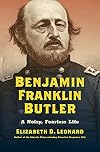
Those who have heard of Benjamin Butler tend to remember him principally by the pejorative sobriquets dipped in venom attached to him by Confederate military and civilian leaders during the American Civil War: “Beast,” an epithet earned when as military governor of occupied New Orleans he issued an order equating all the fine southern ladies in the city with prostitutes, following certain episodes that saw them dumping chamber pots out of windows upon passing Union soldiers; and, show more “Spoons,” assigned based upon a more than passing suspicion that while establishing order he was also regularly lining his pockets. But he was actually an individual of far greater significance than implied by the unfortunate monikers meant to mock him. A Zelig-like figure—or perhaps a craftier Forrest Gump—Butler pops up everywhere, not only during the Civil War where he made a name for himself (for both good and for ill), but on the eve of secession, during Reconstruction, and in the decades that followed. And he was funny-looking too— a dead ringer for Dennis Franz as Detective Andy Sipowicz on NYPD Blue—making him an ideal target for the outlandish political cartoons that ruled his day. Thus, there exists in the historical record a Butler of legend that is mostly caricature, as well as a more nuanced portrait of a complex, fascinating, and by all means flamboyant character who carved a deep groove on his era, for better and for worse. Larger-than-life is an often-overused cliché, but it suits Butler perfectly.
That life gets a detailed scholarly treatment in Benjamin Franklin Butler: A Noisy, Fearless Life [2022], by award-winning historian Elizabeth D. Leonard, a meticulously researched, well-written, if sometimes tedious chronicle that is long on the laudatory and too often a bit blurry when tracking her subject’s many trails of malfeasance. Leonard, a professor at Colby College, Butler’s alma mater when it was known as Waterville College, found inspiration for this work in an article written by her late mentor, Colby’s Civil War historian Harold B. Raymond. Her book explores Butler’s public life without neglecting his private one, a welcome approach for the reader who looks to biography to go beyond dates and deeds to establish a sense of greater intimacy with the protagonist.
Benjamin Franklin Butler (1818-1893) was born in New Hampshire, but as a boy moved with his family to Lowell, Massachusetts, where his mother ran a boarding house for workers at the local textile mills. After Waterville, he became a lawyer and took cases in turn representing the mills, where he also invested, as well as their beleaguered employees. He seems to have developed genuine empathy and affection for these workers, especially the young girls, who labored fourteen hours a day in often brutal conditions, and he became a spirited advocate for “ten hour day” legislation. A pro-slavery, pro-southern “doughface” Democrat who supported first Jefferson Davis and then John C. Breckinridge in the election that put Lincoln in the White House, secession transformed him into a Major General who occupied Baltimore and helped keep Maryland in the Union. Next he went to Fort Monroe in Virginia and demonstrated in the bungled Battle of Big Bethel the lack of military prowess that was to define him on the battlefield throughout much of the war. At the same time, he distinguished himself by devising a clever legal loophole that declared the enslaved who fled to federal lines “contraband of war” who would not be returned to the rebels, a landmark policy later adopted by the Lincoln Administration.
Next up was his stint in New Orleans, which began when he had a civilian tried and executed for tearing down a United States flag. But despite the contempt he provoked in the subject population, he also effected a humane administration that saved many from starvation and disease, and he formed the very first African American regiment in the US Army, the 1st Louisiana Native Guard. That Jefferson Davis loudly called for his execution if captured only added to his popularity back home. Still, in concert with his felonious brother, he confiscated cotton and resold it for personal profit, just one of many financial irregularities that followed his military career. Glaring examples of corruption led to his being replaced in New Orleans, but as one of Lincoln’s “political generals” who abandoned the Democrats and was reborn as a leading Radical Republican, he was reshuffled rather than cashiered, eventually ending up in Norfolk, Virginia in command of what became the Army of the James. Here he famously created multiple regiments comprised of former rebel prisoners of war who became known as “Galvanized Yankees,” while also allegedly enabling illicit trade between northern merchants and the Confederacy. Yet, in 1864, Grant gave him critical responsibility for a planned attack on strategic Petersburg, but Butler dropped the ball entirely and his army ended up out of action, bottled up at Bermuda Hundred. He then botched an attempt to take Fort Fisher, which not long after fell almost effortlessly to Adelbert Ames, his future son-in-law. Finally, Grant and Lincoln had enough of him.
After the war, he embarked on a career in Congress that soon had him managing the impeachment of President Andrew Johnson, which failed for a variety of reasons, not least his own mediocre performance. He championed civil rights, women’s suffrage, and the working poor, but managed to drift through a variety of ideologies, alliances, and parties that saw him develop his own peculiar brand of politics known as “Butlerism,” and led to a single term as a populist Democratic Governor of Massachusetts, followed by a landslide defeat in his bid for the presidency as nominee of the Greenback and Anti-Monopoly parties. Near the end of his life, he published a one thousand page autobiography—Butler’s Book—that revels in his self-importance, and sits on the shelves of my home library. Through it all, he amassed vast wealth and proved to be ingenious, opportunistic, stubborn, difficult, ego-driven, ambitious—and so chameleon-like that many wondered if he was less given to populism than demagoguery. For all his passions on various sides of various issues, in the end the question was whether Benjamin Franklin Butler actually fervently believed in anything other than Benjamin Franklin Butler.
I first encountered Butler back in 2014, when I had a key role in a grant-funded project to digitize the recently rediscovered letters, diaries, and memoirs of the 31st Massachusetts Volunteers, the regiment Butler commanded in New Orleans, materials now available on the web for public access. This motivated me to read up on him, in a number of sources. Some biographers might claim that much of the calumnies charged against Butler were grievance-driven slanders manufactured by proponents of the “Lost Cause” to magnify minor peccadillos in an enduring retaliation for his insults to the honor of southern women and his eagerness in putting African Americans in uniform. Leonard seems to take that position, as well, acknowledging, for example, the financial improprieties that clung to Butler’s tenure in New Orleans, but laying all the blame on Butler’s brother. But the more one reads about Butler, who was hardly naïve and indeed quite shrewd, the more difficult it is to accept that he was some kind of innocent bystander to corruption—or that his shifting allegiances to ideas and principles were always sincere.
Ever the opportunist, Butler did however seem to muster up honest sympathy for the downtrodden, even if he often only put it to best use when there was a mutual benefit for him. Leonard may have missed an opportunity to focus more deeply on Butler’s paternalistic relationship with the Lowell mill girls he sought to shield from overly harsh conditions, since this seems to have left a truly lasting impression. Those who have read Robert Caro may find similar echoes in young Lyndon Johnson’s defining moment as schoolteacher to poverty-stricken Mexican-American children. Both men deeply felt those respective sufferings, and both carried that with them ever after. And each, a century apart, became ardent defenders of black Americans in their struggle for civil rights.
As noted earlier, Leonard dwells a good deal upon the private sphere of Butler’s life, which was marked by a long and happy marriage blessed with several children, and by all indications he was a loving father and an attentive family man. But sometimes the author goes overboard: throughout the book, too many paragraphs are plagued with excerpts from correspondence given to insignificant chatter about quotidian happenings that add nothing to the narrative. There are even multiple references to Butler’s gratitude for the homemade sausages his sister sends him! This stands in stark underscore to Leonard’s coverage of Butler’s part in Johnson’s impeachment, which the astonished reader will find amounts to all of three paragraphs. Moreover, whenever Butler stumbles, as he did mightily in this episode, or seems to be caught with his hand in the cookie jar, as occurred more than once, Leonard takes him at his word and ever gives him the benefit of the doubt, which frequently equates to a superficial treatment of negative incidents that then give way to longer looks at his accomplishments. It should be noted, though, that Leonard is a careful historian who does report dissenting views, even if the latter sometimes seem to have been tacked on begrudgingly.
Still, this tendency towards the all-too-forgiving only serves to dial the volume down on Butler’s so-called “noisy, fearless” life, in which he cast himself as both hero and scoundrel. To varnish away the villain only dulls the outsize impact of his legacy. As it turns out, this book is not quite a hagiography, but it does suffer from a lack of balance that consistently celebrates Butler while rarely finding fault. And that’s a shame, because Butler, warts and all, was a colorful, intriguing character made far more compelling by his manifest blemishes. But for more on that, the reader will have to turn elsewhere.
Letters, diaries, and memoirs of the 31st Massachusetts Volunteers are here: https://31massinf.wordpress.com/
Review of: Benjamin Franklin Butler: A Noisy, Fearless Life, by Elizabeth D. Leonard – Regarp Book Blog https://regarp.com/2024/06/20/review-of-benjamin-franklin-butler-a-noisy-fearles... show less
That life gets a detailed scholarly treatment in Benjamin Franklin Butler: A Noisy, Fearless Life [2022], by award-winning historian Elizabeth D. Leonard, a meticulously researched, well-written, if sometimes tedious chronicle that is long on the laudatory and too often a bit blurry when tracking her subject’s many trails of malfeasance. Leonard, a professor at Colby College, Butler’s alma mater when it was known as Waterville College, found inspiration for this work in an article written by her late mentor, Colby’s Civil War historian Harold B. Raymond. Her book explores Butler’s public life without neglecting his private one, a welcome approach for the reader who looks to biography to go beyond dates and deeds to establish a sense of greater intimacy with the protagonist.
Benjamin Franklin Butler (1818-1893) was born in New Hampshire, but as a boy moved with his family to Lowell, Massachusetts, where his mother ran a boarding house for workers at the local textile mills. After Waterville, he became a lawyer and took cases in turn representing the mills, where he also invested, as well as their beleaguered employees. He seems to have developed genuine empathy and affection for these workers, especially the young girls, who labored fourteen hours a day in often brutal conditions, and he became a spirited advocate for “ten hour day” legislation. A pro-slavery, pro-southern “doughface” Democrat who supported first Jefferson Davis and then John C. Breckinridge in the election that put Lincoln in the White House, secession transformed him into a Major General who occupied Baltimore and helped keep Maryland in the Union. Next he went to Fort Monroe in Virginia and demonstrated in the bungled Battle of Big Bethel the lack of military prowess that was to define him on the battlefield throughout much of the war. At the same time, he distinguished himself by devising a clever legal loophole that declared the enslaved who fled to federal lines “contraband of war” who would not be returned to the rebels, a landmark policy later adopted by the Lincoln Administration.
Next up was his stint in New Orleans, which began when he had a civilian tried and executed for tearing down a United States flag. But despite the contempt he provoked in the subject population, he also effected a humane administration that saved many from starvation and disease, and he formed the very first African American regiment in the US Army, the 1st Louisiana Native Guard. That Jefferson Davis loudly called for his execution if captured only added to his popularity back home. Still, in concert with his felonious brother, he confiscated cotton and resold it for personal profit, just one of many financial irregularities that followed his military career. Glaring examples of corruption led to his being replaced in New Orleans, but as one of Lincoln’s “political generals” who abandoned the Democrats and was reborn as a leading Radical Republican, he was reshuffled rather than cashiered, eventually ending up in Norfolk, Virginia in command of what became the Army of the James. Here he famously created multiple regiments comprised of former rebel prisoners of war who became known as “Galvanized Yankees,” while also allegedly enabling illicit trade between northern merchants and the Confederacy. Yet, in 1864, Grant gave him critical responsibility for a planned attack on strategic Petersburg, but Butler dropped the ball entirely and his army ended up out of action, bottled up at Bermuda Hundred. He then botched an attempt to take Fort Fisher, which not long after fell almost effortlessly to Adelbert Ames, his future son-in-law. Finally, Grant and Lincoln had enough of him.
After the war, he embarked on a career in Congress that soon had him managing the impeachment of President Andrew Johnson, which failed for a variety of reasons, not least his own mediocre performance. He championed civil rights, women’s suffrage, and the working poor, but managed to drift through a variety of ideologies, alliances, and parties that saw him develop his own peculiar brand of politics known as “Butlerism,” and led to a single term as a populist Democratic Governor of Massachusetts, followed by a landslide defeat in his bid for the presidency as nominee of the Greenback and Anti-Monopoly parties. Near the end of his life, he published a one thousand page autobiography—Butler’s Book—that revels in his self-importance, and sits on the shelves of my home library. Through it all, he amassed vast wealth and proved to be ingenious, opportunistic, stubborn, difficult, ego-driven, ambitious—and so chameleon-like that many wondered if he was less given to populism than demagoguery. For all his passions on various sides of various issues, in the end the question was whether Benjamin Franklin Butler actually fervently believed in anything other than Benjamin Franklin Butler.
I first encountered Butler back in 2014, when I had a key role in a grant-funded project to digitize the recently rediscovered letters, diaries, and memoirs of the 31st Massachusetts Volunteers, the regiment Butler commanded in New Orleans, materials now available on the web for public access. This motivated me to read up on him, in a number of sources. Some biographers might claim that much of the calumnies charged against Butler were grievance-driven slanders manufactured by proponents of the “Lost Cause” to magnify minor peccadillos in an enduring retaliation for his insults to the honor of southern women and his eagerness in putting African Americans in uniform. Leonard seems to take that position, as well, acknowledging, for example, the financial improprieties that clung to Butler’s tenure in New Orleans, but laying all the blame on Butler’s brother. But the more one reads about Butler, who was hardly naïve and indeed quite shrewd, the more difficult it is to accept that he was some kind of innocent bystander to corruption—or that his shifting allegiances to ideas and principles were always sincere.
Ever the opportunist, Butler did however seem to muster up honest sympathy for the downtrodden, even if he often only put it to best use when there was a mutual benefit for him. Leonard may have missed an opportunity to focus more deeply on Butler’s paternalistic relationship with the Lowell mill girls he sought to shield from overly harsh conditions, since this seems to have left a truly lasting impression. Those who have read Robert Caro may find similar echoes in young Lyndon Johnson’s defining moment as schoolteacher to poverty-stricken Mexican-American children. Both men deeply felt those respective sufferings, and both carried that with them ever after. And each, a century apart, became ardent defenders of black Americans in their struggle for civil rights.
As noted earlier, Leonard dwells a good deal upon the private sphere of Butler’s life, which was marked by a long and happy marriage blessed with several children, and by all indications he was a loving father and an attentive family man. But sometimes the author goes overboard: throughout the book, too many paragraphs are plagued with excerpts from correspondence given to insignificant chatter about quotidian happenings that add nothing to the narrative. There are even multiple references to Butler’s gratitude for the homemade sausages his sister sends him! This stands in stark underscore to Leonard’s coverage of Butler’s part in Johnson’s impeachment, which the astonished reader will find amounts to all of three paragraphs. Moreover, whenever Butler stumbles, as he did mightily in this episode, or seems to be caught with his hand in the cookie jar, as occurred more than once, Leonard takes him at his word and ever gives him the benefit of the doubt, which frequently equates to a superficial treatment of negative incidents that then give way to longer looks at his accomplishments. It should be noted, though, that Leonard is a careful historian who does report dissenting views, even if the latter sometimes seem to have been tacked on begrudgingly.
Still, this tendency towards the all-too-forgiving only serves to dial the volume down on Butler’s so-called “noisy, fearless” life, in which he cast himself as both hero and scoundrel. To varnish away the villain only dulls the outsize impact of his legacy. As it turns out, this book is not quite a hagiography, but it does suffer from a lack of balance that consistently celebrates Butler while rarely finding fault. And that’s a shame, because Butler, warts and all, was a colorful, intriguing character made far more compelling by his manifest blemishes. But for more on that, the reader will have to turn elsewhere.
Letters, diaries, and memoirs of the 31st Massachusetts Volunteers are here: https://31massinf.wordpress.com/
Review of: Benjamin Franklin Butler: A Noisy, Fearless Life, by Elizabeth D. Leonard – Regarp Book Blog https://regarp.com/2024/06/20/review-of-benjamin-franklin-butler-a-noisy-fearles... show less
Men of Color to Arms!: Black Soldiers, Indian Wars, and the Quest for Equality by Elizabeth D. Leonard
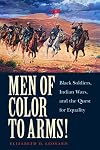
Covers the history of black troops in the US army during the latter part of the 19th century – from the end of the Civil War through the “Indian Wars” years. (There’s some mention of blacks fighting in the Revolution and the War of 1812, and in the Spanish-American War, but these are outside the main focus). Author Elizabeth Leonard contrasts Frederick Douglas’ impassioned speech “Once let the black man get upon his person the brass letters US; let him get an eagle on his button, show more and a musket on his shoulder, and bullets in his pocket, and there is no power on earth or under the earth which deny that he has earned the right of citizenship in the United States” with what actually happened.
Starting with the Civil War, Leonard contrasts the service of the United States Colored Troops during the war with their exclusion from the grand victory parade in Washington. I think Leonard might be exaggerating a bit here; other accounts of the Grand Review mention black pioneer units marching at the head of each division in Sherman’s Army of the West on the second day of the Grand Review.
Leonard continues with black service in the infantry and cavalry during the Indian wars. Of interest is Leonard’s eschewal of the common term “Buffalo Soldiers”; although it’s usually considered a complement, Leonard isn’t sure and uses “Black Regulars” instead.
I note Leonard has praise for Richard Henry Pratt. Pratt was a veteran of the black Tenth Cavalry, as a white officer, and took extremely egalitarian attitudes for the time, commenting that “… the Negro {was entitled} to be treated in every way as other citizens…”, that the Army should be integrated, and even supporting intermarriage: “…if individuals see their affinities crossing the races, that is, in my judgement, entirely their affair.” The catch is Pratt is notorious for founding the Carlisle Indian School, infamous for stripping Native Americans of their culture. The Indian School actually fits with Pratt’s expressed ideas about racial equality – essentially that American citizen would blend together, not remain diverse. (Leonard notes that Pratt’s ideas mesh with those expressed by Frederick Douglas when Douglas spoke of a “composite” American culture).
Pratt’s suggestion that the Army be integrated was actually proposed in 1874; Congress was interested in reducing the military and it was suggested that the black regiments be disbanded and future Army recruits be selected without regard to race. Ironically blacks and their supporters opposed this idea, supposing (probably correctly) that recruiters would choose only white applicants. The bills for Army desegregation were rejected.
Pretty enlightening. As mentioned, I’m a little skeptical of Leonard’s comments about Sherman’s “pioneers”; otherwise everything is scholarly and thoroughly researched. Appropriate illustrations; endnotes. show less
Starting with the Civil War, Leonard contrasts the service of the United States Colored Troops during the war with their exclusion from the grand victory parade in Washington. I think Leonard might be exaggerating a bit here; other accounts of the Grand Review mention black pioneer units marching at the head of each division in Sherman’s Army of the West on the second day of the Grand Review.
Leonard continues with black service in the infantry and cavalry during the Indian wars. Of interest is Leonard’s eschewal of the common term “Buffalo Soldiers”; although it’s usually considered a complement, Leonard isn’t sure and uses “Black Regulars” instead.
I note Leonard has praise for Richard Henry Pratt. Pratt was a veteran of the black Tenth Cavalry, as a white officer, and took extremely egalitarian attitudes for the time, commenting that “… the Negro {was entitled} to be treated in every way as other citizens…”, that the Army should be integrated, and even supporting intermarriage: “…if individuals see their affinities crossing the races, that is, in my judgement, entirely their affair.” The catch is Pratt is notorious for founding the Carlisle Indian School, infamous for stripping Native Americans of their culture. The Indian School actually fits with Pratt’s expressed ideas about racial equality – essentially that American citizen would blend together, not remain diverse. (Leonard notes that Pratt’s ideas mesh with those expressed by Frederick Douglas when Douglas spoke of a “composite” American culture).
Pratt’s suggestion that the Army be integrated was actually proposed in 1874; Congress was interested in reducing the military and it was suggested that the black regiments be disbanded and future Army recruits be selected without regard to race. Ironically blacks and their supporters opposed this idea, supposing (probably correctly) that recruiters would choose only white applicants. The bills for Army desegregation were rejected.
Pretty enlightening. As mentioned, I’m a little skeptical of Leonard’s comments about Sherman’s “pioneers”; otherwise everything is scholarly and thoroughly researched. Appropriate illustrations; endnotes. show less
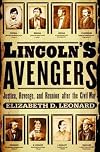
Yet another example of a somewhat unconventional angle on the Lincoln assassination, this book explores the aftermath of the president's murder by focusing on judge advocate general Joseph Holt, the man responsible for the prosecution of the conspirators. Leonard also places the trial and subsequent legal proceedings concerning John Surratt, Jr. and Jefferson Davis in the context of the early Reconstruction period, which offers a very useful narrative framework.
Well researched and a lively show more read; recommended. show less
Well researched and a lively show more read; recommended. show less
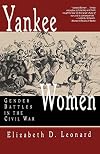
Looks at how lives of Northern women who wanted to help their country during the Civil War were constrained by the social customs of the time period. Considers Mary Edwards Walker, Sophriona Bucklin, and Annie Wittenmyer. Examines their lives after the war. Then looks at the way late 19th century historians like Brockett interpreted these women and their contributions to the war. Excellent scholarly work.
Awards

You May Also Like


Statistics
- Works
- 7
- Members
- 423
- Popularity
- #57,687
- Rating
- 3.7
- Reviews
- 6
- ISBNs
- 20