
Patric Kuh (–1964)
Author of The Last Days of Haute Cuisine: The Coming of Age of American Restaurants
About the Author
Works by Patric Kuh
The Last Days of Haute Cuisine: The Coming of Age of American Restaurants (2001) 149 copies, 3 reviews
Associated Works
Tagged
Common Knowledge
- Date of death
- 1964
- Gender
- male
- Birthplace
- Madrid, Spain
- Map Location
- USA
Members
Reviews
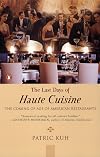
"It was as if French cooking had finally succumbed under all the social aspirations that for so long it had been made to carry. A shift in perception was needed to revive it. That shift would occur in California, in the most unlikely of places: across the Bay Bridge from San Francisco, on Shattuck Avenue in Berkeley, in a restaurant with a collective philosophy located in a building that had once been plumber's store. It had a honeysuckle hedge and a monkey puzzle tree in front and it was show more called Chez Panisse."This paragraph typifies the best and the worst of this book, and indeed, of nonfiction writing of this type in general. If I'm reading a history of something, -- and I think this book is fundamentally a history -- I want it to do two things: to give a context to each event, explaining why each thing happened when it did and where it did and what the significance of the events were and to make the actors of history come alive. On the first account, Kuh succeeds admirably. His writing is clear and concise, and his conclusions follow logically and fluidly from the facts. He traces the story of fine dining in America from Prohibition through the age of elite French restaurants like Le Pavillion and La Caravelle, places where the maitre d' used an application for a house account as a means of vetting the applicant not only of financial standing but also of social status, through the California cuisine revolution sparked by Chez Panisse, the celebrity chef phenomenon (personified here by Wolfgang Puck), and into the age of mass-produced fine dining, such as is currently on display in Las Vegas, in Danny Meyer's Union Square group restaurants, and, to a lesser extent, in the Lettuce Entertain You restaurants. Along the way he gives well-crafted portraits of M.F.K. Fisher, James Beard, Alice Waters, and, most of all, Le Pavillion owner Henri Soule.It's here that the book falls short, often quite literally. In the chapter on Chez Panisse, for instance, Kuh deals with Alice Waters more as a phenomenon than as a person. There is no real sense of Waters and Tower as people, and as a result, it felt to me that he came to somewhat stock conclusions about why Chez Panisse became, well, Chez Panisse. Same for Wolfgang Puck. The more I read the book, the more I felt frustrated by its lack of depth. Here is a 235 page book that probably would've been perfect at 400 pages. It's well-written, it's compelling, it's conclusions are often sound, but it feels sparse, as if the author either didn't have access to some of the people he wanted to profile, or he simply didn't have the time. This is most evident during the section on Lettuce Entertain You. Kuh travels to Chicago to interview LEY president Richard Melman. Melman keeps him waiting in his office for several hours, then gives him a brief and fairly shallow interview. At the end, he offers the aphorism that all restaurants are hot dog stands. While this is interesting, and Kuh does fine work riffing on the Disneyfication of fine dining (even giving credit to Thomas Pynchon for coining the term), it feels slight. It feels like Kuh got screwed out of the interview he wanted, and instead wrote a stub of a chapter. Too many chapters in this book feel that way.Nonetheless, this is a fine book on the history of recent gastronomy in the US. I recommend it to anybody who has ever wondered why every restaurant they go to suddenly offers small plates and has distressed plaster walls, antique photographs, and tea candles on every table. show less
I liked that it was about running a restaurant, and not just the chef's perspective. Some of the business stuff got a little too detailed for me.
A repatriated international chef chronicles the complicated evolution of restaurant culture in the United States and America's struggle to carve out a culinary identity distinctly different from traditionally popular French and Italian cuisines. Sure to be enlightening to younger chefs and entertaining to older gastronomes.

Awards

You May Also Like


Associated Authors
Statistics
- Works
- 7
- Also by
- 6
- Members
- 235
- Popularity
- #96,240
- Rating
- 3.6
- Reviews
- 6
- ISBNs
- 11
- Languages
- 1