
M. F. K. Fisher (1908–1992)
Author of The Art of Eating
About the Author
Born July 3, 1908, in Albion, Michigan, M.F.K Fisher was raised primarily in Whittier, California, where she enjoyed cooking meals for her family. Encouraged in literary pursuits by her parents, she combined her favorite pastimes-cooking and writing-and began writing about cooking as early as 1929 show more when she moved to Dijon, France, with her first husband, Alfred Fisher. Fisher was educated at Illinois College, Occidental College, the University of California at Los Angeles, and the University of Dijon. She has written under the names Mary Frances Parrish, Victoria Bern, and Victoria Berne. A prolific author, her work is primarily autobiography and memoir. Her long list of publications includes Dubious Honors (1988) and Stay Me, Oh Comfort Me: Journals and Stories, 1933-1945, (1993). She also contributed articles to widely known magazines, including the New Yorker, Vanity Fair, and Gourmet. Fisher died of Parkinson's disease on June 22, 1992, in Glen Ellen, California. (Bowker Author Biography) show less
Disambiguation Notice:
MFK Fisher and husband Dillwyn Parrish co-wrote the novel "[Touch and Go]" as Victoria Berne.
Series
Works by M. F. K. Fisher
A Cordiall Water: A Garland of Odd and Old Receipts to Assuage the Ills of Man and Beast (1961) 174 copies, 5 reviews
In My Mother's Kitchen: 25 Writers on Love, Cooking, and Family (2006) — Contributor — 35 copies, 2 reviews
The Cooking of Provincial France / Recipes: The Cooking of Provincial France (1968) 13 copies, 1 review
The 1990 Great American Vineyards Datebook: A Weekly Tour of America's Wineries (1989) 2 copies, 1 review
Aix-en-Provence 1 copy
Recepten in de Franse keuken 1 copy
Cesar 1 copy
Napa County Museum Association (Flyer For An Exhibition Of The Work Of James E. Beard) 1 copy, 1 review
I Was Really Very Hungry [short story] — Author — 1 copy
A ARTE DE BEM SERVIR 1 copy
The physiology of taste 1 copy
anything that she writes 1 copy
Associated Works
The Physiology of Taste or Meditations on Transcendental Gastronomy (1825) — Translator & Annotations, some editions — 1,693 copies, 20 reviews
Secret Ingredients: The New Yorker Book of Food and Drink (2007) — Contributor — 593 copies, 10 reviews
Alone in the Kitchen with an Eggplant: Confessions of Cooking for One and Dining Alone (2007) — Contributor — 584 copies, 31 reviews
Choice Cuts: A Savory Selection of Food Writing from Around the World and Throughout History (2002) — Contributor — 368 copies, 2 reviews
Brother Juniper's Bread Book: Slow-rise As Method And Metaphor (1991) — Foreword, some editions — 235 copies, 1 review
The Unprejudiced Palate: Classic Thoughts on Food and the Good Life (1984) — Afterword, some editions — 191 copies, 5 reviews
Writing Women's Lives: An Anthology of Autobiographical Narratives by Twentieth-Century American Women Writers (1994) — Contributor — 128 copies, 3 reviews
The Glorious American Essay: One Hundred Essays from Colonial Times to the Present (2020) — Contributor — 117 copies
Women's Magazines, 1940-1960: Gender Roles and the Popular Press (1998) — Contributor — 95 copies, 1 review
The Good Cook's Book of Oil and Vinegar: With More Than 100 Recipes (1992) — Foreword — 62 copies, 1 review
Fine Preserving: M.F.K. Fisher's Annotated Edition of Catherine Plagemann's Cookbook (1986) — Contributor — 49 copies, 1 review
Antaeus No. 61, Autumn 1988 - Journals, Notebooks & Diaries (1988) — Contributor — 37 copies, 2 reviews
Great Tours and Detours: The Sophisticated Traveler Series (1985) — Contributor — 35 copies, 1 review
Masters of American Cookery: M.F.K. Fisher, James Andrews Beard, Raymond Craig Claiborne, Julia McWilliams Child (1983) — Contributor — 35 copies
Funk & Wagnalls Cook's and Diner's Dictionary: A Lexicon of Food, Wine, and Culinary Terms (1968) — Introduction, some editions — 25 copies, 1 review
Selected Shorts: Food Fictions (Selected Shorts: A Celebration of the Short Story) (2007) — Contributor — 11 copies, 3 reviews
Not a station but a place : drawings/collages of and related to the Gare de Lyon, Paris (1979) — Introduction, some editions — 8 copies, 1 review
Tagged
Common Knowledge
- Canonical name
- Fisher, M. F. K.
- Legal name
- Fisher, Mary Frances Kennedy
- Other names
- Berne, Victoria
Bern, Victoria
Parrish, Mary Frances - Birthdate
- 1908-07-03
- Date of death
- 1992-06-22
- Gender
- female
- Education
- University of California, Los Angeles
University of Dijon, France
Occidental College
Illinois College
Harker School
The Bishop's School (show all 7)
École des Beaux-Arts - Occupations
- food writer
- Organizations
- American Academy of Arts and Letters (Literature, 1991)
- Awards and honors
- Robert Kirsch Award (1983)
- Relationships
- Barr, Norah Kennedy (sister)
Powell, Lawrence Clark (neighbour)
Parrish, Dillwyn (2nd husband)
Fisher, Alfred Young (1st husband)
Friede, Donald (3rd husband)
Barr, Luke (great-nephew) (show all 7)
Thompson, Sylvia (goddaughter) - Cause of death
- Parkinson's disease
- Nationality
- USA
- Birthplace
- Albion, Michigan, USA
- Places of residence
- Albion, Michigan, USA
Aix-en-Provence, France
Whittier, California, USA
Hemet, California, USA
Glen Ellen, California, USA
Vevey, Vaud, Switzerland (show all 7)
Dijon, France - Place of death
- Glen Ellen, California, USA
- Burial location
- Cremated
- Disambiguation notice
- MFK Fisher and husband Dillwyn Parrish co-wrote the novel "[Touch and Go]" as Victoria Berne.
- Associated Place (for map)
- USA
Members
Discussions
Folio Archives 340: An Alphabet for Gourmets by M. F. K. Fisher 2005 in Folio Society Devotees (September 2023)
Consider the Oyster - The Prototype Press in Fine Press Forum (December 2021)
M.F.K. Fisher in Legacy Libraries (April 2015)
Reviews
A Cordiall Water: A Garland of Odd and Old Receipts to Assuage the Ills of Man and Beast by M. F. K. Fisher

I spotted this small, slim paperback years ago in a used-books shop and almost didn't buy it because of the price. Now that I've finally read it, I know it was well worth the $12 I paid for it. MFK Fisher's smiling take on a layman's guide to odd home medicine is worth every penny. There are remedies and preventatives for colds and wounded cats, rheumatism and warts, scorpion bites and hangovers. Have a bleeding cut? Dress it with spit and spider webs. There's a dung-based concoction for show more fevers and labor. And there's a chapter on the folk remedies that rely on frogs, toads and pigeons. Also, I learned the amazing word (or maybe regional term?) assafeddity for a preventative garland of garlic. Not to mention that this paperback has a dust jacket; how cool is that?! show less

The first thing you need to know about A Considerable Town is that it is not a travel or guide book. The first time Fisher visited Marseille the year was 1929. She is back again...only it's 1976 (yes, you read that right). A Considerable Town was published in the same year but is full of observations of a city Fisher has obviously fallen in love with. Reading this in 2016, sixty years later, felt a little dated and left me wondering how much, or little, Marseille had changed in all that show more time. Fisher noted changes between her 1929 and 1976 visits.
The other thing you need to know about A Considerable Town is that Fisher takes you on a journey that is both thoughtful and thought-provoking. Her observations of people, places and events bring Marseille alive so much so that she accomplishes the opposite of a tour/guide book. Instead of preparing the reader to visit the region, she makes the reader feel as though he or she has already been there. show less
The other thing you need to know about A Considerable Town is that Fisher takes you on a journey that is both thoughtful and thought-provoking. Her observations of people, places and events bring Marseille alive so much so that she accomplishes the opposite of a tour/guide book. Instead of preparing the reader to visit the region, she makes the reader feel as though he or she has already been there. show less
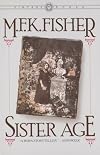
What an odd collection of stories this is -- memoir pieces, short stories, ghost stories, travelogues, philosophy dips -- all bundled into the myriad of thoughts on Aging by the singular MFK Fisher.
Fisher's writing is sublime. You want to be her friend. You want her to invite you for a meal. You want her to knowingly wink at you across the table during coffee. I took my time with this book, reading only a story a day. I wanted her voice, her astute observations, and the scent of her company show more to linger in the air with me.
She addresses stages of aging, from the indignities, senility and fears, to the loss of social acceptability, secrets unwittingly revealed, and, of course, she addresses death too. Sometimes, beyond death. This seeming hodgepodge collection makes for a fifteen course meal and along with each course is wonderment. I don't think it's usual for us to think of old people or aging with wonderment. But Fisher does and she illustrates it beautifully to us.
There was one particular story I read twice, back to back, and then again next day. The story is about a woman preparing for a visit from a long absent daughter and grandson. It brought to mind my grandmother who had a passel of grown children, grandchildren and even great grandchildren who regularly visited her. As she aged and found preparing large meals in real time more difficult, she kept a stand-alone freezer filled with her homemade goodness at the ready. Not only did she live through the Depression as a farmer's wife in Oklahoma, but in her retirement was living on Social Security only. Thus, she was rightfully frugal. But that didn't mean frugality of taste. Rather, it meant she had on hand things like jars of apple butter made from the best of the season apples bought at their best price. It meant she had a special tin of saved bacon fat, that flavorful ingredient now anathema to many. And, of course, like any Grandmother worth her salt in those days, she could whip up fresh hot biscuits and gravy in 15 minutes flat. When a rare, young picky eater appeared in the genetic pool, she would sincerely offer a peanut butter and jelly sandwich, asking which direction the grandchild thought it should be halved. Oh, and cut the crusts, too? She would be only too happy to please them, worried about their hunger, not insulted.
But that was the 1960s and 70s. I think that eating at Grandma's is now less common for most of us and for so very many reasons. Does she still live in her home with her own kitchen? Can she expect a visit from those living far away more than every five or ten years? What about the Vegans? The Gluten-free? Lactose intolerant? Those with nut/soy/egg allergies? Or was there a family rift that won't heal? It is all so complicated.
In "A Kitchen Allegory," the piece I read three times, it is complicated too. Fisher's take, only a few pages long, is done with devastating compassion and accepting pathos.
The whole of Sister Age is like that. Even the pieces that I found odd, they add to Fisher's wide observations about aging and the aged. Together they are an exploration, an inquiry, a testament, or maybe a kind of education as she mentions in the Afterword. I wouldn't take a single story out.
I'm on a campaign to thin my bookshelves. This one is staying to be read again. God willing I myself live to even further old age. show less
Fisher's writing is sublime. You want to be her friend. You want her to invite you for a meal. You want her to knowingly wink at you across the table during coffee. I took my time with this book, reading only a story a day. I wanted her voice, her astute observations, and the scent of her company show more to linger in the air with me.
She addresses stages of aging, from the indignities, senility and fears, to the loss of social acceptability, secrets unwittingly revealed, and, of course, she addresses death too. Sometimes, beyond death. This seeming hodgepodge collection makes for a fifteen course meal and along with each course is wonderment. I don't think it's usual for us to think of old people or aging with wonderment. But Fisher does and she illustrates it beautifully to us.
There was one particular story I read twice, back to back, and then again next day. The story is about a woman preparing for a visit from a long absent daughter and grandson. It brought to mind my grandmother who had a passel of grown children, grandchildren and even great grandchildren who regularly visited her. As she aged and found preparing large meals in real time more difficult, she kept a stand-alone freezer filled with her homemade goodness at the ready. Not only did she live through the Depression as a farmer's wife in Oklahoma, but in her retirement was living on Social Security only. Thus, she was rightfully frugal. But that didn't mean frugality of taste. Rather, it meant she had on hand things like jars of apple butter made from the best of the season apples bought at their best price. It meant she had a special tin of saved bacon fat, that flavorful ingredient now anathema to many. And, of course, like any Grandmother worth her salt in those days, she could whip up fresh hot biscuits and gravy in 15 minutes flat. When a rare, young picky eater appeared in the genetic pool, she would sincerely offer a peanut butter and jelly sandwich, asking which direction the grandchild thought it should be halved. Oh, and cut the crusts, too? She would be only too happy to please them, worried about their hunger, not insulted.
But that was the 1960s and 70s. I think that eating at Grandma's is now less common for most of us and for so very many reasons. Does she still live in her home with her own kitchen? Can she expect a visit from those living far away more than every five or ten years? What about the Vegans? The Gluten-free? Lactose intolerant? Those with nut/soy/egg allergies? Or was there a family rift that won't heal? It is all so complicated.
In "A Kitchen Allegory," the piece I read three times, it is complicated too. Fisher's take, only a few pages long, is done with devastating compassion and accepting pathos.
The whole of Sister Age is like that. Even the pieces that I found odd, they add to Fisher's wide observations about aging and the aged. Together they are an exploration, an inquiry, a testament, or maybe a kind of education as she mentions in the Afterword. I wouldn't take a single story out.
I'm on a campaign to thin my bookshelves. This one is staying to be read again. God willing I myself live to even further old age. show less

I have loved several of M. F. K. Fisher's other books, (Consider the Oyster and How to Cook a Wolf for instance), and treated myself to the Folio Society edition of this classic. As usual, the food was wonderful, from Fisher's childhood realization that there was more to food than boring, unappetizing sustenance; to her first experience with The Oyster; to the delights of French food eaten in France and the excellence of simplicity. The autobiographical bits I found would have been slightly show more mystifying if I had not educated myself about Fisher's life and loves already. Most puzzling, I feel, is the fact that she wrote about living happily in a Swiss villa with her first husband, Al Fisher, and without any explanation at all, was suddenly writing about living in the same place with someone referred to only as "Chexbres" (her second husband, Dillwyn Parrish, as it turns out). Similarly, she brings in Parrish's illness, disability and death in such an offhanded fashion that rather than merely taking a back seat to the main point of her writing, these sketchy references distract the reader with unanswered questions. I realize this was not written as an entity, but composed of individual essays, so the lack of continuity and coherence shouldn't be considered a failing on the author's part. And overall, I really enjoyed this paean to glorious, simple, elegant, sensuous appreciation of food. show less
Lists
Food Memoirs (4)
Folio Society (1)
Awards


You May Also Like


Associated Authors
Statistics
- Works
- 272
- Also by
- 76
- Members
- 9,372
- Popularity
- #2,569
- Rating
- 4.0
- Reviews
- 383
- ISBNs
- 182
- Languages
- 11
- Favorited
- 46

