
Ralph W. Mathisen
Author of Ancient Mediterranean Civilizations: From Prehistory to 640 CE
About the Author
Ralph W. Mathisen is Professor of History, Classics, and Medieval Studies at the University of Illinois at Urbana-Champaign. He has authored, edited, or coedited thirteen books and has published 100 scholarly articles.
Works by Ralph W. Mathisen
Roman Aristocrats in Barbarian Gaul: Strategies for Survival in an Age of Transition (1993) 26 copies, 1 review
The Battle of Vouillé, 507 CE (Millennium-Studien/Millennium Studies) (2012) — Editor — 8 copies, 1 review
People, Personal Expression, and Social Relations in Late Antiquity, Volume I: With Translated Texts from Gaul and Weste (2003) 2 copies
Associated Works
Late Antique Letter Collections: A Critical Introduction and Reference Guide (2016) — Contributor — 6 copies
Fifty Years of Prosopography: The Later Roman Empire, Byzantium and Beyond (2003) — Contributor — 3 copies
Medievalia Et Humanistica: Studies in Medieval and Renaissance Culture, New Series No.12 (1984) — Contributor — 2 copies
Qui Miscuit Utile Dulci: Festschrift Essays for Paul Lachlan Mackendrick (1998) — Contributor — 1 copy
Augustine : presbyter factus sum [Collectanea Augustiniana] (1994) — Contributor, some editions — 1 copy
Tagged
Common Knowledge
Members
Reviews
Roman Aristocrats in Barbarian Gaul: Strategies for Survival in an Age of Transition by Ralph (editor) Mathisen
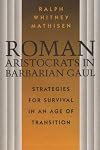
Everybody knows how Rome fell. After a succession of crises, plagues, civil wars, and especially barbarian invasions, the once illustrious empire ended. Even a perfunctory examination shows some issues. Rome was sacked in 410 by Visigoths under Alaric, sacked again several times, and the last Western Roman Emperor, Romulus Augustus, was deposed in 476. Roman institutions limped along in some form or another for the whole 5th century. How did people at the time experience the fall of show more Rome?
Fantastic cover design on Gibbon's Decline and Fall, showing a pillar crumbling over time.
Mathisen conducts a close read of available sources for Gaul in the 5th century, focusing primarily on the letters of Sidonius Apollinaris. Mathisen establishes a Gallo-Roman aristocratic identity as one of the "good people", a criteria established by wealth, lineage, office holding, and literary accomplishment, and then discusses how that criteria shifted over time.
Wealth was always the foremost criterion. Aristocrats were distinguished by their estates. Holding on to them became trickier in the 5th century, requiring aggressive legal and physical defenses against barbarian and Roman neighbors. Lineage mattered, and intermarriage with barbarians was discouraged, but of course bloodlines were negotiable for the right price. Offices and careers shifted from the Roman civil service to the Church hierarchy, with some Bishoprics becoming family holdings, as well as ad hoc work for barbarian kings. And finally, literary matters were very important, though this is somewhat self-selecting. Sidonius collected his letters for publication, which was sponsored by his son, and wrote extensively about the importance of cultivating a literary circle.
Yet at the same time as Mathisen makes a convincing case for the ductility of Gallo-Roman aristocratic identity, it is impossible to deny its diminishment over time. Many aristocrats sought exile. Travel essentially stopped, first between Gaul and other provinces, and then within Gaul, as various barbarian kings divided up the region. Sidonius writing that letters were the best form of friendship seems to have been sour grapes for a man who clearly did not feel comfortable embarking on even moderate journeys. While courts continued to function for some decades, ultimately justice became a matter of helping oneself, contributing to cycles of feuds.
While Sidonius was recognizably a Roman aristocratic writer in a lineage we would recognize with Cicero and Pliny, no one followed him. By the 6th century, the time of his grandchildren, genealogical records show Roman and German names in the same century. The fall of Rome was perhaps less violent than we remember, but it was definitely comprehensive. show less
Fantastic cover design on Gibbon's Decline and Fall, showing a pillar crumbling over time.
Mathisen conducts a close read of available sources for Gaul in the 5th century, focusing primarily on the letters of Sidonius Apollinaris. Mathisen establishes a Gallo-Roman aristocratic identity as one of the "good people", a criteria established by wealth, lineage, office holding, and literary accomplishment, and then discusses how that criteria shifted over time.
Wealth was always the foremost criterion. Aristocrats were distinguished by their estates. Holding on to them became trickier in the 5th century, requiring aggressive legal and physical defenses against barbarian and Roman neighbors. Lineage mattered, and intermarriage with barbarians was discouraged, but of course bloodlines were negotiable for the right price. Offices and careers shifted from the Roman civil service to the Church hierarchy, with some Bishoprics becoming family holdings, as well as ad hoc work for barbarian kings. And finally, literary matters were very important, though this is somewhat self-selecting. Sidonius collected his letters for publication, which was sponsored by his son, and wrote extensively about the importance of cultivating a literary circle.
Yet at the same time as Mathisen makes a convincing case for the ductility of Gallo-Roman aristocratic identity, it is impossible to deny its diminishment over time. Many aristocrats sought exile. Travel essentially stopped, first between Gaul and other provinces, and then within Gaul, as various barbarian kings divided up the region. Sidonius writing that letters were the best form of friendship seems to have been sour grapes for a man who clearly did not feel comfortable embarking on even moderate journeys. While courts continued to function for some decades, ultimately justice became a matter of helping oneself, contributing to cycles of feuds.
While Sidonius was recognizably a Roman aristocratic writer in a lineage we would recognize with Cicero and Pliny, no one followed him. By the 6th century, the time of his grandchildren, genealogical records show Roman and German names in the same century. The fall of Rome was perhaps less violent than we remember, but it was definitely comprehensive. show less

The battle of Vouillé saw the Frankish king Clovis defeat the Visigoths under Alaric II, and as a consequence most of what's now southwestern France, incl the Visigothic capital at Toulouse, passed into Frankish control. Whether this constitutes the beginning of France is obviously definitional, but it's not an unreasonable take.
This then is a collection of papers related to the battle. As is not uncommon with this sort of collections on ancient or medieval battles, only one is actually show more about the battle itself. Another is on the wider war, the rest of questions like whether the war was religious in motivation (probably not, but succeeding generations liked to think so), Byzantine diplomatic involvement, and the Visigoths in Gaul being more-or-less unidentifiable archaeologically.
I found some papers more interesting than others, but overall it's a good read. It's legally available as a free download here. show less
This then is a collection of papers related to the battle. As is not uncommon with this sort of collections on ancient or medieval battles, only one is actually show more about the battle itself. Another is on the wider war, the rest of questions like whether the war was religious in motivation (probably not, but succeeding generations liked to think so), Byzantine diplomatic involvement, and the Visigoths in Gaul being more-or-less unidentifiable archaeologically.
I found some papers more interesting than others, but overall it's a good read. It's legally available as a free download here. show less
Very good book. See my review on my blog at: http://medievalhistorygeek.wordpress.com/2011/08/06/review-romans-barbarians-and...
You May Also Like
Associated Authors
Statistics
- Works
- 20
- Also by
- 13
- Members
- 178
- Popularity
- #120,888
- Rating
- 4.0
- Reviews
- 3
- ISBNs
- 31
- Languages
- 1