
Pierre Bayle (1647–1706)
Author of Historical and Critical Dictionary: Selections (Hackett Classics)
About the Author
Born at Carla-le-Comte (now Carla-Bayle) in southern France, Pierre Bayle was the son of a French Protestant minister. Because of the persecution of the Huguenots in France, Bayle was forced to flee to Holland in 1681 where he lived the rest of his life. Bayle wrote a large number of works show more attacking all kinds of theological and philosophical theories and opposing all kinds of intolerance; he also edited one of the first major philosophical journals. Bayle's most widely known work is his immense four-folio Historical and Critical Dictionary (1697-1702), in which he developed a complete skepticism about everything that is said and everything that is done. Considered the Arsenal of the Enlightenment, the work greatly influenced Berkeley, Hume, and Voltaire. (Bowker Author Biography) show less
Image credit: wikimedia commons
Works by Pierre Bayle
Sparta nel Dizionario 4 copies
Histoire des ouvrages des sçavans 2 copies
[Dizionario storico-critico] 1 2 copies
The great contest of faith and reason (Milestones of thought in the history of ideas) (Milestones of thought in the hist (2013) 2 copies
Dictionnaire Historique Et Critique Par Pierre Bayle, Avec La Vie De L'auteur, Par Mr. Des Maizeaux... (French Edition) (2023) 1 copy
Nouvelles de la république des lettres. [Publ. par P. Bayle, D. de Larroque et J. Barin]. 2-e éd. rev. et corr. Juin 1684-août 1687; avril-juin 1688 — Editor — 1 copy
pensieri sulla cometa 1 copy
Dictionnaire Historique Et Critique de Pierre Bayle, Vol. 12: Ph.-R (Classic Reprint) (French Edition) (2017) 1 copy
Janvier 1678 - Fin 1683, Lettres 147 - 241 (Correspondance De Pierre Bayle) (French Edition) (2004) 1 copy
Correspondance De Pierre Bayle: v. 2: Novembre 1674 - Novembre 1677, Lettres 66 - 146 (French Edition) (2001) 1 copy
Nouvelles Lettres 1 copy
Associated Works
Tagged
Common Knowledge
- Canonical name
- Bayle, Pierre
- Other names
- Bèle, Pierre
- Birthdate
- 1647-11-18
- Date of death
- 1706-12-28
- Gender
- male
- Occupations
- theoloog
filosoof
vrijdenker - Nationality
- France
- Birthplace
- Carla-le-Comte, Ariège, Frankrijk
Carla-Bayle, Frankrijk - Place of death
- Rotterdam, Holland, Nederland
- Associated Place (for map)
- France
Members
Reviews
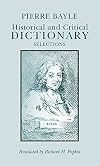
Pierre Bayle (1647-1706), French philosophe and reviewer. After moving to Rotterdam, he devoted himself to writing this biographical and historical "dictionary", a seminal work appearing in parts in Europe. Bayle fought for religious tolerance in the face of persecution. He also showed, repeatedly, that atheist objections to theological claims could not be answered.
His discussion of Spinoza was controversial, and as translated here, does not appear to do much. But in its day, it inspired show more incendiary reaction by both Protestant and Catholic factions. He discusses the injustice of classes, the hypocrisy of the pious, the physical annihilation of the Manicheans without disposing of their arguments, and the fact that those who can successfully oppose the arguments of the Manicheans find themselves to be Unitarians.(!) [418-19]
Includes the biography of "Ariosta", the concubine whose faithfulness and political skills so nicely coupled with great beauty. Bayle notes that from her eleven children comes a titled House of Este, which still exists in the branch of Modena and of Rhegio. That Ariosta gave more honor to her family than she took from it. [21] He discusses the "singular efficacy" of marriage, which changes the nature of three kinds of time:
"The past is no less free from its influences than is the present or the future." He acknowledges the force, the irresistable authority, of custom.
Bayle keenly scrutinizes how women are treated, exposing its badly baud. [22, 23]
With detailed Index. show less
His discussion of Spinoza was controversial, and as translated here, does not appear to do much. But in its day, it inspired show more incendiary reaction by both Protestant and Catholic factions. He discusses the injustice of classes, the hypocrisy of the pious, the physical annihilation of the Manicheans without disposing of their arguments, and the fact that those who can successfully oppose the arguments of the Manicheans find themselves to be Unitarians.(!) [418-19]
Includes the biography of "Ariosta", the concubine whose faithfulness and political skills so nicely coupled with great beauty. Bayle notes that from her eleven children comes a titled House of Este, which still exists in the branch of Modena and of Rhegio. That Ariosta gave more honor to her family than she took from it. [21] He discusses the "singular efficacy" of marriage, which changes the nature of three kinds of time:
"The past is no less free from its influences than is the present or the future." He acknowledges the force, the irresistable authority, of custom.
Bayle keenly scrutinizes how women are treated, exposing its badly baud. [22, 23]
With detailed Index. show less
A philosophical commentary on these words of the Gospel, Luke XIV. 23. Compel them to come in, that my house may be full. In four parts. ... Translated from the French of Mr. Bayle, by Pierre Bayle

John Kilcullen, Introduction to the 2005 edition:
The popular mind often associates scepticism with irreligion, and critical distance with unbelief. In this view, reason and faith, or scientific method and religious dogma, are not only different but indeed antagonistic means of viewing the world, understanding human existence, and conducting one's life. Pierre Bayle's scepticism was of a singularly distinct sort. He argued not that religion is untrue, but that the discourses proper to show more theology and the discourses proper to philosophy are incapable of any meaningful exchange. Bayle sought to advance a secular morality that would be independent of both speculative theism and religious revelation. Bayle blazed a philosophical path that Denis Diderot, David Hume, and other Enlightenment thinkers would follow. The continuing significance of this work is its vigorous defence of complete religious toleration. It is in itself a primary historical source of our modern tradition of religious tolerance. show less
The popular mind often associates scepticism with irreligion, and critical distance with unbelief. In this view, reason and faith, or scientific method and religious dogma, are not only different but indeed antagonistic means of viewing the world, understanding human existence, and conducting one's life. Pierre Bayle's scepticism was of a singularly distinct sort. He argued not that religion is untrue, but that the discourses proper to show more theology and the discourses proper to philosophy are incapable of any meaningful exchange. Bayle sought to advance a secular morality that would be independent of both speculative theism and religious revelation. Bayle blazed a philosophical path that Denis Diderot, David Hume, and other Enlightenment thinkers would follow. The continuing significance of this work is its vigorous defence of complete religious toleration. It is in itself a primary historical source of our modern tradition of religious tolerance. show less
Lists
Awards

You May Also Like


Associated Authors
Statistics
- Works
- 91
- Also by
- 1
- Members
- 522
- Popularity
- #47,609
- Rating
- 3.6
- Reviews
- 3
- ISBNs
- 104
- Languages
- 8
- Favorited
- 3