
Jonathan I. Israel
Author of Radical Enlightenment: Philosophy and the Making of Modernity 1650-1750
About the Author
Jonathan Israel is professor of modern history at the Institute for Advanced Study in Princeton. He is the author of A Revolution of the Mind: Radical Enlightenment and the Intellectual Origins of Modern Democracy (Princeton).
Works by Jonathan I. Israel
Radical Enlightenment: Philosophy and the Making of Modernity 1650-1750 (2001) 561 copies, 7 reviews
A Revolution of the Mind: Radical Enlightenment and the Intellectual Origins of Modern Democracy (2009) 271 copies, 4 reviews
Enlightenment Contested: Philosophy, Modernity, and the Emancipation of Man 1670-1752 (2006) 264 copies
Revolutionary Ideas: An Intellectual History of the French Revolution from The Rights of Man to Robespierre (2014) 214 copies, 1 review
Democratic Enlightenment: Philosophy, Revolution, and Human Rights, 1750-1790 (2011) 213 copies, 2 reviews
The Enlightenment that Failed: Ideas, Revolution, and Democratic Defeat, 1748-1830 (2019) 110 copies
Revolutionary Jews from Spinoza to Marx: The Fight for a Secular World of Universal and Equal Rights (2021) 16 copies
Conflicts of Empires: Spain, the Low Countries and the Struggle for World Supremacy, 1585-1713 (1997) 15 copies
Razas, clases sociales y vida politica en el México colonial (Historia (Fondo de Cultura Economica de Argentina)) (1980) 7 copies
Diasporas within a diaspora : Jews, Crypto-Jews, and the world of maritime empires (1540-1740) (2002) 5 copies
Revolution 1 copy
Associated Works
The Oxford History of the British Empire, Volume 1 : The Origins of Empire: British Overseas Enterprise to the Close of the Seventeenth Century (1998) — Contributor — 286 copies, 1 review
Scriptural authority and biblical criticism in the Dutch golden age : God's word questioned (2017) — Contributor — 6 copies
Desperta Ferro Moderna. Richelieu contra Olivares. Francia en la Guerra de los Treinta Años (2014) — Contributor — 2 copies, 1 review
Tagged
Common Knowledge
- Canonical name
- Israel, Jonathan I.
- Legal name
- Israel, Jonathan Irvine
- Birthdate
- 1946-01-22
- Gender
- male
- Education
- Queens' College, University of Cambridge (BA|1967)
University of Oxford (D.Phil|1972)
El Colegio de México - Occupations
- professor (Modern European History, Dutch History and Institutions)
- Organizations
- Institute for Advanced Study, Princeton University
University College London
University of Hull
University of Newcastle upon Tyne - Awards and honors
- Fellow, British Academy (1992)
Order of the Netherlands Lion (2004)
Corresponding Fellow, Koninklijke Nederlandse Akademie van Wetenschappen (1994)
Leo Gershoy Award (2001)
Dr A.H. Heineken Prize (2008)
Benjamin Franklin Medal (2010) (show all 10)
PROSE Award (2015)
Comenius Prize (2017)
Frans Banninck Cocq Medal (2012)
Wolfson Literary Award for History (1986) - Nationality
- UK
- Birthplace
- London, England, UK
- Places of residence
- London, England, UK
- Associated Place (for map)
- London, England, UK
Members
Reviews

It does what it says - a heavyweight (in every sense) overview of Dutch history from the late medieval period to Napoleon, focussing on how the Republic came into being, how it was governed, and how the political system related to developments in religious and intellectual life. Economic, military and colonial developments are covered as well, but not quite in the same level of detail.
What really interests Israel - probably to the despair of some readers, although I found it oddly show more fascinating - is the complicated way in which the Republic operated as a not-quite-federation of unequal and frequently disunited provinces, each of which had its own internal conflicts and divisions. In most of what I've read before about Dutch history, you only really get to hear about Holland, with the occasional passing mention of Geuzen in Zeeland and sieges in Brabant. But when you're reading Israel you also have to be aware of how the political manoeuvres in The Hague are affected by the complexities of relations between Groningen and its Ommelanden, or between the three quarters of Gelderland (I still don't know why they call them quarters if there are only three of them...). Endless fun, if you enjoy that kind of thing.
The other big element of the book is the analysis of what was going on in religion, science and philosophy (and to a lesser extent, the arts), and how it was enabled and sometimes restricted by the peculiarities of the Dutch political system. Israel makes it clear that there's a lot more to it than the standard idea that official tolerance created a kind of free market in ideas and gave the Netherlands an advantage over the repressive, absolutist rest of Europe. In fact, when it comes down to it, the religious establishment in the 17th century Netherlands had as little tolerance for divergent ideas as their protestant and catholic neighbours, and preachers were constantly campaigning to have sects other than their own shut down, books burnt, professors banned from teaching Descartes or Spinoza, and all the rest of it. There was always a strong "Voetian" element in the Dutch Reformed Church that felt that religious observance ought to be enforced by law. And it never took much to provoke the urban working classes to start an anti-Catholic riot. Where the Dutch Republic was different from the rest of Europe seems to have been in a pragmatic sense at the highest levels of government that public order mattered more than religious conformity. The state never regulated what people believed, but it could - and did - intervene to stop them causing unnecessary trouble, e.g. by publishing revolutionary ideas in Dutch, or by over-zealous preaching. Then as now, Dutch society was all about minimising overlast (nuisance). The other key thing in the 17th century Netherlands was that there was so much divergence from province to province and town to town, that you could almost always find somewhere where your views were acceptable. Spinoza moved from Amsterdam to Voorburg after he was expelled from the synagogue; professors who were too unorthodox for Leiden were generally welcomed in the rival universities at Franeker or Groningen (and vice-versa).
Whilst reading this book, I more than once had to wonder why OUP didn't split it into two (or more) volumes. This is essentially narrative history that you want to read sequentially and at leisure, not a reference book for dipping into. But a dictionary-sized book like this (1130 pages of text plus another hundred of index and bibliography) is just far too heavy to hold comfortably. My Everyman edition of Motley is about the same total number of pages in total, but in three nice, pocket-sized volumes. You could easily slip one of those into your backpack. Not that you can in any way compare Motley's chatty style and unconcealed protestant propaganda with what Israel is doing... show less
What really interests Israel - probably to the despair of some readers, although I found it oddly show more fascinating - is the complicated way in which the Republic operated as a not-quite-federation of unequal and frequently disunited provinces, each of which had its own internal conflicts and divisions. In most of what I've read before about Dutch history, you only really get to hear about Holland, with the occasional passing mention of Geuzen in Zeeland and sieges in Brabant. But when you're reading Israel you also have to be aware of how the political manoeuvres in The Hague are affected by the complexities of relations between Groningen and its Ommelanden, or between the three quarters of Gelderland (I still don't know why they call them quarters if there are only three of them...). Endless fun, if you enjoy that kind of thing.
The other big element of the book is the analysis of what was going on in religion, science and philosophy (and to a lesser extent, the arts), and how it was enabled and sometimes restricted by the peculiarities of the Dutch political system. Israel makes it clear that there's a lot more to it than the standard idea that official tolerance created a kind of free market in ideas and gave the Netherlands an advantage over the repressive, absolutist rest of Europe. In fact, when it comes down to it, the religious establishment in the 17th century Netherlands had as little tolerance for divergent ideas as their protestant and catholic neighbours, and preachers were constantly campaigning to have sects other than their own shut down, books burnt, professors banned from teaching Descartes or Spinoza, and all the rest of it. There was always a strong "Voetian" element in the Dutch Reformed Church that felt that religious observance ought to be enforced by law. And it never took much to provoke the urban working classes to start an anti-Catholic riot. Where the Dutch Republic was different from the rest of Europe seems to have been in a pragmatic sense at the highest levels of government that public order mattered more than religious conformity. The state never regulated what people believed, but it could - and did - intervene to stop them causing unnecessary trouble, e.g. by publishing revolutionary ideas in Dutch, or by over-zealous preaching. Then as now, Dutch society was all about minimising overlast (nuisance). The other key thing in the 17th century Netherlands was that there was so much divergence from province to province and town to town, that you could almost always find somewhere where your views were acceptable. Spinoza moved from Amsterdam to Voorburg after he was expelled from the synagogue; professors who were too unorthodox for Leiden were generally welcomed in the rival universities at Franeker or Groningen (and vice-versa).
Whilst reading this book, I more than once had to wonder why OUP didn't split it into two (or more) volumes. This is essentially narrative history that you want to read sequentially and at leisure, not a reference book for dipping into. But a dictionary-sized book like this (1130 pages of text plus another hundred of index and bibliography) is just far too heavy to hold comfortably. My Everyman edition of Motley is about the same total number of pages in total, but in three nice, pocket-sized volumes. You could easily slip one of those into your backpack. Not that you can in any way compare Motley's chatty style and unconcealed protestant propaganda with what Israel is doing... show less
A Revolution of the Mind: Radical Enlightenment and the Intellectual Origins of Modern Democracy by Jonathan Israel

Jonathan Israel begins with an apparently simple question: Where do the values central to Western political culture—democracy, individual liberty, egalitarianism—come from? His answer, not so simply, is Philosophy.
Israel’s study in intellectual history and historiography makes clear that the usual representation of the European Enlightenment is incomplete. He demonstrates how the Enlightenment was driven by a debate between two incompatible projects of political, social and moral show more reform. While the Moderate Enlightenment attempted to reconcile empiricism with tradition and refused ultimately to repudiate the monarchical-aristocratic order of society, it was the Radical Enlightenment that portrayed society as it had evolved as inherently defective, oppressive and systematically unjust, and hence wrongly organized for the purpose of human happiness. For the Radicals, enlightenment was not knowledge of abstract, speculative, or theoretical sciences, but ‘understanding,’ and in particular an understanding of how privilege, vast inequalities of wealth and status, and the prevalence of aristocracy and ecclesiastical authority were anathema to freedom. Israel’s review of the arguments is succinct but thorough (he provides a grander exegesis in Radical Enlightenment: Philosophy and the Making of Modernity 1650-1750).
The mistake in the historiography, according to Israel, has been to assume that a dramatic transformation of conditions and/or powerful social forces drove developments in the West. Too often neglected has been the gradual “revolution of the mind,” generated by thinkers and writers during the 1770s and 1780s, which laid the groundwork for the evolution toward liberty and democracy during the 19th century. Ideas have consequences, writes Israel, and the real work was accomplished not by the usual suspects (Locke, Hume, Smith, Rousseau, Voltaire, etc) but by the likes of Bayle, Diderot, Helvétius, d’Holbach, Paine and others, who were responsible for the critical shift in perceptions, concepts, and attitudes. The giant upon whose shoulders the others stood was Spinoza, and the wellspring of Western political culture was the first Dutch republic, not ancient Greece. (Stephen Nadler's Spinoza: A Life is an excellent treatment of the social, cultural, and political milieu within which Spinoza moved.)
What distinguishes the political culture of the West from the rest? In one key sense it has been the formulation of a conception of liberty rooted in a secular moral system that recognizes the interests of the individual as a member of society. In A Revolution of the Mind, Jonathan Israel explains the origins of that conception of liberty. show less
Israel’s study in intellectual history and historiography makes clear that the usual representation of the European Enlightenment is incomplete. He demonstrates how the Enlightenment was driven by a debate between two incompatible projects of political, social and moral show more reform. While the Moderate Enlightenment attempted to reconcile empiricism with tradition and refused ultimately to repudiate the monarchical-aristocratic order of society, it was the Radical Enlightenment that portrayed society as it had evolved as inherently defective, oppressive and systematically unjust, and hence wrongly organized for the purpose of human happiness. For the Radicals, enlightenment was not knowledge of abstract, speculative, or theoretical sciences, but ‘understanding,’ and in particular an understanding of how privilege, vast inequalities of wealth and status, and the prevalence of aristocracy and ecclesiastical authority were anathema to freedom. Israel’s review of the arguments is succinct but thorough (he provides a grander exegesis in Radical Enlightenment: Philosophy and the Making of Modernity 1650-1750).
The mistake in the historiography, according to Israel, has been to assume that a dramatic transformation of conditions and/or powerful social forces drove developments in the West. Too often neglected has been the gradual “revolution of the mind,” generated by thinkers and writers during the 1770s and 1780s, which laid the groundwork for the evolution toward liberty and democracy during the 19th century. Ideas have consequences, writes Israel, and the real work was accomplished not by the usual suspects (Locke, Hume, Smith, Rousseau, Voltaire, etc) but by the likes of Bayle, Diderot, Helvétius, d’Holbach, Paine and others, who were responsible for the critical shift in perceptions, concepts, and attitudes. The giant upon whose shoulders the others stood was Spinoza, and the wellspring of Western political culture was the first Dutch republic, not ancient Greece. (Stephen Nadler's Spinoza: A Life is an excellent treatment of the social, cultural, and political milieu within which Spinoza moved.)
What distinguishes the political culture of the West from the rest? In one key sense it has been the formulation of a conception of liberty rooted in a secular moral system that recognizes the interests of the individual as a member of society. In A Revolution of the Mind, Jonathan Israel explains the origins of that conception of liberty. show less
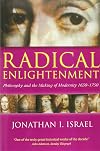
"The Radical Enlightenment" is extremely interesting until the very end, but I suppose at the same time a book not every reader (I mean: reader of this kind of non-fiction) would like. One could remark that the quality of this work is also its weak side.
The central thesis: Spinoza and his circle (all Dutchmen) furnished the fundamental ideas of the Enlightenment in its strongest form. J.Israel, the author, defends his idea that neither England (Locke, Newton,&c.), nor France (Voltaire, show more Fontenelle, &c.), nor Germany (mainly Leibniz) were the real birthplaces of Enlightenment in its purest form ( absolute liberty of conscience and religion, rationalism, equality of the sexes, tolerance, &c.). The principal thinkers in these countries tried to conciliate traditional values (Christianity as a revealed religion with its dogmatic theology, absolute monarchy, male superiority, &c.) with new scientific ideas (empiricism in particular). French thinkers (in particular Voltaire) were the least prone to reconciliation, but even they didn't propose original ideas. The High Enlightenment (from about 1750) was only possibly because the most infuentious thinkers had by then integrated Spinoza's ideas. Israel proves his thesis so abundantly thatto attack him will be difficult for anyone who would feel the need.
But the abundance is also the problem of this book. There is such a proficiency in detail, so many -even very minor -contributions to Enlightenment are quoted at length, the lives of so many theologians, heretics, philosophers, editors, vicars, scoundrels or aristocrats (and some people were all of that at once) are minitiously rendered, that it is difficult at some moments to keep an eye on the general idea. However the book is conceived as a unity, attested by the fact that in every paragraph there are references to other parts, making it impossible to consider the book just as a kind of encyclopaedia, a companion to Enlightenment thought and historiography.
An occasional reader cannot dip into it without feeling lost. This is a book that should be read from page 1 to 720 (in small print!), which supposes a really motivated public.
But if you accept that, it is an extremely enriching experience, offering many insights even concerning recent events or discussions (e.g. the 'Intelligent Design' debate among American intelligentsia these last years).
private comment posted by Caroline show less
The central thesis: Spinoza and his circle (all Dutchmen) furnished the fundamental ideas of the Enlightenment in its strongest form. J.Israel, the author, defends his idea that neither England (Locke, Newton,&c.), nor France (Voltaire, show more Fontenelle, &c.), nor Germany (mainly Leibniz) were the real birthplaces of Enlightenment in its purest form ( absolute liberty of conscience and religion, rationalism, equality of the sexes, tolerance, &c.). The principal thinkers in these countries tried to conciliate traditional values (Christianity as a revealed religion with its dogmatic theology, absolute monarchy, male superiority, &c.) with new scientific ideas (empiricism in particular). French thinkers (in particular Voltaire) were the least prone to reconciliation, but even they didn't propose original ideas. The High Enlightenment (from about 1750) was only possibly because the most infuentious thinkers had by then integrated Spinoza's ideas. Israel proves his thesis so abundantly thatto attack him will be difficult for anyone who would feel the need.
But the abundance is also the problem of this book. There is such a proficiency in detail, so many -even very minor -contributions to Enlightenment are quoted at length, the lives of so many theologians, heretics, philosophers, editors, vicars, scoundrels or aristocrats (and some people were all of that at once) are minitiously rendered, that it is difficult at some moments to keep an eye on the general idea. However the book is conceived as a unity, attested by the fact that in every paragraph there are references to other parts, making it impossible to consider the book just as a kind of encyclopaedia, a companion to Enlightenment thought and historiography.
An occasional reader cannot dip into it without feeling lost. This is a book that should be read from page 1 to 720 (in small print!), which supposes a really motivated public.
But if you accept that, it is an extremely enriching experience, offering many insights even concerning recent events or discussions (e.g. the 'Intelligent Design' debate among American intelligentsia these last years).
private comment posted by Caroline show less
Excellent book and ideas, with some flaws I found irritating. First, some quotes are provided without translations - I wish my French was better, and I have no real understanding of Dutch - and it would have been nice to link to the translation, if not had it displayed in the text. Second, the history is very detailed, a bit too much for my taste, and I would have preferred a somewhat higher-level view of the actions of the various actors in the enlightenment drama, although as I pored on, show more the complexity of the story was very engaging. show less
Lists
Awards


You May Also Like


Associated Authors
Statistics
- Works
- 30
- Also by
- 4
- Members
- 2,684
- Popularity
- #9,570
- Rating
- 4.2
- Reviews
- 24
- ISBNs
- 106
- Languages
- 7
- Favorited
- 6