
Tania Bayard
Author of A Medieval Home Companion: Housekeeping in the Fourteenth Century
About the Author
Series
Works by Tania Bayard
Tagged
Common Knowledge
- Birthdate
- 1946-01-04
- Gender
- female
- Occupations
- art historian
horticulturist - Organizations
- The Cloisters
Members
Reviews

I love a good historical mystery with a central character that is someone I know from history, but I've never really considered as an individual. Murder in the Cloister features just such a "detective": Christine de Pizan, 14th Century feminist, scribe, and writer. Under the cover of copying a valuable book for the Prioress, Christine is sent to the Priory of Poissy. Her real responsibility is uncovering the events and people behind the death of a novice—and Christine needs to act quickly show more as the priory faces threats from those who object to women directing their own lives, even when they are cloistered.
The mystery is solid, though the revelation when it comes isn't completely unexpected. Readers can see the finger of guilt pointing in a particular direction, but don't know exactly what has transpired to point it that way. What makes this mystery successful isn't that plot line so much as its cast of characters, strong, intelligent women and men with very different views of how the world should be ordered, but who nonetheless must work together to arrive at justice for the victim.
This is the first book in this series I've read, though it is the fourth volume, and I had no trouble following the plot line or grasping the relationships among the characters. I want to go back and read the earlier volumes not to clarify any back-story specifics, but just because I like those characters as depicted by Tania Bayard and want to spend more time with them. I received a free electronic review copy of this title from the publisher via NetGalley; the opinions are my own. show less
The mystery is solid, though the revelation when it comes isn't completely unexpected. Readers can see the finger of guilt pointing in a particular direction, but don't know exactly what has transpired to point it that way. What makes this mystery successful isn't that plot line so much as its cast of characters, strong, intelligent women and men with very different views of how the world should be ordered, but who nonetheless must work together to arrive at justice for the victim.
This is the first book in this series I've read, though it is the fourth volume, and I had no trouble following the plot line or grasping the relationships among the characters. I want to go back and read the earlier volumes not to clarify any back-story specifics, but just because I like those characters as depicted by Tania Bayard and want to spend more time with them. I received a free electronic review copy of this title from the publisher via NetGalley; the opinions are my own. show less
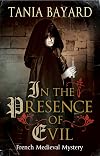
I was drawn to this cozy-mystery as it featured one of medieval Frances' better known women - Christise de Pizan.
Set in France in 1392 during the reign of mad King Charles VI, recently widowed Christine, is employed as a scribe for the French Queen, Isabeau of Bavaria. The French Court in this period was a hot-bed of political and sexual intrigue, with the various factions fighting for control of both the government and the King (think Wars of the Roses). Into this, Christine, who grew up at show more the Court, insinuates herself and embarks on an investigation into the death of one of the King's favourites, the Chamberlain, Hugues, whose 16yo wife Alix stands accused.
"... when women set out to do something, they are smarter and shrewder than men .."
What is the link between a young local prostitute, a mysterious book, a hooded figure, and the mad King's brother, Louis Duke of Orleans. At the French Court no-one is whom they appear to be - it is a place haunted by intrigue, secrets, magic and superstition. Bear in mind, the miracle of Joan of Arc is only a few decades away!
As a first novel, this make a nice change from most historical mysteries which have been predominantly set on the other side of the English Channel. I would be interested to read the next in the series to see how the characters develop and the storyline tightens up - sometimes less is more in storytelling. show less
Set in France in 1392 during the reign of mad King Charles VI, recently widowed Christine, is employed as a scribe for the French Queen, Isabeau of Bavaria. The French Court in this period was a hot-bed of political and sexual intrigue, with the various factions fighting for control of both the government and the King (think Wars of the Roses). Into this, Christine, who grew up at show more the Court, insinuates herself and embarks on an investigation into the death of one of the King's favourites, the Chamberlain, Hugues, whose 16yo wife Alix stands accused.
"... when women set out to do something, they are smarter and shrewder than men .."
What is the link between a young local prostitute, a mysterious book, a hooded figure, and the mad King's brother, Louis Duke of Orleans. At the French Court no-one is whom they appear to be - it is a place haunted by intrigue, secrets, magic and superstition. Bear in mind, the miracle of Joan of Arc is only a few decades away!
As a first novel, this make a nice change from most historical mysteries which have been predominantly set on the other side of the English Channel. I would be interested to read the next in the series to see how the characters develop and the storyline tightens up - sometimes less is more in storytelling. show less

This is the third in the series featuring Christine de Pisan, and I would suggest starting from the beginning with In the Presence of Evil and In the Shadow of the Enemy and many of the characters in this instalment have their origins in the first two books, as does the historical background.
It is three years since the events in the previous books; the French court is still a hot bed of political intrigue, the King is still battling bouts of insanity, and witchcraft and sorcery are being show more touted as the causes for all that has befallen France.
Someone is out to blacken the name of Valentina Visconti, Duchess of Orleans, and it the Fools of the Duke, her husband, that provide both the impetus and clues that Christine will need to solve this mystery.
I am enjoying the series as the setting is medieval France and features Christine de Pisan. These would fall into the category of mystery; they are not particularly action driven though do provide us with an insider's view of the French Court. I am looking forward to the next in the series. show less
It is three years since the events in the previous books; the French court is still a hot bed of political intrigue, the King is still battling bouts of insanity, and witchcraft and sorcery are being show more touted as the causes for all that has befallen France.
Someone is out to blacken the name of Valentina Visconti, Duchess of Orleans, and it the Fools of the Duke, her husband, that provide both the impetus and clues that Christine will need to solve this mystery.
I am enjoying the series as the setting is medieval France and features Christine de Pisan. These would fall into the category of mystery; they are not particularly action driven though do provide us with an insider's view of the French Court. I am looking forward to the next in the series. show less

If you're interested in what a young woman married off to an older man in the 14th century was expected to do then this is a great read. I found this book a fascinating look into a history of normal people rather than the normal look at history through major events.
You May Also Like


Associated Authors
Statistics
- Works
- 10
- Members
- 866
- Popularity
- #29,560
- Rating
- 3.6
- Reviews
- 15
- ISBNs
- 35
- Languages
- 1