
Christophe Arleston
Author of Lanfeust de Troy, tome 1 : L'ivoire du Magohamoth
About the Author
Series
Works by Christophe Arleston
Lanfeust des Etoiles, Tome 4 : Les Buveurs de Mondes : (Sale temps pour les mouches) (2004) 113 copies, 1 review
Les forêts d'Opale tome 02: L'envers du grimoire (SOL.FANTASTIQUE) (French Edition) (2001) 57 copies, 1 review
Le Chant d'Excalibur T06: Les Gardiennes de Brocéliande (Le Chant d'Excalibur (6)) (French Edition) (2010) 11 copies
Lanfeust de Troy, Tome 7&8 : Les pétaures se cachent pour mourir - La bête fabuleuse (2005) 5 copies
Léo Loden, Tome 17 : Hélico Pesto 4 copies
La Baroque épopée du monde qui ne voulait plus tourner - vol. 01/2: Le rugissement des étoiles (2021) 4 copies
Les feux d'Askell, Tomes 1 à 3 : Tome 1, L'Onguent admirable ; Tome 2, Retour à Vocable ; Tome 3, Corail sanglant (2004) 4 copies
Gainsbourg, Tomes 1 à 3 : Tome 1, Polars polaires ; Tome 2, Melody&Marilou ; Tome 3, Filles de fortune (2007) 2 copies
Die Gnome von Troy Ferienpaket: Band 1 - 3: Die ersten Bände der kultig-komischen Fantasy-Cartoons (2023) 1 copy
Lanfeust de Troy : Coffret en 4 volumes : Tome 5, Le Frisson de l'Haruspice ; Tome 6, Cixi impératrice ; Tome 7, Les PÃ (2005) 1 copy
Patrick Bruel 1 copy
Lanfeust de Troy: Intégrale 1 copy
Ekhkho: Zerkalnyj Mir. T. 5. Ekspress "Abidzhan - Najrobi". Prizrak v Pekine: graficheskie romany (2024) 1 copy
De haven der schaduwen 1 copy
Modrá CREW 1: Ekhö – Zrcadlový svět 1 (New York) a 2 (Císařská Paříž) (Ekhö, Zrcadlový svět #1-2) 1 copy
Associated Works
Astérix et ses Amis : Hommage à Albert Uderzo (2007) — some editions; some editions — 99 copies, 2 reviews
Tagged
Common Knowledge
- Canonical name
- Arleston, Christophe
- Legal name
- Pelinq, Christophe
- Other names
- Arleston, Scotch
- Birthdate
- 1963-08-14
- Gender
- male
- Nationality
- France
- Associated Place (for map)
- France
Members
Reviews

This ninth issue is a passable but ultimately disappointing ending to a high-speed series.
The series The Shipwrecks of Ythaq follows three protagonists (two female, one male) who are among the few survivors when their interstellar passenger liner crashlands on a wondrous but completely unknown planet. A kick-ass military heroine, a materialistic sex-kitten, and a poet-cum-engineer enthusiastically amass a bunch of allies and, having traipsed around for eight issues due to behind-the-screens show more machinations, finally figure out what made them crashland, what the overarching storyline was all about, and whether or not they get to go home. At this point they’ve gone through kidnappings, teleporters, a massive siege, equipment failure, rickety flying ships, and numerous attempts on their lives. They’ve survived confrontations with sea monsters, sky monsters, torture chambers, killer bugs, dragons, pirates, space marines, and both arctic and tropical killer climates. In short, it’s been an exciting journey and a wonderfully diverse journey in the best sword and planet tradition.
The artwork for the entire series is lovely, a classical ligne claire wedded to careful attention to detail and a warm colour palette.
It is all the more galling, then, that in the final issues (8 and particularly 9) the series takes a nose-dive into tawdriness: the resolution just cannot live up to the high standards set by the series up till this point. There’s a sharp turn towards the conventional, and, at one point, the laughable.
In issue 1 the kick-ass heroine acquires some magical powers, but hardly uses them throughout the series, relying on both wit and physique to keep her companions safe. But the finalereverts to 1970s values in that the entire climax suddenly revolves around the male character becoming super-powered for no adequately explained reason and finally bedding the comparatively chaste female protagonist whose magical powers then promptly disappear; the sex kitten gets a minimal reward. Admittedly, there were hints in earlier issues, where the wimpy male protagonist (non-military) was regularly expected to save and/or protect a military kickass heroine, but even back then the series clearly dealt with three main characters. This ending abruptly pretends that the series was the poet’s story all along, leaving it struggling to find something relevant to do for the female protagonists; his sudden and complete dominance over all protagonists and main side characters is completely unwarranted and out of all proportion. To wit: out of the blue his mind absorbs a humongous, eternal, planet-killing telepathic entity, thereby saving the planet and the galaxy. Of course. And he does so -- this is where the big twist becomes laughable -- through the power of poetry. This is where I felt as though the authors just weren’t trying any more and had defaulted to a boring climax that required minimal creative (or progressive) input. show less
The series The Shipwrecks of Ythaq follows three protagonists (two female, one male) who are among the few survivors when their interstellar passenger liner crashlands on a wondrous but completely unknown planet. A kick-ass military heroine, a materialistic sex-kitten, and a poet-cum-engineer enthusiastically amass a bunch of allies and, having traipsed around for eight issues due to behind-the-screens show more machinations, finally figure out what made them crashland, what the overarching storyline was all about, and whether or not they get to go home. At this point they’ve gone through kidnappings, teleporters, a massive siege, equipment failure, rickety flying ships, and numerous attempts on their lives. They’ve survived confrontations with sea monsters, sky monsters, torture chambers, killer bugs, dragons, pirates, space marines, and both arctic and tropical killer climates. In short, it’s been an exciting journey and a wonderfully diverse journey in the best sword and planet tradition.
The artwork for the entire series is lovely, a classical ligne claire wedded to careful attention to detail and a warm colour palette.
It is all the more galling, then, that in the final issues (8 and particularly 9) the series takes a nose-dive into tawdriness: the resolution just cannot live up to the high standards set by the series up till this point. There’s a sharp turn towards the conventional, and, at one point, the laughable.
In issue 1 the kick-ass heroine acquires some magical powers, but hardly uses them throughout the series, relying on both wit and physique to keep her companions safe. But the finale

The Forsaken World collects the first three bandes dessinées of Christophe Arleston's Ythaq in English translation. The story is quite an entertaining adventure, told in a style that reminds me of Jeff Smith's Bone. Whereas the epic fantasy of Smith is written for all ages, Ythaq is decidedly adult, with its three castaways organized into an unrequited triangular affection.
The space opera frame story lands the protagonists in a Flash Gordon-style world with many non-human sentient races, show more but the overall tone is a little closer to the wonderful sword-and-planet work of Leigh Brackett. As in Bone, the setting has its own mysteries, and the working out of the plot involves coming to understand the history of the fantasy world. This first volume brings the story through many major plot developments, but provides very little in the way of resolution.
Adrien Floch's art is really comics-stylized and somewhat lighthearted, but his characters and settings are all quite expressive, and they communicate the action very effectively. show less
The space opera frame story lands the protagonists in a Flash Gordon-style world with many non-human sentient races, show more but the overall tone is a little closer to the wonderful sword-and-planet work of Leigh Brackett. As in Bone, the setting has its own mysteries, and the working out of the plot involves coming to understand the history of the fantasy world. This first volume brings the story through many major plot developments, but provides very little in the way of resolution.
Adrien Floch's art is really comics-stylized and somewhat lighthearted, but his characters and settings are all quite expressive, and they communicate the action very effectively. show less
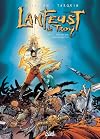
While I understand the popularity of the "héroic fantasy" genre of franco-belgian bande-dessinée and can appreciate its importance, Lanfeust is a little more (less?) than I can handle. The rampant sexism combined with the flimsy storyline (and the early death of my favorite character) create a book that I could have lived my entire life without reading. Yes, magic powers and alternate universes are pretty cool. They're also no longer original or groundbreaking; in fact, they've become a show more bit trite. Though this series is remarkably popular (no doubt due to the young male fantasy crowd), it is evident in the first book that its popularity is very loosely, if at all, correlated with its literary or artistic value. show less

This second volume of the English translation of Arleston and Floch's Ythaq reveals a couple more layers to the conspiratorial plot, but offers no resolution. The art remains excellent, and the characters affecting, although the story is increasingly an affair of some god(s) in the machine (planet). It doesn't seem that the further story beyond this segment is currently available in English, but hopefully it will be in the future. As with other titles of the Marvel Soleil imprint, I find the show more reduction of the art from the larger European BD size to the smaller US comic book page format to be a loss, but the book is otherwise materially excellent. show less
Awards


You May Also Like


Associated Authors
Statistics
- Works
- 285
- Also by
- 2
- Members
- 6,663
- Popularity
- #3,675
- Rating
- 3.6
- Reviews
- 47
- ISBNs
- 986
- Languages
- 12
- Favorited
- 4