
Karen Bush Gibson
Author of Native American History for Kids: with 21 Activities
About the Author
Karen Bush Gibson is the author of three dozen books for young readers, including Women in Space and Native American History for Kids.
Series
Works by Karen Bush Gibson
Women in Space: 23 Stories of First Flights, Scientific Missions, and Gravity-Breaking Adventures (2014) 48 copies, 4 reviews
Women Aviators: 26 Stories of Pioneer Flights, Daring Missions, and Record-Setting Journeys (2013) 38 copies, 3 reviews
The Oregon Trail: The Journey Across the Country From Lewis and Clark to the Transcontinental Railroad With 25 Projects (2017) 10 copies
Celebrating Groundhog Day: History, Traditions, and Activities – A Holiday Book for Kids (Holiday Books for Kids) (2021) 4 copies
The Great Basin Indians: Daily Life in the 1700s (Native American Life: Regional Tribes) (2005) 4 copies
Ways to Help Children With Disabilities (How to Help: A Guide to Giving Back) (2010) 4 copies, 1 review
Tagged
Common Knowledge
- Birthdate
- 1960-05-01
- Gender
- female
Members
Reviews

This is another book in the terrific series of non-fiction histories for kids published by the Chicago Review Press. This one provides an unvarnished history of the native peoples in America, and the fate they met after the country was colonized by Europeans.
The author begins by noting that with 562 federally recognized nations or tribes, “there are a minimum of 562 histories.” She makes a point in this book to identify the specific nation about which she is writing for any one show more historical event, along with teaching us something of their cultures. There is a lot of information to impart, for as she observes in the preface:
"White men originally wrote American history because they were the ones in power. Unfortunately, they also wrote that history with cultural bias.”
Even in the latter half of the 20th Century, with all the emphasis on “political correctness,” she notes that incorrect and incomplete information is pervasive in books, television, movies, and society generally. She concludes her preface:
"Everyone has a responsibility to verify and correct information when possible. ... We owe this to the Native Americans of all nations.”
Why? The rest of the book sets out to let you know.
The first two chapters are a bit geographically disjointed, because they recount what happened to Indians impacted by the early explorers, whose voyages took them all over in a nonlinear way. Most readers will recognize some elements of the history beginning with the third chapter, when Europeans settled on the eastern shores of America. But their recognition will fade quickly, because these are not the stories generally taught in school. Rather, it is a rather continuous succession of bad news. The Native population was decimated by the new Americans via diseases, expulsions, guns, treachery, and atrocities. Even so, the author doesn't include reports of all the massacres that took place (how could she?), and she doesn't include too many disturbing details about the horrific abuses that occurred during the worst of them (at Sand Creek, for example).
There are some bright spots along the way, such as the story of the legendary Jim Thorpe, an introduction to author Sherman Alexie, and an explanation of the unique way in which some Native Americans helped their country in the two world wars. Readers may have heard of the “Code Talkers” who helped send secret messages for the military during both wars. The book even includes a fascinating excerpt from the Navajo Code Talker’s Dictionary.
Like the other books in this series, this one includes 21 activities for kids that extend the lessons imparted in history to other subject areas, such as math, social studies, and science. There are instructions, for example, for designing a diorama of a trading post, making a totem pole, baking Arapaho Fry Bread, and creating a family tree. In addition to footnotes and sources, the back of the book has an annotated list of websites for additional information and a glossary.
Evaluation: This book is outstanding but exceedingly depressing. Nevertheless, it is a story that must be told, and one that all American children should learn. Besides the informative narration of the main story, there are plenty of photos and graphics and sidebars and boxes that mix it up and keep it interesting.
Highly recommended! show less
The author begins by noting that with 562 federally recognized nations or tribes, “there are a minimum of 562 histories.” She makes a point in this book to identify the specific nation about which she is writing for any one show more historical event, along with teaching us something of their cultures. There is a lot of information to impart, for as she observes in the preface:
"White men originally wrote American history because they were the ones in power. Unfortunately, they also wrote that history with cultural bias.”
Even in the latter half of the 20th Century, with all the emphasis on “political correctness,” she notes that incorrect and incomplete information is pervasive in books, television, movies, and society generally. She concludes her preface:
"Everyone has a responsibility to verify and correct information when possible. ... We owe this to the Native Americans of all nations.”
Why? The rest of the book sets out to let you know.
The first two chapters are a bit geographically disjointed, because they recount what happened to Indians impacted by the early explorers, whose voyages took them all over in a nonlinear way. Most readers will recognize some elements of the history beginning with the third chapter, when Europeans settled on the eastern shores of America. But their recognition will fade quickly, because these are not the stories generally taught in school. Rather, it is a rather continuous succession of bad news. The Native population was decimated by the new Americans via diseases, expulsions, guns, treachery, and atrocities. Even so, the author doesn't include reports of all the massacres that took place (how could she?), and she doesn't include too many disturbing details about the horrific abuses that occurred during the worst of them (at Sand Creek, for example).
There are some bright spots along the way, such as the story of the legendary Jim Thorpe, an introduction to author Sherman Alexie, and an explanation of the unique way in which some Native Americans helped their country in the two world wars. Readers may have heard of the “Code Talkers” who helped send secret messages for the military during both wars. The book even includes a fascinating excerpt from the Navajo Code Talker’s Dictionary.
Like the other books in this series, this one includes 21 activities for kids that extend the lessons imparted in history to other subject areas, such as math, social studies, and science. There are instructions, for example, for designing a diorama of a trading post, making a totem pole, baking Arapaho Fry Bread, and creating a family tree. In addition to footnotes and sources, the back of the book has an annotated list of websites for additional information and a glossary.
Evaluation: This book is outstanding but exceedingly depressing. Nevertheless, it is a story that must be told, and one that all American children should learn. Besides the informative narration of the main story, there are plenty of photos and graphics and sidebars and boxes that mix it up and keep it interesting.
Highly recommended! show less
Women in Space: 23 Stories of First Flights, Scientific Missions, and Gravity-Breaking Adventures (Women of Action) by Karen Bush Gibson

Chicago Review Press adds to their “Women of Action” series with this compendium of vignettes about the remarkable women who became part of the space program. (While more than fifty women have now traveled into outer space, 23 are profiled in depth in this book.)
There are many interesting anecdotes in this book, such as the fact that the television series “Star Trek” was originally envisioned by Gene Roddenberry as having a female captain, but sponsors refused to sign on unless the show more captain was a man. Roddenberry acceded to their demands, and the Enterprise was commanded by William Shatner as James T. Kirk.
Nichelle Nichols, who played Lieutenant Uhura on “Star Trek,” was tempted to leave the show after one year to pursue a Broadway career. She reported that a conversation with Dr. Martin Luther King, Jr., changed her mind. He urged her to stay, telling her she was providing a vital role model for black children and young women across the country. When “Star Trek” was cancelled, Nichols went around to high schools and colleges to encourage women and minorities to apply to be astronauts. It was she who recruited Guion Bluford, Jr., who became the first African American in space. Mae Jemison also said that Nichols influenced her desire to be an astronaut.
Mae Jemison, the first African American female astronaut, loved astronomy and science fiction stories as a girl. But when she told her kindergarten teacher she wanted to be a scientist, her teacher said, “You mean a nurse.” Somehow, in spite of all the discouragement, Jemison persevered, starting Stanford at just age 16 in the chemical engineering department. She went on to Cornell Medical School, the Peace Corps, and graduate studies in engineering courses before applying successfully to the astronaut program in 1987.
Barbara Morgan’s story would make anyone think twice about a career in space. First, she was chosen as an alternate for Christa McAuliffe to be the first teacher in space. Christa McAuliffe was part of the flight that blew up on television when the space shuttle Challenger exploded on January 28, 1986, killing all of its crew. The Teacher In Space program was discontinued, so then Barbara trained to be an astronaut and graduated her class in 1998. In 2002, she was assigned to a November, 2003 mission on the Columbia shuttle, but it exploded on reentry on February 1, 2003, killing all crew members. You would think she would step back, but she too was persistent, and finally got safely into space and back in 2007 on the Endeavour.
At the end of each chapter, resources are provided to learn more about the woman being profiled. There are also occasional sidebars with supplementary information like listings of types of jobs in space, summaries of other NASA projects, and the effects of space on aging. A glossary and bibliography are appended.
Evaluation: It’s hard not to be inspired by the stories in this book. In spite of a huge amount of discouragement from society, these women vowed to stop at nothing to achieve their dreams. show less
There are many interesting anecdotes in this book, such as the fact that the television series “Star Trek” was originally envisioned by Gene Roddenberry as having a female captain, but sponsors refused to sign on unless the show more captain was a man. Roddenberry acceded to their demands, and the Enterprise was commanded by William Shatner as James T. Kirk.
Nichelle Nichols, who played Lieutenant Uhura on “Star Trek,” was tempted to leave the show after one year to pursue a Broadway career. She reported that a conversation with Dr. Martin Luther King, Jr., changed her mind. He urged her to stay, telling her she was providing a vital role model for black children and young women across the country. When “Star Trek” was cancelled, Nichols went around to high schools and colleges to encourage women and minorities to apply to be astronauts. It was she who recruited Guion Bluford, Jr., who became the first African American in space. Mae Jemison also said that Nichols influenced her desire to be an astronaut.
Mae Jemison, the first African American female astronaut, loved astronomy and science fiction stories as a girl. But when she told her kindergarten teacher she wanted to be a scientist, her teacher said, “You mean a nurse.” Somehow, in spite of all the discouragement, Jemison persevered, starting Stanford at just age 16 in the chemical engineering department. She went on to Cornell Medical School, the Peace Corps, and graduate studies in engineering courses before applying successfully to the astronaut program in 1987.
Barbara Morgan’s story would make anyone think twice about a career in space. First, she was chosen as an alternate for Christa McAuliffe to be the first teacher in space. Christa McAuliffe was part of the flight that blew up on television when the space shuttle Challenger exploded on January 28, 1986, killing all of its crew. The Teacher In Space program was discontinued, so then Barbara trained to be an astronaut and graduated her class in 1998. In 2002, she was assigned to a November, 2003 mission on the Columbia shuttle, but it exploded on reentry on February 1, 2003, killing all crew members. You would think she would step back, but she too was persistent, and finally got safely into space and back in 2007 on the Endeavour.
At the end of each chapter, resources are provided to learn more about the woman being profiled. There are also occasional sidebars with supplementary information like listings of types of jobs in space, summaries of other NASA projects, and the effects of space on aging. A glossary and bibliography are appended.
Evaluation: It’s hard not to be inspired by the stories in this book. In spite of a huge amount of discouragement from society, these women vowed to stop at nothing to achieve their dreams. show less
Women aviators : 26 stories of pioneer flights, daring missions, and record-setting journeys / Karen Bush Gibson by Karen Bush Gibson
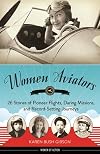
Women Aviators by Karen Bush Gibson covers the history of the women who contributed to the progress of aviation.
Most of the aviation books I've read cover exactly one aviatrix, to use an out of date term. I'm speaking of Amelia Earhart, of course. The one exception is Amelia Lost by Candace Fleming which mentions her female competitors as a way to put her flying career into perspective.
Gibson's book does a better and more even handed job by presenting Earhart in the midst of twenty-five show more other short biographies that include their planes and majors flights. show less
Most of the aviation books I've read cover exactly one aviatrix, to use an out of date term. I'm speaking of Amelia Earhart, of course. The one exception is Amelia Lost by Candace Fleming which mentions her female competitors as a way to put her flying career into perspective.
Gibson's book does a better and more even handed job by presenting Earhart in the midst of twenty-five show more other short biographies that include their planes and majors flights. show less

This is a good chapter book for advanced elementary readers or, middle school, high school, and adult readers interested in helping students with disabilities. This book talks about the various disabilities that exist and how to best approach helping individuals with disabilities. It discusses alternative ways of communicating with disabled students like using music and it talks about looking pasts fellow students' behavior issues to give them a chance to become friends.
Awards

You May Also Like


Statistics
- Works
- 50
- Members
- 662
- Popularity
- #38,093
- Rating
- 4.0
- Reviews
- 22
- ISBNs
- 128
- Languages
- 1