
Florian Cajori (1859–1930)
Author of A History of Mathematical Notations (Dover Books on Mathematics)
About the Author
Series
Works by Florian Cajori
A history of physics in its elementary branches (through 1925): including the evolution of physical laboratories (1962) 27 copies
A History of the Logarithmic Slide Rule and Allied Instruments and on the History of Gunter's Scale and the Slide Rule During the Seventeenth Century (1994) 16 copies, 1 review
A History of Elementary Mathematics, with Hints on Methods of Teaching. Revised & enlarged edition. (2009) 4 copies
Associated Works
Tagged
Common Knowledge
- Birthdate
- 1859-02-28
- Date of death
- 1930-08-15
- Gender
- male
- Education
- Tulane University (PhD)
- Occupations
- mathematician
professor - Organizations
- University of California, Berkeley
Colorado College
Tulane University - Nationality
- USA
Switzerland (birth) - Birthplace
- St. Aignan, Switzerland
- Place of death
- Berkeley, California, USA
- Associated Place (for map)
- Berkeley, California, USA
Members
Reviews
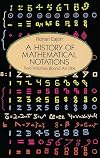
Now that I am nearing the end of my (very) long journey through this tome, I feel I can honestly review it.
It's difficult to know how best to couch this review. I can't exactly recommend anyone do what I did and read A History of Mathematical Notations straight through ... I have more than once referred to this as my "Sominex book," a quite useful sort of book to have handy if you are having trouble falling asleep!
That's snotty, though, and Cajori does not deserve snottiness. This book is a show more monumental work of scholarship, a feat that I expect no one -- despite the fact that it's drawing near the book's centenary -- will likely want to repeat. Imagine, if you will, someone choosing a particular mathematical symbol, say for the sake of argument the symbol for multiplication. Now imagine someone combing through every historical work of mathematical nature and exhaustively listing the different forms of the symbol for multiplication, who used each form and when. Now imagine someone doing this for the entire imaginable range of mathematical symbols (to be fair, I'm sure the list here is incomplete). You have now imagined this book.
After I reached a certain point in my reading, the prose did take on a certain grey fascination, and there is interesting material here. But ... whew!
One thing Cajori does that definitely irks me is present snippets from historical texts in their original languages (I'm pretty sure Latin, French and German were the only three), sometimes providing translations but most often not. Of course, this was written at a time when general knowledge of these languages by people likely to read this book was pretty widespread. It's really the inconsistency here that bothers me. If there is a pattern to when he provided a translation into English and when he did not, I could not see it.
I'm not at all sorry I read this. On the other hand, I doubt I will use the knowledge I gained. Your mileage may vary. show less
It's difficult to know how best to couch this review. I can't exactly recommend anyone do what I did and read A History of Mathematical Notations straight through ... I have more than once referred to this as my "Sominex book," a quite useful sort of book to have handy if you are having trouble falling asleep!
That's snotty, though, and Cajori does not deserve snottiness. This book is a show more monumental work of scholarship, a feat that I expect no one -- despite the fact that it's drawing near the book's centenary -- will likely want to repeat. Imagine, if you will, someone choosing a particular mathematical symbol, say for the sake of argument the symbol for multiplication. Now imagine someone combing through every historical work of mathematical nature and exhaustively listing the different forms of the symbol for multiplication, who used each form and when. Now imagine someone doing this for the entire imaginable range of mathematical symbols (to be fair, I'm sure the list here is incomplete). You have now imagined this book.
After I reached a certain point in my reading, the prose did take on a certain grey fascination, and there is interesting material here. But ... whew!
One thing Cajori does that definitely irks me is present snippets from historical texts in their original languages (I'm pretty sure Latin, French and German were the only three), sometimes providing translations but most often not. Of course, this was written at a time when general knowledge of these languages by people likely to read this book was pretty widespread. It's really the inconsistency here that bothers me. If there is a pattern to when he provided a translation into English and when he did not, I could not see it.
I'm not at all sorry I read this. On the other hand, I doubt I will use the knowledge I gained. Your mileage may vary. show less
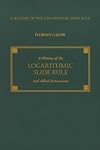
A specialized field of interest in this day and age, but as informative as it can be. Much useful historical information and reasonably well presented. Aside from the Author's noted misconception which is corrected by the Author himself in a foreword, might as well be the authoritative source on the subject.
You May Also Like


Statistics
- Works
- 19
- Also by
- 1
- Members
- 280
- Popularity
- #83,033
- Rating
- 3.9
- Reviews
- 2
- ISBNs
- 41
- Languages
- 1